

Long-term kit
RL116 long-term radon test kit
- Lab fee extra
Method: Alpha track
In home: 90 days to 12 months
PRO-LAB
Long-term radon test kit, lab fee included
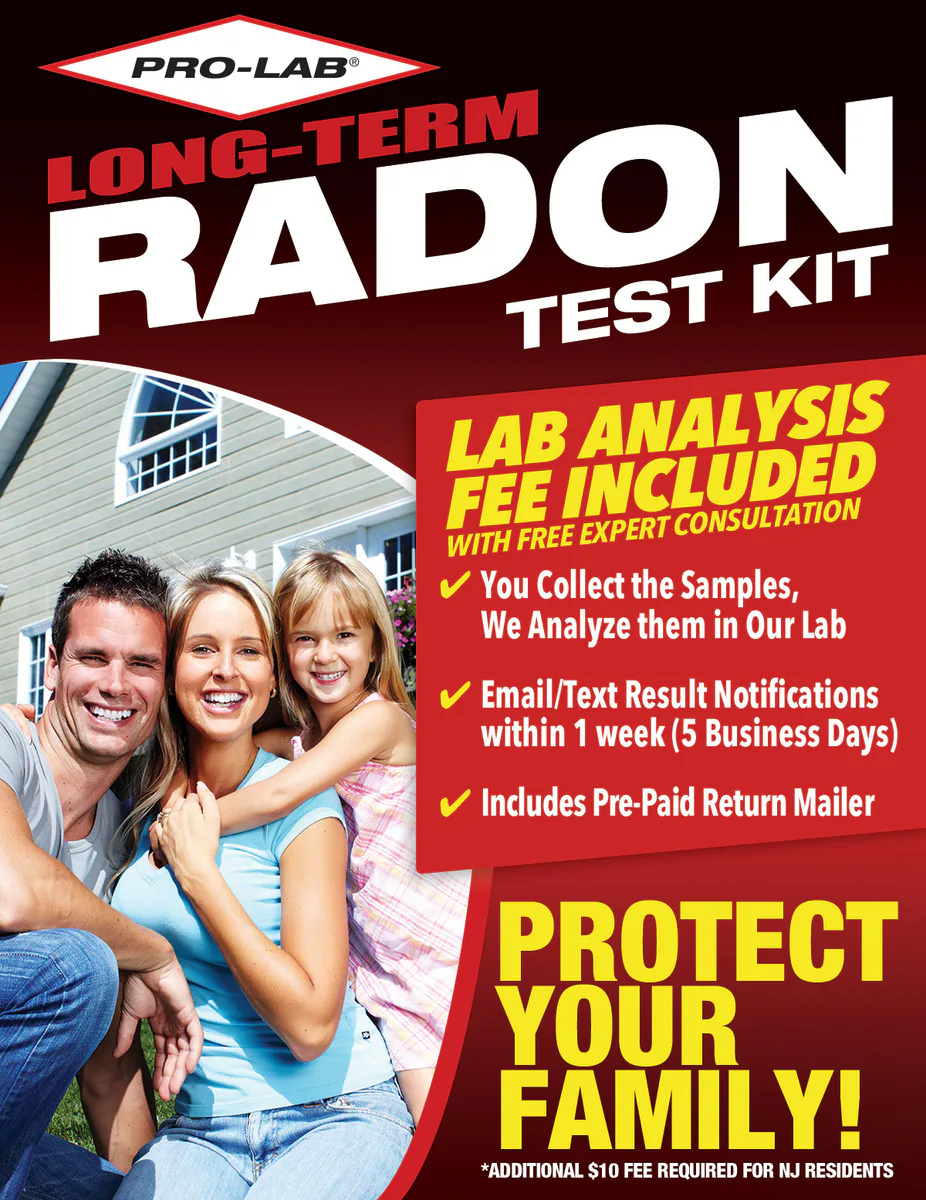
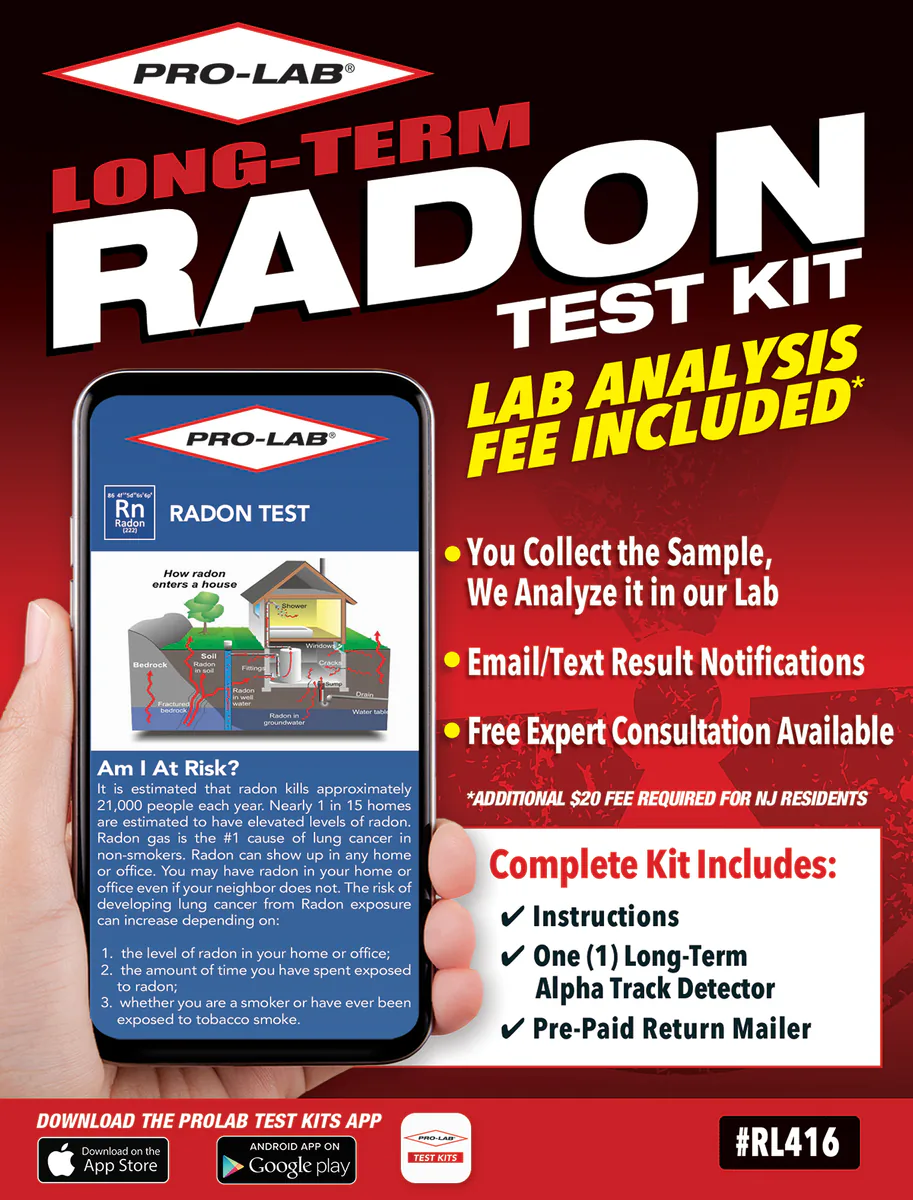
Photos: PRO-LAB
 (opens in a new tab)Check price on Amazon (opens in a new tab)
As an Amazon Associate, Radon411 earns from qualifying purchases.
Amazon and the Amazon logo are trademarks of Amazon.com, Inc. or its affiliates.
See ratings and reviews on Amazon (opens in a new tab)As PRO-LAB states it
The RL416 is PRO-LAB's do-it-yourself long-term radon test with the laboratory analysis included: one passive detector that switches on when it leaves its sealed bag, stays in your home for 90 days to 12 months, and then goes back to PRO-LAB for analysis. PRO-LAB lists it beside the RL116, its long-term kit of the same name sold without the analysis. The National Radon Safety Board approves a Pro-Lab alpha track detector and lists Pro-Lab Inc of Weston, Florida among the laboratories it accredits.
The RL416 box PRO-LAB pictures on its radon kits page lists the contents as instructions, one long-term alpha track detector and a pre-paid return mailer; PRO-LAB lists the kit itself as its long-term test kit with lab analysis included. PRO-LAB's long-term instructions add the long-term radon data card, which you detach, keep during the test and send back with the detector, and describe the return envelope as Business Reply with prepaid postage. The FAQ adds the void sticker on the detector, which must stay in place.
In the box and running costsHow it works
The sensor, the sampling and the readings, then who has checked it
In our words, from the maker's documents
This is a test of averages. PRO-LAB's store page says the RL416 is used to find the average radon level in your home over a long, extended period, 3 months to 1 year, and points anyone who wants the current level to its short-term kit instead. PRO-LAB's FAQ sets the long-term kit's window at a minimum of 90 days and a maximum of twelve months. The EPA counts a test that stays in a home for more than 90 days as long-term, and because radon levels tend to vary from day to day and season to season, a long-term result is more likely than a short-term one to tell you the home's year-round average.
Nothing in the kit runs on power or shows a number. PRO-LAB's FAQ describes the long-term device as a single detector that becomes active once it is out of its sealed plastic bag, with no caps or parts to remove, and warns that peeling off the void sticker or opening the device makes the sample invalid. The long-term instructions describe a black detector in a clear bag and say the test begins the moment the bag is opened. The reading is produced later, at the laboratory, from the detector you mail back.
PRO-LAB's web text does not name the technology. The RL416 box PRO-LAB pictures on its radon kits page, printed with the number RL416, lists one long-term alpha track detector, and the National Radon Safety Board's July 2026 list of approved measurement devices includes a Pro-Lab Alpha Track, device 10401. An alpha track detector holds a special plastic or film inside a filter-covered chamber that lets radon in while filtering out its decay products; alpha particles from radon decaying in the chamber leave damage tracks in the plastic, and at the end of the test a laboratory counts the tracks. The number of tracks correlates with the integrated radon level over the whole test. The EPA names alpha track and electret ion chamber detectors as the devices commonly used for long-term testing.
PRO-LAB says all analyses are done by PRO-LAB or by laboratories it recognizes as licensed, certified or accredited. The National Radon Safety Board's June 2026 list of accredited radon laboratories includes Pro-Lab Inc of Weston, Florida, laboratory ARL0028, with the Pro Lab Alpha Track among the devices listed for it and an accreditation that runs to March 30, 2027. PRO-LAB is the brand of Professional Laboratories, Inc., the company behind those analyses.
PRO-LAB sells two long-term kits under one name. Its radon kits page lists the PRO-LAB Radon Gas Long-Term Test Kit as SKU RL116 and, separately, the PRO-LAB Radon Gas Long-Term Test Kit (Lab Analysis Included) as SKU RL416, UPC 683431994164. The long-term instructions PRO-LAB publishes sit on its long-term kit page, which names the RL116 as its model; this page follows them for the RL416 as well. Where the instructions in your box differ, follow the box.
The result is one number: the average radon level over the whole time the detector was out of its bag. The EPA's guide for home buyers and sellers says that when long-term test results are at or above 4 pCi/L, it recommends fixing the home, and its Citizen's Guide suggests considering a fix between 2 and 4 pCi/L. The EPA reads a long-term result on its own; it averages two results only when both are short-term tests.
PRO-LAB's own statements, attributed
These are PRO-LAB's own statements, attributed to it. They are not our findings, and we have not tested this product ourselves.
Who checks a device like this
C-NRPP's consumer evaluation covers electronic monitors, not laboratory-analyzed test kits, so it has no result for PRO-LAB RL416. A kit's result comes from the laboratory that analyzes it. Where the maker names that laboratory, or the page cites the National Radon Safety Board's lists of approved devices and accredited laboratories for it, the “How it works” panel and “Questions people ask” say so.
Specifications
Every figure as the maker states it
The RL416 box PRO-LAB pictures on its radon kits page lists the contents as instructions, one long-term alpha track detector and a pre-paid return mailer; PRO-LAB lists the kit itself as its long-term test kit with lab analysis included. PRO-LAB's long-term instructions add the long-term radon data card, which you detach, keep during the test and send back with the detector, and describe the return envelope as Business Reply with prepaid postage. The FAQ adds the void sticker on the detector, which must stay in place.
Keep the envelope with the card. PRO-LAB's FAQ says it does not send replacements for lost or misplaced prepaid mailers; without one, you can send the detector to the address on the information form or to PRO-LAB's physical address in Weston, Florida. Neither the store page nor the FAQ states a warranty for the kit.
The analysis is paid for with the kit. PRO-LAB lists the RL416 as its long-term kit with lab analysis included, and both RL416 box pictures on PRO-LAB's sites say the lab analysis fee is included and offer a free expert consultation, which PRO-LAB's text pages do not describe. Return postage is prepaid through the Business Reply envelope. There is nothing to power, no app to pay for and nothing to recalibrate; each test uses one detector for at least 90 days.
New Jersey adds a fee. PRO-LAB's FAQ says New Jersey residents pay an additional administrative fee that goes to the New Jersey Department of Environmental Protection and is required for all samples collected in the state, and its long-term instructions ask New Jersey residents to send a check made payable to PRO-LAB. The two RL416 box pictures on PRO-LAB's sites print different amounts for it, so confirm the current figure with PRO-LAB before you mail the detector.
If you already own PRO-LAB's RL116, the kit sold without the analysis, you do not need this one; you need the RL116's lab fee instead. If the average comes back at or above 4 pCi/L, the EPA recommends fixing the home, which is a separate cost from testing.
Fit and setup
The fit, then setup and placement as the guidance asks
Good fit if, and look elsewhere if
Good fit if
Look elsewhere if
7 steps
For where any radon test or monitor should sit in a home, see where to place a radon test.
Compare
The same three rows for each, and the one difference that matters
This page
PRO-LAB RL416
This page: The RL416 is PRO-LAB's do-it-yourself long-term radon test with the laboratory analysis included: one passive detector that switches on when it leaves its sealed bag, stays in your home for 90 days to 12 months, and then goes back to PRO-LAB for analysis.
First Alert
The difference: A short-term charcoal sampler left out for two to four days, with lab fees included except New Jersey's state fee.
Kidde
The difference: A short-term activated charcoal sampler bag for three days, analyzed by Alpha Energy Laboratories; analysis is included and return postage is not.
No Amazon listing on file
See details of the Kidde 442020
PRO-LAB
The difference: PRO-LAB's short-term kit: two liquid scintillation detectors set side by side for 48 to 96 hours, with the lab fee sent in with the detectors.
PRO-LAB
The difference: PRO-LAB's long-term kit of the same name without the analysis: PRO-LAB lists it apart from the Lab Analysis Included kit, so its lab fee is paid separately.
Compared with similar products: 1 of 5
Long-term kit
Method: Alpha track
In home: 90 days to 12 months
Questions
6 questions about the PRO-LAB RL416, answered
The analysis. PRO-LAB's radon kits page lists both as its Radon Gas Long-Term Test Kit, the RL416 with lab analysis included (UPC 683431994164) and the RL116 without it (UPC 683431991163), so with the RL116 the lab fee is paid separately. PRO-LAB's long-term instructions and the long-term line in its FAQ name the RL116; this page applies them to the RL416 too. Our short-term vs long-term guide covers the choice between test lengths.
In the home, 90 days to 12 months. PRO-LAB's store page says 3 months to 1 year, its FAQ a minimum of 90 days and a maximum of twelve months, and its long-term instructions three to twelve months. After that, mail the detector right away.
PRO-LAB's long-term instructions say it sends the evaluation within 2 weeks after it receives the detector. The RL416 box pictured on PRO-LAB's store promises email or text result notifications within 1 week, 5 business days. The two do not match; add mailing time to either.
For the analysis, yes: PRO-LAB lists the RL416 as its long-term kit with lab analysis included, and the return envelope is prepaid. New Jersey is the exception, since PRO-LAB's FAQ says residents there pay an additional administrative fee that goes to the state's Department of Environmental Protection.
A passive alpha track detector, by the RL416 box PRO-LAB pictures and the National Radon Safety Board's approved device list, which includes a Pro-Lab Alpha Track. The board's list of accredited laboratories includes Pro-Lab Inc of Weston, Florida, ARL0028, through March 30, 2027. PRO-LAB says its analyses are done by PRO-LAB or by laboratories it recognizes as licensed, certified or accredited.
Not entirely. The long-term instructions say to mail the detector within 24 hours of the end of the test, while the FAQ says, for the RL116, that PRO-LAB must receive it within 2 months of the stop date. The instructions ask for a room used 8 to 10 hours a day; the FAQ says 6 or more hours a day. The long-term page counts over 40,000 stores carrying PRO-LAB kits and the where-to-buy page over 60,000.
The boxes differ too. The RL416 box on PRO-LAB's store gives result notifications within 1 week against the instructions' 2 weeks, and the two RL416 box pictures print different New Jersey fees. None of this changes how to run the test: open the bag with the detector in place, leave it for at least 90 days, and mail it promptly with the card.
Rarely, because it runs for at least 90 days. The EPA's guide for buyers and sellers lists three short-term testing options for a sale, and says that if time permits, more than 90 days, long-term tests can be used to confirm initial short-term results. Many states require radon professionals to be licensed, certified or registered, so check your state's rules before relying on any do-it-yourself kit in a sale.
Updated October 8, 2026