 RadonSeal
RadonSeal DIY Foundation Crack Repair Kit, Urethane
Polyurethane foam crack injection kit
- Sealing material
- Polyurethane injection foam
- 10 ft kit
Photos: RadonSeal
 (opens in a new tab)Check price on Amazon (opens in a new tab)
As an Amazon Associate, Radon411 earns from qualifying purchases.
Amazon and the Amazon logo are trademarks of Amazon.com, Inc. or its affiliates.
See ratings and reviews on Amazon (opens in a new tab)- Made ofPolyurethane injection foam
- Package10 ft kit
- Every figure checked against the specifications RadonSeal publishes
- The maker's own figures and limits, shown the same way for every part, unranked
About this item
As RadonSeal states it
- Made of: Polyurethane injection foam: two-component, expanding and low-viscosity
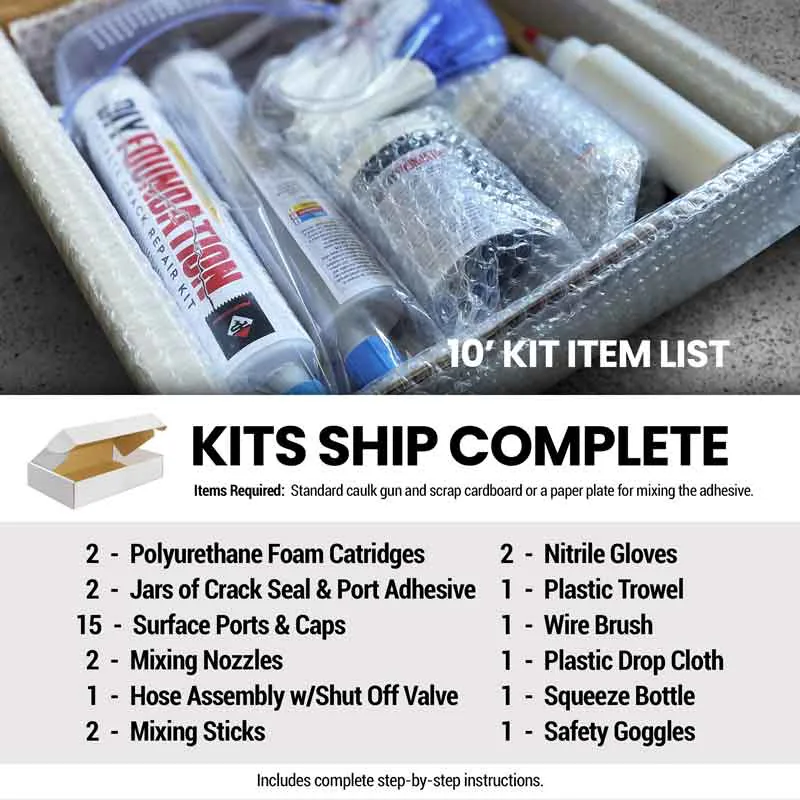
- Package: 10 ft kit: 2 polyurethane foam injection cartridges, 15 injection ports with caps, a surface seal jar set (Part A and Part B) and the tools to apply them
- Coverage: Each kit covers up to its stated crack length, based on a 1/16 in. wide crack in a 10 in. thick poured concrete wall; cracks up to 1/2 in. wide
- Application temperature: Ambient temperature above 40°F
- Working and cure time: Surface seal cures typically 1 to 2 hours before injection; foam cures four hours before the ports are removed
- Shelf life: One year from the date of purchase
- Warranty: Free from defects in materials and workmanship; limited to repair or replacement of the defective product; uses outside the instructions not covered
RadonSeal's DIY Foundation Crack Repair Kit, Urethane, injects a two-component polyurethane foam into cracks in poured concrete walls, through ports set along the crack, using a standard caulking gun; the listing is the 10 ft kit. RadonSeal says the foam seals water leaks, vapor intrusion and radon gas. The EPA does not recommend sealing alone, because by itself sealing has not been shown to lower radon levels significantly or consistently.
What you get
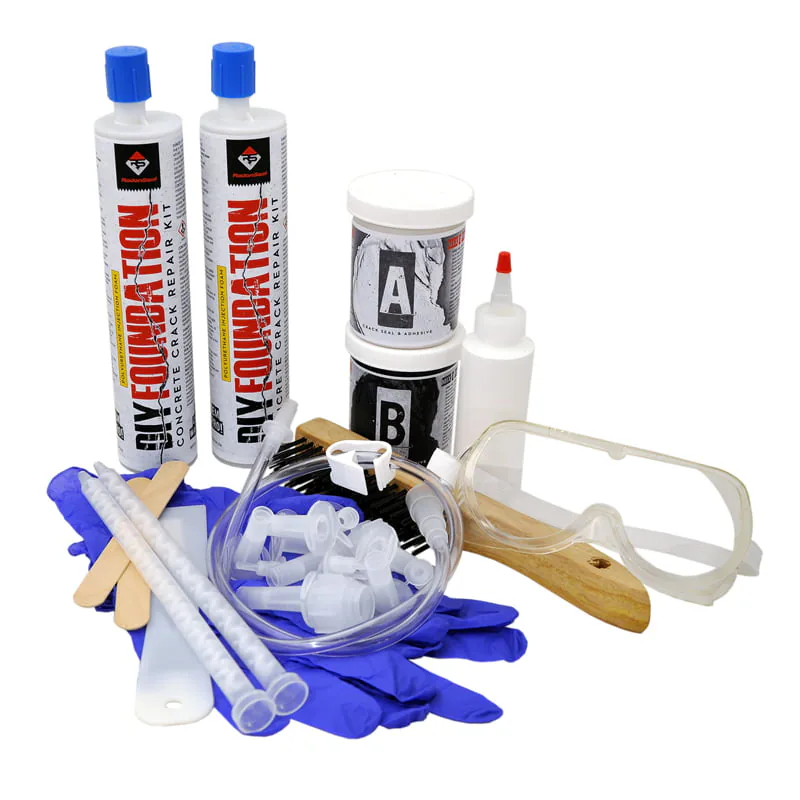
The 10 ft kit, in RadonSeal's item list: 2 polyurethane foam injection cartridges, 15 injection ports with caps, a surface seal jar set (Part A and Part B), 2 mixing nozzles, a hose assembly with shut-off valve, 2 mixing sticks, 2 crossover restrictors, a plastic trowel, a wire brush, a squeeze bottle, safety goggles, a drop cloth, 2 nitrile gloves and the instructions. You supply a standard caulking gun and a paper plate or scrap cardboard for mixing.
In the box and running costsHow it works
What it does and how
What it is made of and the job it does in a system, then who has checked it
How it works
In our words, from the maker's documents
The kit fills a crack rather than covering it. Injection ports are fixed over the crack no more than 8 inches apart with a two-part surface seal, which is also spread along the crack itself; the foam is then pushed in at low pressure, port by port, working upward. RadonSeal describes the two-component liquid urethane as reacting with moisture and expanding as a foam to seal the entire depth of the crack, and says the repair is made from the inside, with no drilling and no excavation.
RadonSeal's own expansion figures differ between its documents: the product page says the foam expands up to 35X, and the 2026 instructions say up to 20 times its volume. The page says the foam works on wet or damp cracks; the instructions add that the concrete surface must be completely dry for the ports and surface seal to bond, that the crack is flushed with water before injection because water is required for the foam to expand, and that injection cannot be done while the crack is actively leaking.
RadonSeal sets the limits plainly. The kit is for poured concrete walls and cracks up to 1/2 inch wide, and it is not intended for floor cracks, cracks in concrete block walls, or repairs that need structural reinforcement, for which RadonSeal points to its epoxy kit. Its instructions add that the kits are for common vertical or diagonal settling cracks and should not be used on horizontal cracks or cracks that may indicate structural problems.
Where it fits in radon work: the EPA calls sealing cracks and other openings a basic part of most approaches to radon reduction, because it limits the flow of radon into the home and makes other techniques more effective, while saying sealing alone has not been shown to lower radon levels significantly or consistently. The EPA's 1994 standards for radon contractors list expanding foam among the materials for large openings below ground, and recommend urethane sealants for cracks and small openings because of their durability.
What the manufacturer says
RadonSeal's own statements, attributed
- RadonSeal saysRadonSeal states its two-component expanding polyurethane injection foam penetrates deep into foundation wall cracks and expands to fully seal water leaks, vapor intrusion, insects, and radon gas.
- RadonSeal saysRadonSeal says the low-pressure injection method eliminates the need for drilling, and that the low-viscosity urethane is suitable for hairline cracks.
- RadonSeal saysRadonSeal states the repair is permanent and prevents water seepage permanently.
- RadonSeal saysRadonSeal states the kits come in 5-ft, 10-ft and 20-ft sizes and require only a standard caulking gun.
- RadonSeal saysRadonSeal says in its instructions that the manufacturer guarantees its products are free from defects in materials and workmanship.
These are RadonSeal's own statements, attributed to it. They are not our findings, and we have not tested this product ourselves.
Independent evidence
Who checks a device like this
C-NRPP's consumer evaluation covers electronic radon monitors, not the parts of a mitigation system, so it has no result for RadonSeal DIY Foundation Crack Repair Kit, Urethane. The standards and results the maker states are under “What the manufacturer says”, and what shows whether radon in your home is lower is a radon test after the work is done.
Specifications
Specifications
Every figure as the maker states it
The maker's figures
- Type
- Sealing material, polyurethane foam crack injection kit for poured concrete walls
- Made of
- Polyurethane injection foam: two-component, expanding and low-viscosity
- Package
- 10 ft kit: 2 polyurethane foam injection cartridges, 15 injection ports with caps, a surface seal jar set (Part A and Part B) and the tools to apply them
- Coverage
- Each kit covers up to its stated crack length, based on a 1/16 in. wide crack in a 10 in. thick poured concrete wall; cracks up to 1/2 in. wide
- Application temperature
- Ambient temperature above 40°F
- Working and cure time
- Surface seal cures typically 1 to 2 hours before injection; foam cures four hours before the ports are removed
- Shelf life
- One year from the date of purchase
- Warranty
- Free from defects in materials and workmanship; limited to repair or replacement of the defective product; uses outside the instructions not covered
What is in the box
The 10 ft kit, in RadonSeal's item list: 2 polyurethane foam injection cartridges, 15 injection ports with caps, a surface seal jar set (Part A and Part B), 2 mixing nozzles, a hose assembly with shut-off valve, 2 mixing sticks, 2 crossover restrictors, a plastic trowel, a wire brush, a squeeze bottle, safety goggles, a drop cloth, 2 nitrile gloves and the instructions. You supply a standard caulking gun and a paper plate or scrap cardboard for mixing.
RadonSeal says each kit covers up to its stated crack length, based on a 1/16 inch wide crack in a 10 inch thick poured concrete wall, and that more material is available if a crack needs it; its instructions say to expect to use the entire 16 ounces of surface seal on a 10 ft crack. The product page offers flat, corner or mixed ports and an optional caulk gun. The warranty, in the instructions, covers defects in materials and workmanship, excludes uses outside the instructions, and is limited to repair or replacement of the defective product.
What it costs to run
There is no power or service cost. A larger crack can take more than the kit holds: RadonSeal says to continue with a new cartridge if you run out, and that each extra cartridge includes a new hose assembly, mixing nozzle and crossover restrictor. RadonSeal's page gives the kit a shelf life of one year from the date of purchase; the foam's safety data sheet gives a typical shelf life of 6 months or more from the date of manufacture, stored between 60°F and 85°F in sealed containers.
RadonSeal says soil movement or crack shifting may occasionally create a small gap, which can be drilled and re-injected. The EPA says much the same of any sealing: normal settling of a house opens new entry routes and reopens old ones. A radon test after the work, and a retest at least every two years, is how you see whether radon is lower.
Fit and setup
Who it fits, and installation
The fit, then how it goes on and what the standards ask
Who it fits
Good fit if, and look elsewhere if
Good fit if
- A mitigator or an inspection has found cracks in a poured concrete basement wall that should be sealed as part of a radon system.
- The cracks are vertical or diagonal settling cracks up to 1/2 inch wide, the kind RadonSeal says the kit is for.
- You want to work from inside the basement, with no drilling or excavation, using a standard caulking gun.
- The crack is damp or seeps water, which RadonSeal says the foam works on, as long as it is not actively leaking during injection.
Look elsewhere if
- You hope sealing alone will bring a high radon test down; the EPA does not recommend sealing alone.
- The crack is in the floor slab or a concrete block wall; RadonSeal says the kit is not intended for either.
- The crack is horizontal or may be structural; RadonSeal says the kit should not be used on those, and to have a crack evaluated by a licensed repair specialist if unsure.
- Someone doing the work has known respiratory or allergy problems; the foam's safety data sheet says such persons must not be exposed to it.
Application
3 steps
- RadonSeal's 10 ft instructions run in six steps. Clean at least 2 inches either side of the crack with the wire brush and make sure the surface is completely dry. Mix equal amounts of Surface Seal A and B, only about a tablespoon from each jar at a time because it hardens quickly, and fix the first port about 4 inches above the lowest point of the crack, the rest every 8 inches at most. Spread the surface seal about 1/8 inch thick and 2 inches wide along the crack and let it cure, typically 1 to 2 hours. Flush the crack with water, assemble the cartridge, and inject at low pressure from the lowest port up, expecting 2 to 4 minutes at each port and capping each one as foam reaches the port above.
- Then the foam cures for four hours before the ports are tapped off, and the surface seal can be painted or ground off. RadonSeal suggests waiting for a heavy rain before removing the ports, to check the repair, and injecting more foam if water seeps from a port. The ambient temperature should be above 40°F; when the work is done from inside, RadonSeal says cold outdoor temperatures will not affect it.
- Read the safety data sheet first, as the instructions ask. The foam's sheet says not to breathe vapors, to wear respiratory protection if ventilation is inadequate, to wear protective gloves and eye protection, and that persons with known respiratory or allergy problems must not be exposed to the product. For the radon system itself, the EPA recommends a qualified radon mitigation contractor and a post-mitigation radon test within 30 days of installation.
For how the sealing, the gauge and the fan work together, see radon mitigation systems, and to find someone to design and install one, radon mitigation professionals.
Compare
Compare with similar items
The same three rows for each, and the one difference that matters
This page
RadonSeal DIY Foundation Crack Repair Kit, Urethane
- What it is
- Polyurethane injection foam
- Power
- None needed
- C-NRPP 2024/25
- Not applicable (system part)
This page: RadonSeal's DIY Foundation Crack Repair Kit, Urethane, injects a two-component polyurethane foam into cracks in poured concrete walls, through ports set along the crack, using a standard caulking gun; the listing is the 10 ft kit.
RadonSeal
- What it is
- Penetrating concrete sealer
- Power
- None needed
- C-NRPP 2024/25
- Not applicable (system part)
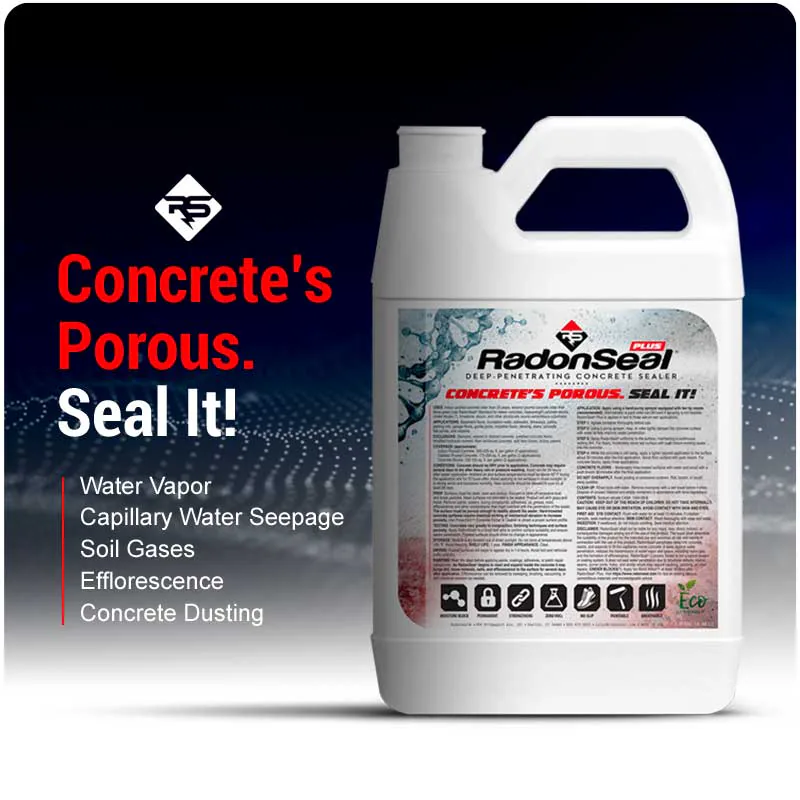
The difference: From the same maker, for the concrete itself: RadonSeal says the Plus sealer penetrates up to 4 inches into concrete, and its data sheet says it does not seal water coming through cracks.
Titebond
- What it is
- Elastomeric acrylic
- Power
- None needed
- C-NRPP 2024/25
- Not applicable (system part)
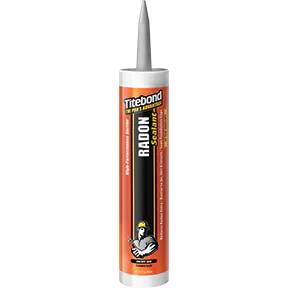
The difference: Seals into joints rather than injecting a crack: Titebond's acrylic sealant goes on from a 10.1 oz. cartridge into joints no deeper than 1/2 inch.
Compared with similar products: 1 of 3
More sealants and sump covers3
All sealants and sump coversSealing materialRadonSeal
Plus Concrete Sealer penetrating concrete sealer
- 2.5 gal or 5 gal
Made of: Penetrating concrete sealer
Sealing material

Radon Sealant (3251) acrylic sealant for foundation cracks and joints
- 10.1 oz. cartridge
Made of: Elastomeric acrylic
- All sealants and sump coversMore sealants and sump covers

More sealants and sump covers: 1 of 3
Questions
Questions people ask
5 questions about the RadonSeal DIY Foundation Crack Repair Kit, Urethane, answered
Asked about the DIY Foundation Crack Repair Kit, Urethane
Will sealing a wall crack fix a radon problem?
Not on its own, on the EPA's evidence. The EPA does not recommend the use of sealing alone to reduce radon, because by itself sealing has not been shown to lower radon levels significantly or consistently; it does say sealing limits the flow of radon and makes other radon reduction techniques more effective. Sealing is part of mitigation, not a substitute for it.
Can I use it on a floor crack?
No, by RadonSeal's own limits: the kit is not intended for floor cracks or for cracks in concrete block walls. For the floor, the EPA's 1994 standards ask for the floor-wall joint to be sealed with urethane caulk or an equivalent, with a foam backer rod in channels wider than 1/2 inch, and for slab cracks to be sealed with caulks and sealants designed for the job.
How big a crack will it fill?
RadonSeal says the kit repairs cracks up to 1/2 inch wide, and rates each kit's length on a 1/16 inch wide crack through a 10 inch thick wall. A wider crack, or voids behind the wall, use more foam; RadonSeal's instructions say the lower part of a crack usually takes the most.
Does the crack have to be dry?
The surface does; the crack does not. RadonSeal says the foam adheres even to moist surfaces, but the concrete around the crack must be completely dry for the ports and surface seal to bond, the crack is flushed with water before injection, and injection cannot be done while the crack is actively leaking.
How long does the repair last?
RadonSeal calls the repair permanent and says the injected foam forms a permanent barrier against water, but adds that soil movement or crack shifting may occasionally create a small gap, which can be drilled and re-injected. For radon, test after the work and retest at least every two years, as the EPA advises.
What to do next
- See how a radon system fits togetherThe suction point, the pipe, the fan, the gauge and the sealing, and what each one does.
- Find a mitigation professionalMost systems are designed and installed by one; some states require a license.
- Seal cracks as part of a systemWhat sealing a basement floor can and cannot do for radon.
- Test after the workA short-term test afterwards shows whether radon in the home is lower.
Updated October 9, 2026