ProductsExplained
Radon manometers: the gauge on your system, and the ones sold
Short answer
A radon manometer is a U-shaped tube of fluid on the system's pipe: uneven levels mean the fan is pulling suction, and even levels mean it has stopped or the system is not working. Compare the reading with the value your installer wrote on the sticker, and remember it shows suction, not radon.
Key takeaways
- A radon manometer is a U-shaped tube of colored fluid on the system's pipe that shows whether the fan is pulling suction.
- Uneven fluid levels mean the fan is running; even levels mean the fan has stopped or another part of the system is not working.
- The number to compare with is the one your installer wrote on the sticker beside the gauge when the system was installed.
- A manometer shows suction, not radon. Only a radon test shows whether the system is lowering radon.
- Minnesota asks for the manometer and an active alarm, both checked monthly.
The radon manometer in short
If your home has an active radon system, there is almost certainly a small U-shaped gauge on the pipe, usually in the basement. This page explains what that gauge shows, how to read it, what a change in the reading means, and what it cannot tell you. It also lists the manometers four makers of radon parts sell, in their own descriptions and unranked. The whole system, gauge included, is explained in the radon system guide.
| What you see | What it means, per state guidance | What to do |
|---|---|---|
| Fluid higher on one side than the other | The fan is running and pulling suction | Compare with the reading on the sticker |
| Fluid level on both sides | The fan may be off or another part of the system is not working | Check the fan has power; call the installer |
| Reading well away from the sticker value | The system may not be functioning properly | Check the tubing, then call the installer |
What a manometer is and where it sits
Minnesota's health department describes it simply: the U-tube manometer uses colored fluid in a tube to show visually that the radon system is working. A small tube connects to a hole in the radon pipe, and the suction from the fan pulls the fluid up one side. Another state health department says most businesses use a plastic, U-shaped manometer to show that the fan is operating, and that it is typically on the vent pipe in the basement, about 4 feet above the suction point.
- Inches of water column (in. WC)
- The unit on a radon manometer's scale: how far the suction lifts the fluid. Fan makers rate their fans' pressure in the same unit, which is why the reading and a fan's specification can be compared by a professional.
The EPA says a warning device must be installed to alert you if an active system stops working properly, and that you should look at it, usually a manometer, on a regular basis. Minnesota goes further: every system there must have two fan monitors, a U-tube manometer and an active notification monitor that alerts you with a light or a sound, and both should be checked monthly.
How to read it
Pennsylvania's guidance gives the core rule: the fan is running if the fluid levels on the two sides of the tube are uneven, and if they are even with each other the fan may not be working properly or may be off completely. Minnesota adds the second rule: when the system is installed, the manometer reading is taken and written on a sticker next to the gauge, and a reading that is even, or significantly different from the one at installation, means the system may not be functioning properly.
Step 1 of 5:
Find the sticker
Look for the installer's recorded reading next to the manometer; that is your system's normal value.
Step 2 of 5:
Read both columns
Note the difference in height between the two sides of the fluid on the scale.
Step 3 of 5:
Compare
Close to the sticker value: the system is pulling as installed. Level on both sides, or far from the sticker: something has changed.
Step 4 of 5:
Check the simple things
Minnesota says to make sure the tubing is connected to the pipe and not kinked, and that the fan has power.
Step 5 of 5:
Call the installer
If the reading stays off, the fan or another part of the system needs attention.
What a manometer cannot tell you
Minnesota is explicit that the monitor does not show or measure radon levels; it shows there is suction in the pipe. A steady reading means the fan is pulling as it did on the day it was installed, not that radon is low. The EPA's advice is to retest your home at least every two years to be sure radon levels remain low, and to keep the fan running all the time: it should never be turned off.
| Device | What it shows | What it does not show |
|---|---|---|
| U-tube manometer | Suction in the pipe, on a scale | Radon level; it is silent, so you must look at it |
| Active notification monitor | Air flow or air pressure in the pipe, with a light or sound if the system stops | Radon level |
| Radon test or monitor | The radon level in the home | Whether the fan is running at this moment |
Alarms that sound when suction drops, and radon detectors with their own alarms, are compared on radon alarms.
Manometers sold by radon parts makers
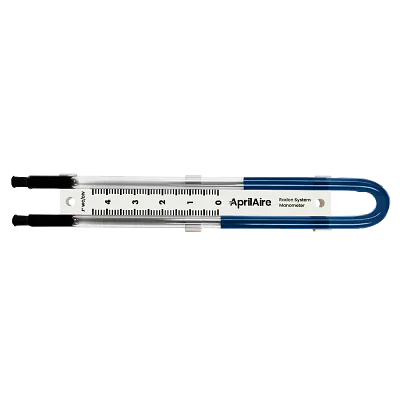
Four makers of radon mitigation parts sell U-tube manometers, in their own descriptions. Fantech's and RadonAway's packages include the tubing, two self-tap screws, installation instructions and labels for the system. Festa describes its gauges as coming in a variety of colors and sizes. AprilAire describes its ARN05M as mounting to the outside of the system's PVC pipe and showing vacuum in real time, packs it in its radon mitigation kits, and says a system label comes with it; it publishes no range for the gauge.
| Maker | Range | As the maker describes it |
|---|---|---|
| AprilAire (ARN05M) | Not stated by AprilAire | Mounts to the outside of the PVC pipe; shows vacuum in real time; a second check when a system alarm goes off; comes with a system label; packed in AprilAire's radon kits |
| Fantech | 0 to 5 in. WC | Adjustable zero; molded scale curved to fit the pipe; tubing, two self-tap screws, instructions, an information sheet and system labels |
| Festa | Not stated on its collection page | Radon manometer gauges in a variety of colors and sizes, with warning stickers |
| RadonAway (Easy Read U-Tube) | 0 to 4.5 in. WC | Non-toxic fluid; adjustable zero; molded scale curved to fit the pipe; tubing, screws, instructions, labels and a 10-page OM&M document; not for systems above 4.5 in. WC |
Show all 4 rows
A manometer is normally fitted by the installer as part of the system. If you are replacing one, match its range to your system: RadonAway notes its gauge is not suitable for system pressures above 4.5 inches of water column. Where to buy radon products is covered on where to buy a radon test kit or monitor, and the fans themselves on radon fan models compared.
When the reading changes
A reading that drops to level means the fan has stopped or another part of the system is not working, in Minnesota's words. The EPA says fans may last five years or more and that manufacturer warranties tend not to exceed five years. A reading that moves well away from the sticker value without going level also matters: Minnesota treats a significant difference from the installed reading as a sign the system may not be functioning properly. In cold climates, Minnesota warns that extended cold can freeze a system up, and that pipe in unconditioned areas may need insulation.
Questions about radon manometers
How do I read a radon manometer?
Look at the two columns of fluid. Uneven levels mean the fan is pulling suction; even levels mean the fan may be off or the system is not working. Compare the reading with the value your installer wrote on the sticker beside it.
What should my radon manometer read?
Close to the value recorded on its sticker when the system was installed. There is no single correct number for every home, because the reading depends on the fan, the pipe and the soil.
My manometer reads zero. What does that mean?
Even fluid levels mean the fan has stopped or another part of the system is not working. Check that the fan has power and the tubing is connected and not kinked, then call your installer.
Does a manometer measure radon?
No. Minnesota's health department says it shows there is suction in the pipe, not radon levels. Retest your home at least every two years.
How often should I check the manometer?
The EPA says to look at it on a regular basis; Minnesota says both fan monitors should be checked monthly.
Where is the manometer on a radon system?
State health guidance says it is typically on the vent pipe in the basement, about 4 feet above the suction point.
Do I need an alarm as well as a manometer?
Minnesota requires both a U-tube manometer and an active notification monitor that alerts with a light or a sound. The EPA says the warning device must be placed where it can be seen or heard easily.
Can I replace a radon manometer myself?
Makers sell U-tube manometers with tubing and screws for the pipe. Match the range to your system, record the new reading, and call your installer if the reading looks wrong.