ProductsCompare
Radon fan models compared: makers' own figures
Short answer
A radon fan pulls soil gas from under the slab and vents it outdoors, and its key figures are static pressure, airflow, power and pipe size. AprilAire's ARN fans, Fantech's Rn line, Festa's AMG Maverick and RadonAway's XP and Contractor series are listed here in each maker's own figures, unranked; the right fan for a house is sized by a mitigator from measurements under its slab.
Key takeaways
- A radon fan is the part of an active mitigation system that pulls soil gas from under the slab and vents it outdoors; it must run all the time.
- The figures that matter are static pressure (how hard it can pull), airflow in CFM (how much air it moves), power in watts, and the pipe size it fits.
- The right fan depends on what is under the slab, which a mitigator measures. A bigger fan is not a better one: it uses more power to move air the system may not need.
- This page lists AprilAire's ARN fans, Fantech's Rn line, Festa's AMG Maverick and RadonAway's XP and Contractor (C) series in each maker's own figures, unranked.
- Whatever fan is installed, the proof is a radon test after the system runs, and a retest at least every two years.
Radon fans in short
Most people shopping for a radon fan are replacing one that has stopped, or are curious about what a mitigator installed. This page sets out what a fan's specifications mean, then lists the models whose makers publish a specification table, in the makers' own figures. It does not pick one: the fan that suits a house depends on its soil, slab and pipe run, and the makers' tables do not all measure the same things.
| Maker | Models | What the maker publishes |
|---|---|---|
| AprilAire | ARN15F, ARN25F (the fan in the ARN25K kit) | Power range, recommended maximum operating pressure at sea level, and airflow at static pressures from 0 to 2.0 inches of water column |
| Fantech | Rn 1, Rn 2, Rn 2EC, Rn 2SL, Rn 2X, Rn 3, Rn 4EC | Application pressure range, maximum static pressure, maximum power and maximum airflow |
| Festa | AMG Maverick | Maximum flow and pressure, supply, watts, amps, speed and Fernco coupling size, and airflow at static pressures from 0 to 2.21 inches of water column |
| RadonAway | XP151, XP201, XR261, XP201c (XP series); RP140c, RP145c, RP260c, RP265c, GP301c, GP501c (Contractor Series) | Duct diameter, power range, recommended maximum operating pressure, and typical airflow at set static pressures |
Show all 4 rows
The fans in this section7
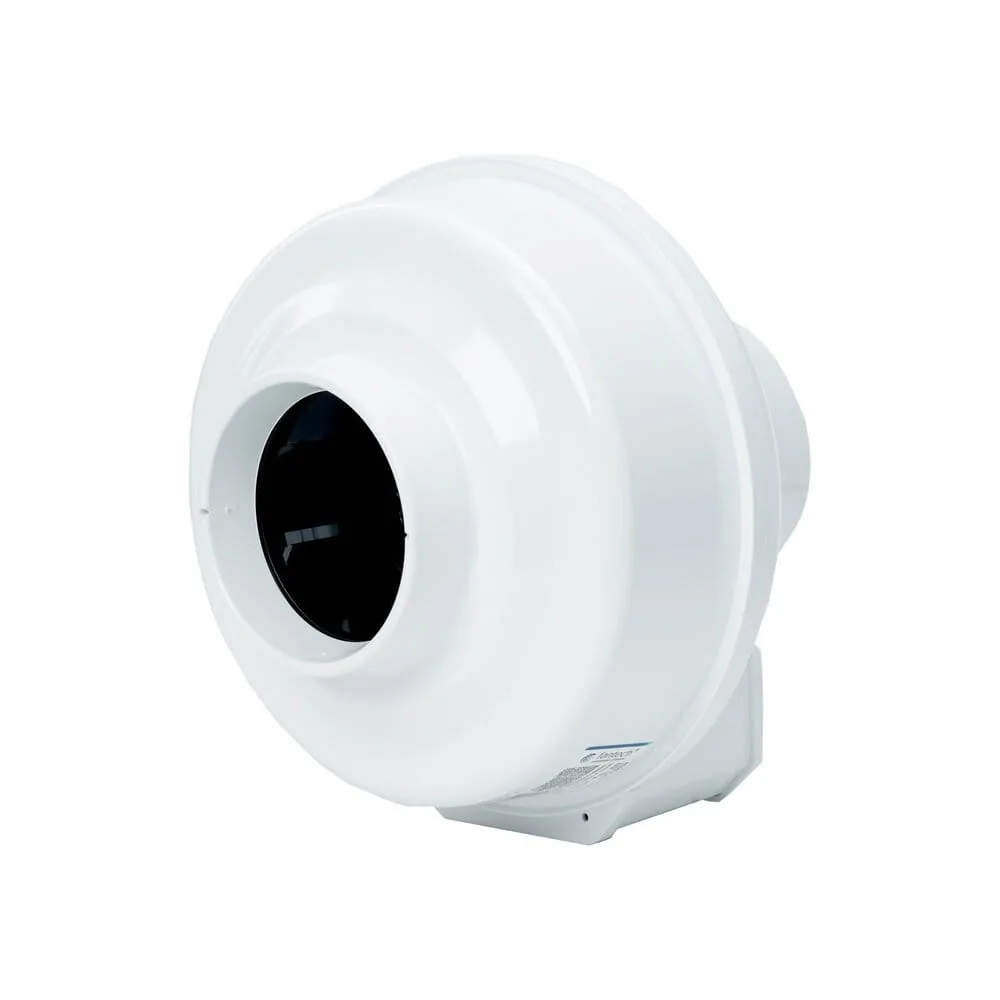
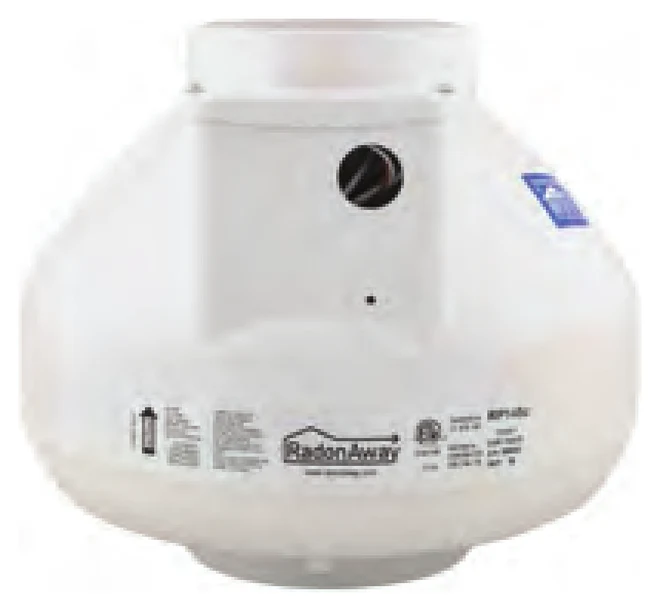
Radon fan

Rn2 inline radon mitigation fan
- 3 or 4 in. schedule 40 PVC
- 59 W
Max airflow: 174 CFM
Max pressure: 2.0 in w.c.
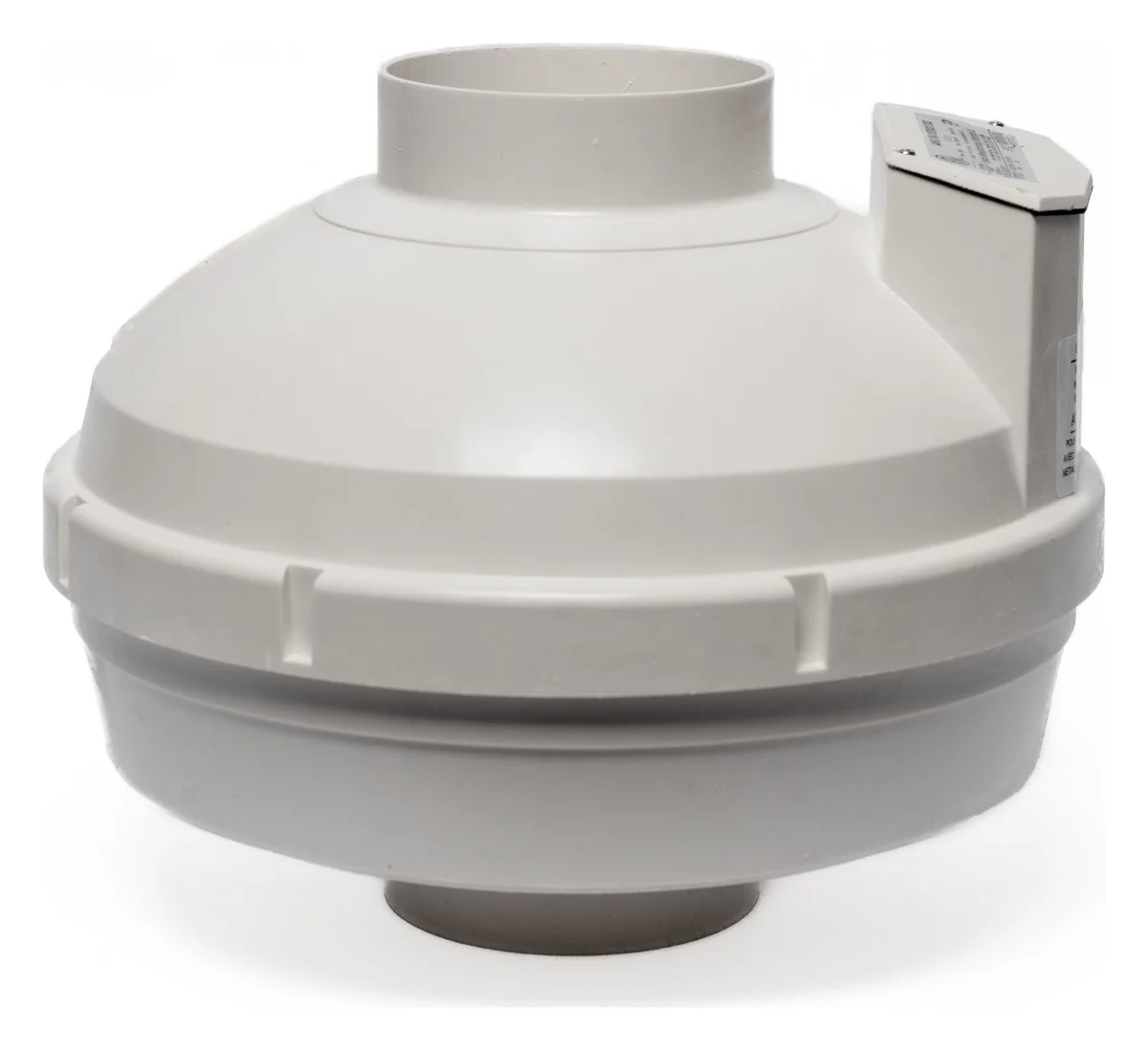
Radon fan

AMG Maverick inline radon mitigation fan
- 4 in. Fernco coupler size
- 66 W
Max airflow: 260 CFM
Max pressure: 2.21 in w.c.

The fans in this section: 1 of 7
As an Amazon Associate, Radon411 earns from qualifying purchases.
Reading a radon fan's specifications
The EPA describes the job simply: a fan connected to the suction pipes draws radon from below the home and releases it outdoors, while creating a negative pressure beneath the slab. Its guide to radon-resistant construction says the fan should be large enough to keep the pressure beneath the slab or membrane lower than the pressure above it. How much fan that takes depends on how easily air moves through the material under the slab.
- Static pressure (inches of water column)
- How strongly a fan can pull against resistance, written as inches of water column (WC, or in. w.c.). A tight soil or a long pipe run needs more of it. A maker's maximum static pressure is the most the fan can pull with no air moving.
- Airflow (CFM)
- Cubic feet of air moved per minute. Airflow falls as the pressure the fan works against rises, so a single maximum CFM figure is the airflow with nothing in the way, and a table of CFM at set pressures shows the curve.
For a sense of scale, the EPA's guide to radon-resistant new construction says most contractors have found 90-watt in-line fans adequate for most home styles, locations and sizes, and refers to a fan capable of moving 100 cubic feet of air per minute at one inch of water column as sufficient for most applications. That is a general figure for a new home's passive system being activated, not a sizing rule for yours; a mitigator sizes a fan from measurements taken under your slab.
AprilAire ARN radon fans
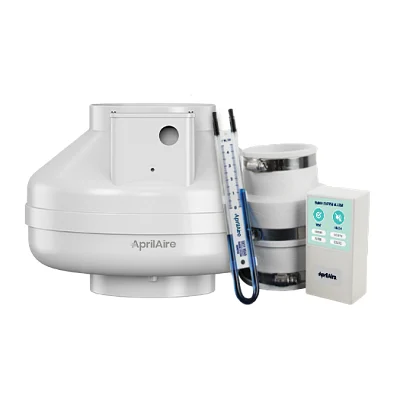
AprilAire's installation manual describes three radon fans: the ARN15F for general purpose use, the ARN25F where additional airflow is required, and the ARNHPF for tight soil conditions. It sells the ARN25F as the AprilAire ARN25K kit, with a 6 by 4 inch coupling, a manometer and its ARNALM radon system alarm, and it publishes a recommended maximum operating pressure rather than a maximum static pressure.
AprilAire's ARN25F specification sheet gives slightly different figures for the same fan: 95 to 139 W and a recommended maximum operating pressure of 2.3 inches. Both figures are the maker's own; which one applies to a given fan is a question for AprilAire or the installer.
Fantech Rn radon fans
Fantech says its Rn fans are designed specifically for active soil depressurization, with an air-tight housing, a UV-resistant resin housing, a UL listing for safety and outdoor use, HVI-certified fan performance and a 5-year factory warranty. It describes the Rn 1, Rn 2 and Rn 3 as covering the majority of radon
The two EC models differ from the rest in their motor and their dial. Fantech says the Rn 2EC and Rn 4EC have a built-in speed controller, so the installer can turn the fan down to the suction a system needs, with lower power use; its manual says to turn the dial counterclockwise with a small screwdriver to reduce speed. The brochure describes the Rn 2EC for medium suction, low flow jobs and the Rn 4EC for high suction, high flow jobs with elevated radon and poor sub-slab communication. The Rn 4EC comes with Fantech's LDVI couplings: 3-inch on item 99922 and 4-inch on item 99923.
The brochure's descriptions of the other models follow the same pattern: the Rn 1 for low suction, low flow jobs with good sub-slab communication; the Rn 2 for medium suction, low flow; the Rn 2X and Rn 3 for medium suction, medium flow with elevated radon or poor communication; and the Rn 2SL, a sealed housing with built-in condensation bypass that blends with outdoor utility boxes.
Festa AMG Maverick
Festa publishes its AMG fans' figures in its 2022 catalog: a maximum flow and a maximum pressure, the supply, watts, amps, speed and Fernco coupling size, then the airflow at rising static pressures. Festa's installation instructions for its AMG fans say they can be mounted indoors or outdoors and should not be used with solid state speed controllers. The Festa AMG Maverick has its own page.
RadonAway XP series
RadonAway publishes a specification table on its XP201 page covering three fans: the XP151, the XP201 and the XR261. Its figures are a range of power use, a recommended maximum operating pressure, and the typical airflow at four static pressures, which shows how each fan's airflow falls as the pressure it works against rises. RadonAway marks the XP151 and XP201 as RRNC type RF1, which it says means suitable as designated by the Reducing Radon in New Construction standard, RRNC 2.0.
| Model (P/N) | Duct | Watts | Recommended max operating pressure (in. w.c.) | CFM at 0 in. | at 0.5 in. | at 1.0 in. | at 1.5 in. |
|---|---|---|---|---|---|---|---|
| XP151 Pro Series (28469) | 4 in. | 53 to 70 | 1.4 | 167 | 127 | 77 | Not stated |
| XP201 Pro Series (28470) | 4 in. | 45 to 66 | 1.6 | 126 | 98 | 60 | 26 |
| XR261 (23019-1) | 6 in. | 67 to 117 | 1.6 | 217 | 149 | 87 | 27 |
RadonAway lists the XP201's features as an Eternalast polycarbonate plastic housing, a five-year limited warranty, thermal protection, a moisture-resistant J-frame motor and a low-profile design. It says the fan is UL507 compliant, ETL listed for indoor or outdoor use, and rated for residential and commercial use. Its dimensions table gives the XP151 and XP201 as 8.5 by 9.5 by 4.5 inches and the XR261 as 8.5 by 9.5 by 6 inches.
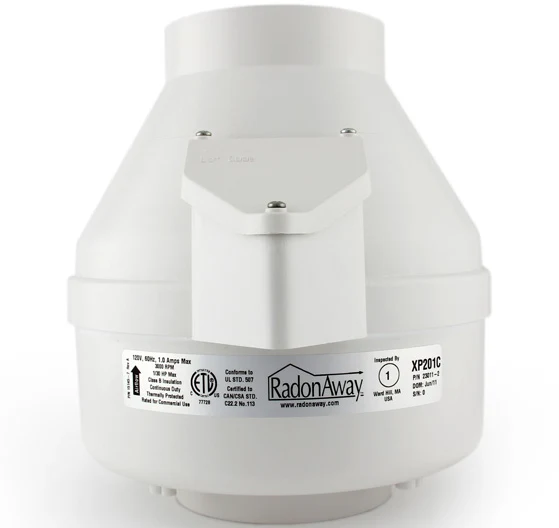
An older fan sold under the XP201 name, the XP201c (part number 23011-1), is a different product from the XP201 Pro: RadonAway's 2017 XP/XR Series sheet lists it at 45 to 66 W, a 1.7 inch recommended maximum operating pressure and 112, 95, 70 and 40 CFM at 0, 0.5, 1.0 and 1.5 inches. The RadonAway XP201c has its own page.
RadonAway Contractor (C) Series
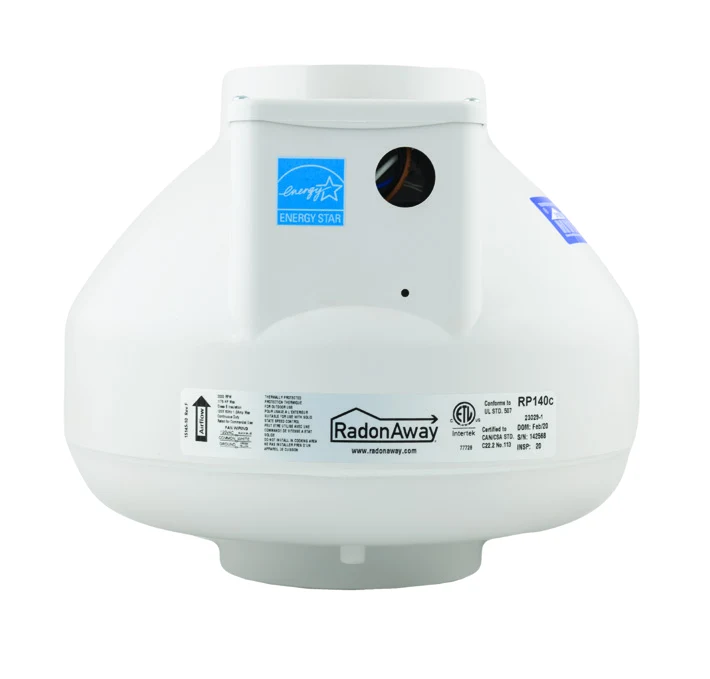
RadonAway publishes a separate performance table for its Contractor Series, also called the C Series. Each fan is given by part number with its duct size, power range, recommended maximum operating pressure and typical airflow at set static pressures; RadonAway marks some figures as HVI certified values and the RP140c as ENERGY STAR rated. The RadonAway RP140c, RP145c and GP501c have their own pages.
| Model (P/N) | Duct | Watts | Recommended max operating pressure (in. w.c.) | CFM at 0 in. | at 0.5 in. | at 1.0 in. | at 1.5 in. |
|---|---|---|---|---|---|---|---|
| RP140c (23029-1) | 4 in. | 17 to 21 | 0.7 | 138 | 66 | Not stated | Not stated |
| RP145c (23030-1) | 4 in. | 46 to 72 | 1.7 | 168 | 123 | 84 | 44 |
| RP260c (23032-1) | 6 in. | 47 to 65 | 1.3 | 251 | 157 | 70 | Not stated |
| RP265c (23033-1) | 6 in. | 86 to 122 | 2.2 | 326 | 241 | 174 | 118 |
Show all 4 rows
| Model (P/N) | Duct | Watts | Recommended max operating pressure (in. w.c.) | CFM at 1.0 in. | at 1.5 in. | at 2.0 in. | at 2.5 in. | at 3.0 in. | at 3.5 in. |
|---|---|---|---|---|---|---|---|---|---|
| GP301c (28466) | 3 in. | 56 to 100 | 2.3 | 64 | 54 | 41 | 4 | Not stated | Not stated |
| GP501c (28468) | 3 in. | 68 to 146 | 3.8 | Not stated | Not stated | 66 | 58 | 50 | 27 |
RadonAway gives the 3 inch fans' airflow only from 1.0 inch up, and the GP501c's only from 2.0 inches up, so their airflow with no resistance is not stated. Each figure in the pressure column is a recommended maximum operating pressure, not a maximum static pressure.
ENERGY STAR certification
ENERGY STAR certifies some in-line fans and publishes each certified model's tested airflow and efficacy, in cubic feet per minute per watt. Two radon fans appear in its list of certified ventilating fans: Fantech's Rn 1 and RadonAway's RP140C. These are results from the program's own certification records, not the makers' brochures, and they are measured at the program's test conditions, so they do not match the maximum figures in the tables above.
| Brand and model | Type | Duct size | Tested airflow (CFM) | Efficacy (CFM per watt) | Certified |
|---|---|---|---|---|---|
| Fantech Rn 1 (89051) | In-line, single-port | 5 in. | 130 | 7.3 | September 2022 |
| RadonAway RP140C | In-line, single-port | 4 in. | 110 | 5.9 | March 2025 |
Certification is a fact about energy use at a test point, not about how well a fan reduces radon in a given house. Many radon fans are not in the program at all, which says nothing either way about them.
Where a radon fan goes, and how it runs
The EPA's construction guide says the most commonly used radon fans are centrifugal in-line fans, and that the fan and every positively pressurized part of the vent pipe belong outside the building's habitable space, so a leak cannot push radon into the home. Fantech's manual recommends installation by a trained, licensed, certified mitigation professional and says radon fans are to be installed vertically only.
Step 1 of 5:
Outside the living space
The EPA says a fan cannot be inside the living space or in the crawlspace beneath the home; fans are most often in attics or garages, unless there is living space above the garage.
Step 2 of 5:
In a vertical pipe run
The EPA's guide says to install the fan in a vertical run of the vent pipe and that fans need a 30-inch vertical run of pipe.
Step 3 of 5:
On an unswitched supply
The EPA's guide says fans need an unswitched electrical junction box, so the fan cannot be turned off by accident.
Step 4 of 5:
Running all the time
The EPA says the fan should never be turned off; it must run continuously for the system to work.
Step 5 of 5:
Tested once it runs
Fantech's manual says checking radon levels after installation is required, and the EPA suggests retesting at least every two years.
On lifespan, the EPA says fans may last five years or more and that manufacturer warranties tend not to exceed five years, which matches the five-year warranties Fantech states for its Rn fans and RadonAway for its XP201. Systems that use fans are more effective at reducing radon, the EPA adds, but slightly increase the electric bill, which is where the power figures above come in.
One system on the market works differently. Tjernlund's RMS160 Radon VAC is a plug-in fan, an exterior hood and installer-purchased PVC pipe: the fan is typically installed between the basement floor joists, and the exhaust leaves through a four inch hole in the rim joist to the hood on the side wall, rather than up to the roof. EPA's 1994 Radon Mitigation Standards say a vent fan shall not be installed in any basement and that the discharge shall be above the eave of the roof, so whether a side-wall system is accepted where you live is a question for your state's radon program and a certified mitigator.
The fan in this section
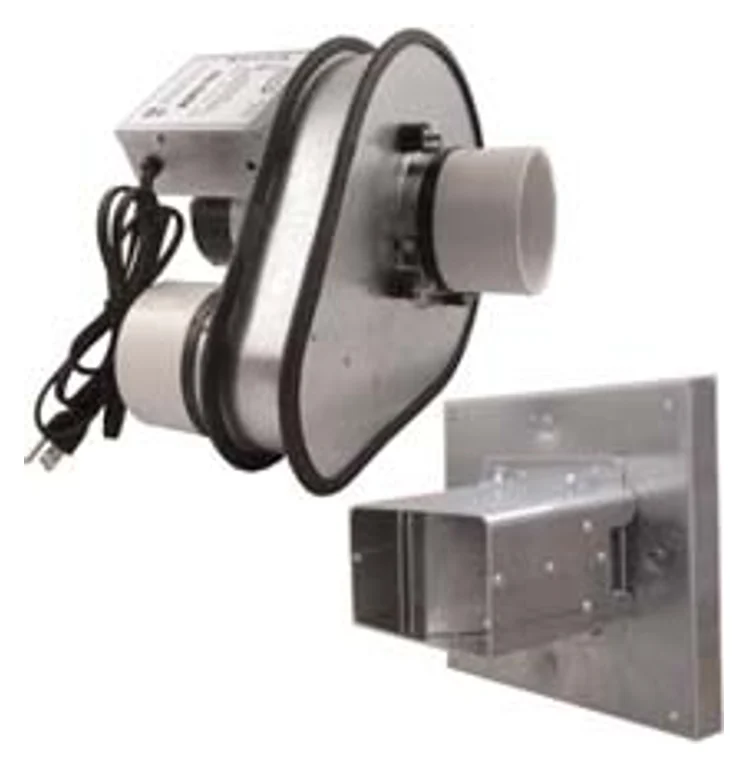
Radon fan
RMS160 side-wall radon mitigation system
- 3 in. schedule 40 PVC
- 50 W
Max airflow: 160 CFM
Max pressure: 2.3 in w.c.
Choosing or replacing a fan
For a new system, the fan is part of a design a mitigator makes after measuring how easily air moves under the slab. The EPA recommends that a qualified radon mitigation contractor fix a home, and notes that many states require radon professionals to be licensed, certified or registered; find one in radon mitigation professionals. For a replacement, the installed fan's model and the system's pressure gauge reading are the starting point, and the makers' tables above show how each fan's figures compare with what it replaces. Two makers publish their own replacement guides: Fantech's maps its models to other makers' fans by pressure capability (above), and Festa's 2022 catalog pairs its AMG Maverick or AMG Patriot with installed XP151, XP201, RP145, FR100, HP190, HP2190, RN2 and RN2SL fans. How the whole system works is explained in how a radon fan works and on radon mitigation fans.
Questions about radon fans
Which radon fan should I buy?
The one sized for your house, which takes measurements under the slab. The makers' tables above show each fan's pressure, airflow and power, but no maker's figures say which suits your soil and pipe run; a mitigator decides that.
What size radon fan do I need?
It depends on how much suction your slab needs. The EPA's guide to radon-resistant construction says the fan should keep the pressure under the slab lower than above it, and refers to a fan moving 100 CFM at one inch of water column as sufficient for most new-home applications, but your system's own readings are what matter.
What do the static pressure and CFM figures mean?
Static pressure, in inches of water column, is how hard a fan can pull; CFM is how much air it moves. Airflow falls as pressure rises, which is why AprilAire, Festa and RadonAway list CFM at set pressures and Fantech lists a maximum of each.
How many watts does a radon fan use?
It varies by model. Fantech lists maximum power from 20 W for the Rn 1 to 174 W for the Rn 4EC-43, and RadonAway lists 45 to 66 W for the XP201 and 67 to 117 W for the XR261. Fantech's EC models can be turned down to use less.
Can I install a radon fan myself?
Fantech's manual recommends a trained, licensed, certified mitigation professional and says incorrect installation voids its warranties. Either way, test after installation.
Where should a radon fan be installed?
Outside the living space: the EPA says not inside the home's living area or in the crawlspace, and most often in an attic or garage, in a vertical run of pipe, on an unswitched supply.
Should a radon fan run all the time?
Yes. The EPA says the fan should never be turned off; it must run continuously for the system to work.
How long does a radon fan last?
The EPA says fans may last five years or more, and that manufacturer warranties tend not to exceed five years. Fantech states a five-year warranty on its Rn fans, RadonAway on its XP201 and AprilAire on its radon fans.
Can I turn down a radon fan?
Only if it is built for it. Fantech's Rn 2EC and Rn 4EC have a built-in speed controller, and Fantech's manual warns against using its fans with any solid state speed control device.
Why are some fans missing from this page?
This page lists the fans whose makers publish a specification table we could read and check. More models will be added as their makers' figures are checked.
Some fans we cover come from makers with no table we could find, such as the MIDCVFRUN radon fan kit, the MIDCVFRUN radon fan and the Dcfairfan radon fan kit. Each has its own page, which marks every figure no maker document we could read states.
The fans in this section3
The fans in this section: 1 of 3