Monitor
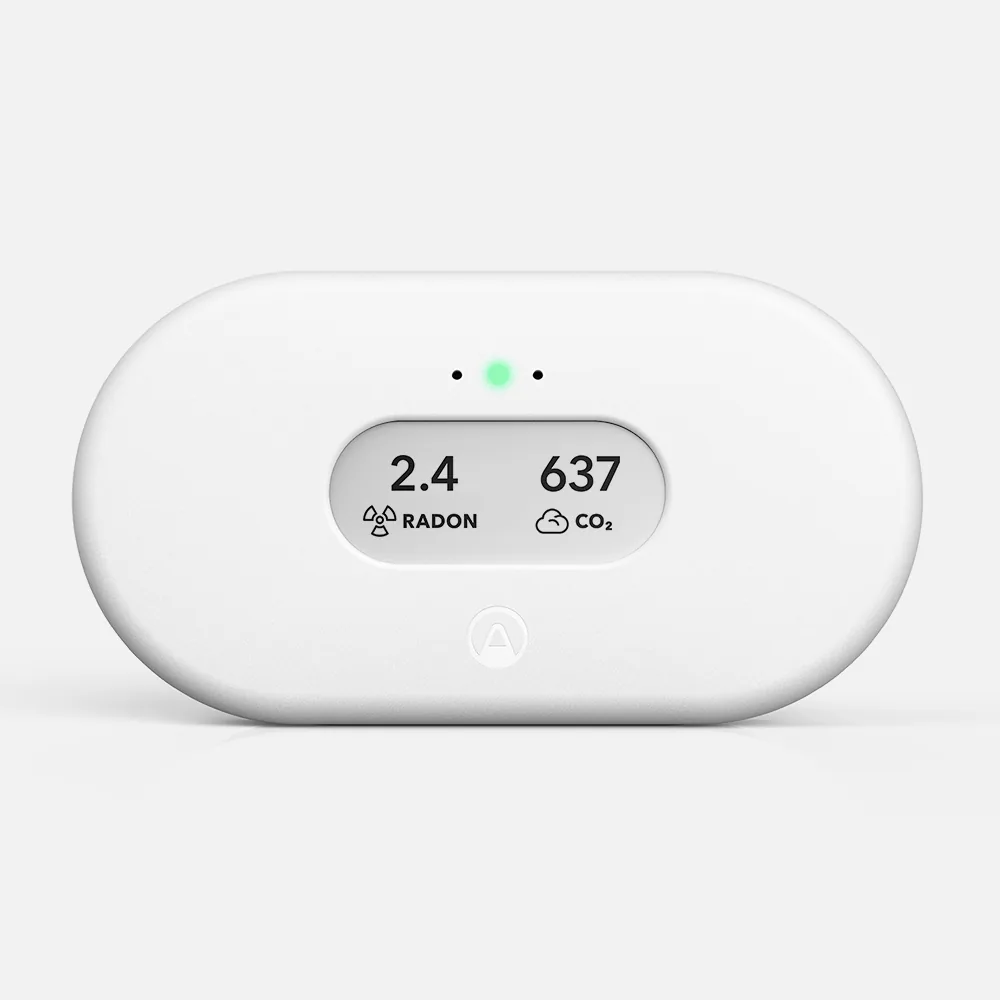
View Plus radon and air quality monitor
- C-NRPP 2024/25: Approved
- Battery
- Wi-Fi, Bluetooth
- Screen, app
Method: Alpha spectrometry
ProductsCompare
Short answer
The Airthings View Plus and Wave Plus measure radon the same way, with a passive diffusion chamber and alpha spectrometry. The View Plus adds a screen, a particulate matter sensor and Wi-Fi, while the Wave Plus has only a glow ring, runs on 2 AA batteries and connects over Bluetooth or a hub.
The Airthings View Plus and Wave Plus are two of the maker's air quality monitors, and both measure radon alongside carbon dioxide, volatile organic compounds, temperature, humidity and air pressure. They share a radon sensor design and the same stated radon range and accuracy. They differ in how you read them, how they are powered and connected, one extra sensor, and their independent results. This page sets those differences out side by side, in Airthings' own figures, and picks neither.
| Compared | View Plus | Wave Plus |
|---|---|---|
| Radon sensor | Passive diffusion chamber, alpha spectrometry | Passive diffusion chamber, alpha spectrometry |
| Where you read it | 2.9-inch ePaper screen and a glow indicator; app | Red, yellow and green glow ring; app and web dashboard |
| Other sensors | PM2.5, CO2, VOCs, temperature, humidity, air pressure | CO2, TVOC, temperature, humidity, air pressure |
| Power | 6 AA batteries or USB-C | 2 AA batteries |
| Connection | Wi-Fi (2.4 GHz), SmartLink and Bluetooth Low Energy | Bluetooth or Airthings SmartLink |
| C-NRPP 2024/25 | Approved, listed as "Airthings View" | Not included |
For radon itself, Airthings lists the same design and figures for both. Air reaches a passive diffusion chamber, and the radon in it is measured by alpha spectrometry. Both state a measurement range of 0 to 500
| Specification | Both models |
|---|---|
| Radon sampling | Passive diffusion chamber |
| Detection method | Alpha spectrometry |
| Radon range | 0 to 500 pCi/L (0 to 20,000 Bq/m3) |
| Maker's accuracy claim | About 10% after 7 days, about 5% after 2 months |
| Sensor sampling interval | 5 minutes |
| Carbon dioxide range | 400 to 5,000 ppm |
The View Plus has a 2.9-inch ePaper screen, so the numbers are on the device, along with a red, yellow and green glow indicator. Airthings lists its radon thresholds for that indicator as 4 pCi/L and above, and from 2.7 to under 4 pCi/L. It adds a particulate matter sensor for PM2.5, which makes seven sensors in all. It connects over 2.4 GHz Wi-Fi, Airthings SmartLink and Bluetooth Low Energy, and with Wi-Fi and its USB-C cable connected, its hub functionality is enabled.
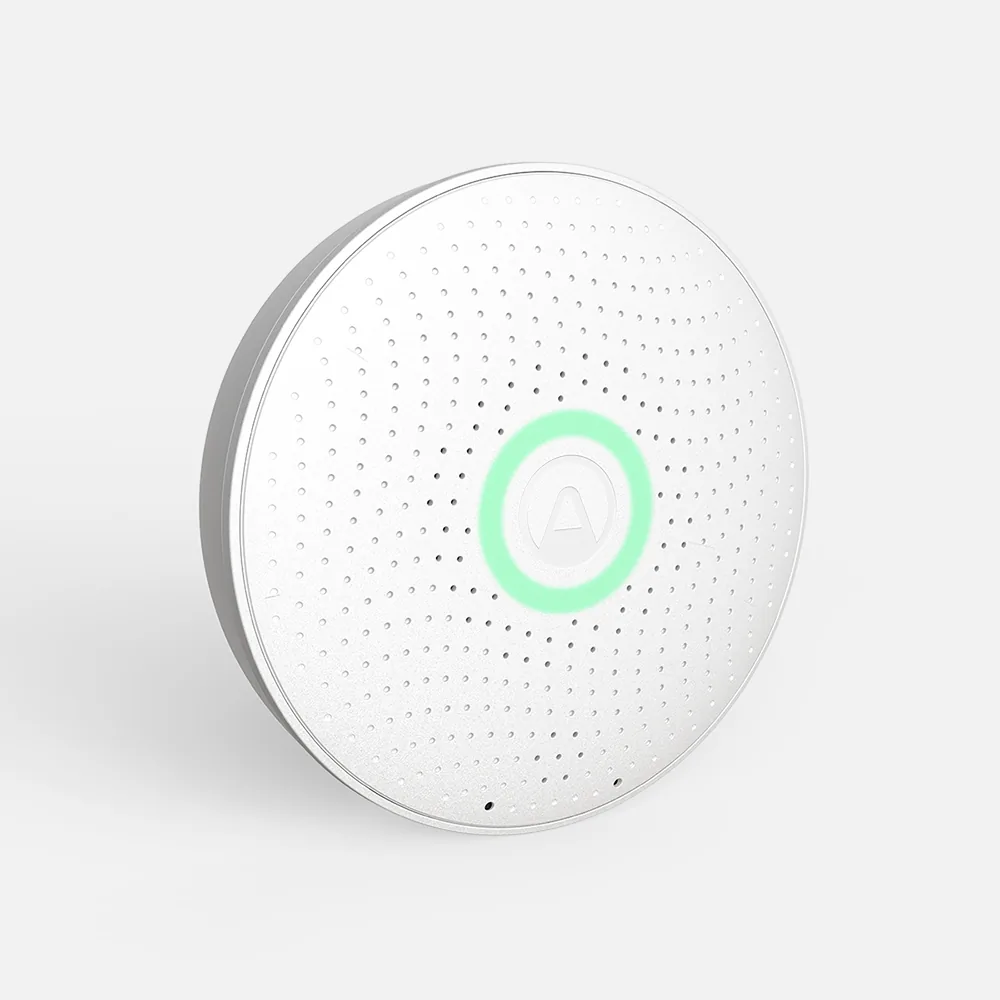
The Wave Plus has no screen. Its red, yellow and green glow ring gives the level at a glance, and the figures are in the free app for iOS and Android and on a web dashboard. Airthings describes it as a smart monitor with six sensors: radon, carbon dioxide, TVOC, temperature, humidity and air pressure. It connects over Bluetooth or through an Airthings SmartLink hub, and it supports mounting on a wall or a ceiling, with a mounting screw in the box.
| Compared | View Plus | Wave Plus |
|---|---|---|
| On the device | 2.9-inch ePaper screen, plus a glow indicator | Red, yellow and green glow ring |
| In the app | The Airthings app | The Airthings app and a web dashboard |
| Particulate matter (PM2.5) | Yes | Not listed |
| Connection | Wi-Fi, SmartLink, Bluetooth Low Energy | Bluetooth or SmartLink |
| Hub functionality | With Wi-Fi and USB-C connected | Not stated |
| Mounting | Not stated | Wall or ceiling |
The View Plus runs on 6 AA batteries or a USB-C cable, and runs from its batteries if the cable is removed. Airthings gives a battery life of up to 2 years, depending on the sensor interval and the Wi-Fi router. The Wave Plus runs on 2 AA batteries, with a stated battery life of 16 months on Bluetooth and 18 months through a SmartLink hub, about a year and a half either way.
| Compared | View Plus | Wave Plus |
|---|---|---|
| Batteries | 6 AA, or USB-C | 2 AA |
| Stated battery life | Up to 2 years, depending on sensor interval and Wi-Fi router | 16 months on Bluetooth, 18 months on SmartLink |
| Weight | 360 g (12.7 oz) with batteries | 219 g (7.7 oz) with batteries |
| Size | 17 x 9 x 3.3 cm | 4.7 in across, 1.4 in high |
| Model number | 2960 | 2910 |
C-NRPP's 2024/25 consumer monitor list approves a model it names only as the "Airthings View", which our product pages apply to both View models, as the accuracy results explainer sets out. Its 2023 report listed the View Plus by name as passing. The Wave Plus was not included in the 2024/25 evaluation, which is a fact about which devices took part, not a failed test, and C-NRPP's 2023 report listed it as passing.
Both were also run in a 2024 field study beside a calibrated reference instrument at a natural radiation laboratory in Salamanca, Spain, between 1 July and 23 August 2023. Over that period the View Plus's average differed from the reference by 7.7% and the Wave Plus's by 11.0%; the View Plus lost 1.6% of its records and the Wave Plus 6.1%. In the study's test of how quickly each monitor followed a rise in radon, the View Plus, View Radon and Wave Plus reached the 10% level but not the 50% and 90% levels, so a sudden change shows on these monitors later than on some others.
| Evidence | View Plus | Wave Plus |
|---|---|---|
| C-NRPP 2024/25 evaluation | Approved, listed as "Airthings View" | Not included |
| C-NRPP 2023 report | Passed | Passed |
| 2024 field study: difference from the reference over 54 days | 7.7% | 11.0% |
| 2024 field study: records lost | 1.6% | 6.1% |
Neither comes out ahead. Each list below has four points, drawn from the features Airthings states, so the choice rests on how you will use it.
| Compared | The View Plus fits if | The Wave Plus fits if |
|---|---|---|
| Reading it | You want to read the numbers on the device | A glow ring at a glance is enough, with the numbers in the app |
| What it measures | You also want to track particulate matter | Radon, CO2 and VOCs cover what you want to track |
| Connection | You want Wi-Fi, or the monitor itself to act as a hub | You prefer Bluetooth, or already have a SmartLink hub |
| Power and mounting | You can run it from USB-C as well as batteries | You want to mount it on a wall or a ceiling |
Both models, with their full specifications and evidence, are on their own pages: Airthings View Plus and Airthings Wave Plus. Every monitor we cover is on radon detectors and monitors.
Monitor
Method: Alpha spectrometry
Monitor
Method: Alpha spectrometry
As an Amazon Associate, Radon411 earns from qualifying purchases.
Step 1 of 4:
Pick the floor
The lowest lived-in level of the home, in a room used regularly, such as a living room, playroom, den or bedroom, not a kitchen or bathroom.
Step 2 of 4:
Pick a room people use
A room occupied for at least 4 hours each day.
Step 3 of 4:
Set the height
At least 20 inches above the floor and away from drafts, high heat, high humidity and exterior walls.
Step 4 of 4:
Give it time
Test for at least 3 months, preferably in the heating season, and decide on the long-term average.
More on placement is at where to place a radon test, and on reading the result at continuous radon monitors.
Yes. Airthings lists a passive diffusion chamber and alpha spectrometry for both, with the same 0 to 500 pCi/L range and the same accuracy figures.
Neither is shown to be more accurate. Airthings states the same radon accuracy for both. In a 2024 field study one unit of each differed from the reference by 7.7% and 11.0%; one unit in one summer is not a ranking.
No. It has a red, yellow and green glow ring, and its figures are in the Airthings app and on a web dashboard.
No. Airthings lists Bluetooth or an Airthings SmartLink hub as its connection.
The View Plus. Airthings lists PM2.5 among its sensors; the Wave Plus's six sensors are radon, CO2, TVOC, temperature, humidity and air pressure.
Airthings gives up to 2 years for the View Plus on 6 AA batteries, depending on the sensor interval and the Wi-Fi router, and 16 to 18 months for the Wave Plus on 2 AA batteries.
Not in the 2024/25 evaluation, which did not include it. C-NRPP's 2023 report listed the Wave Plus as passing.
C-NRPP's 2024/25 list names the model only as the "Airthings View". Its 2023 report named the View Plus. See independent accuracy results explained.
Consumer monitors cannot be professionally calibrated and are not approved by C-NRPP for use by radon measurement professionals. Check what the contract and your state accept; see radon detectors and monitors.
At least 3 months, preferably in the heating season, and decide on the long-term average rather than the latest reading.