ProductsExplained
Professional radon monitors: what your tester uses
Short answer
A professional radon monitor is the calibrated device a certified tester leaves in a home for a set test and turns into a report; household monitors cannot be professionally calibrated. The Airthings Corentium Pro, Ecosense RadonEye Pro and SunRADON XP are sold for that work, and the Ecosense EcoTracker is a four-monitor diagnostic set for mitigators.
Key takeaways
- A professional radon monitor is the device a certified tester or home inspector leaves in a home for a real-estate or follow-up test, then turns into a signed report.
- What sets it apart from a household monitor is less the sensor than the calibration, the test protocol built into its software, and the report it produces.
- C-NRPP says household monitors cannot be professionally calibrated and are not approved for use by radon measurement professionals.
- Four professional devices are described here: the Airthings Corentium Pro, the Ecosense EcoTracker (a diagnostic set for mitigators), the Ecosense RadonEye Pro and the SunRADON XP (formerly the Model 1028 XP).
- If you are buying or selling a home, the useful questions are which device your tester uses, when it was last calibrated, and which protocol they follow.
Professional radon monitors in short
Most people never need to own a professional radon monitor. They meet one when a radon tester or home inspector sets it on a table in the basement, leaves it for two days or more, and returns to collect it and issue a report. This page explains what that device is, how it differs from the monitors sold for watching your own home, and what three makers publish about the professional devices they sell. It picks none of them: they are built for different jobs.
| Device | Who it is for | Radon detection | Power | Connection |
|---|---|---|---|---|
| Airthings Corentium Pro | Radon professionals and home inspectors | Alpha spectrometry, 4 radon chambers | 3 AA alkaline batteries, about 15 months | Bluetooth to the app; online Pro Dashboard |
| Ecosense EcoTracker | Mitigators diagnosing a home | Pulsed ionization chamber, in each of 4 monitors | 12 V adapter, or a battery pack with a step-up cable | Bluetooth Low Energy only |
| Ecosense RadonEye Pro | Professionals and home inspectors | Pulsed ion chamber | 12 V adapter, or a battery pack with a step-up cable | Bluetooth; optional Wi-Fi |
| SunRADON XP | Radon testing professionals and home inspectors | Solid-state photodiode detector, passive diffusion | 4 AA batteries, up to 300 hours, or USB-C power | Bluetooth and USB-C to the OneRADON app; cellular on the XP+ Cellular |
Show all 4 rows
The monitors in this section4
Pro monitor

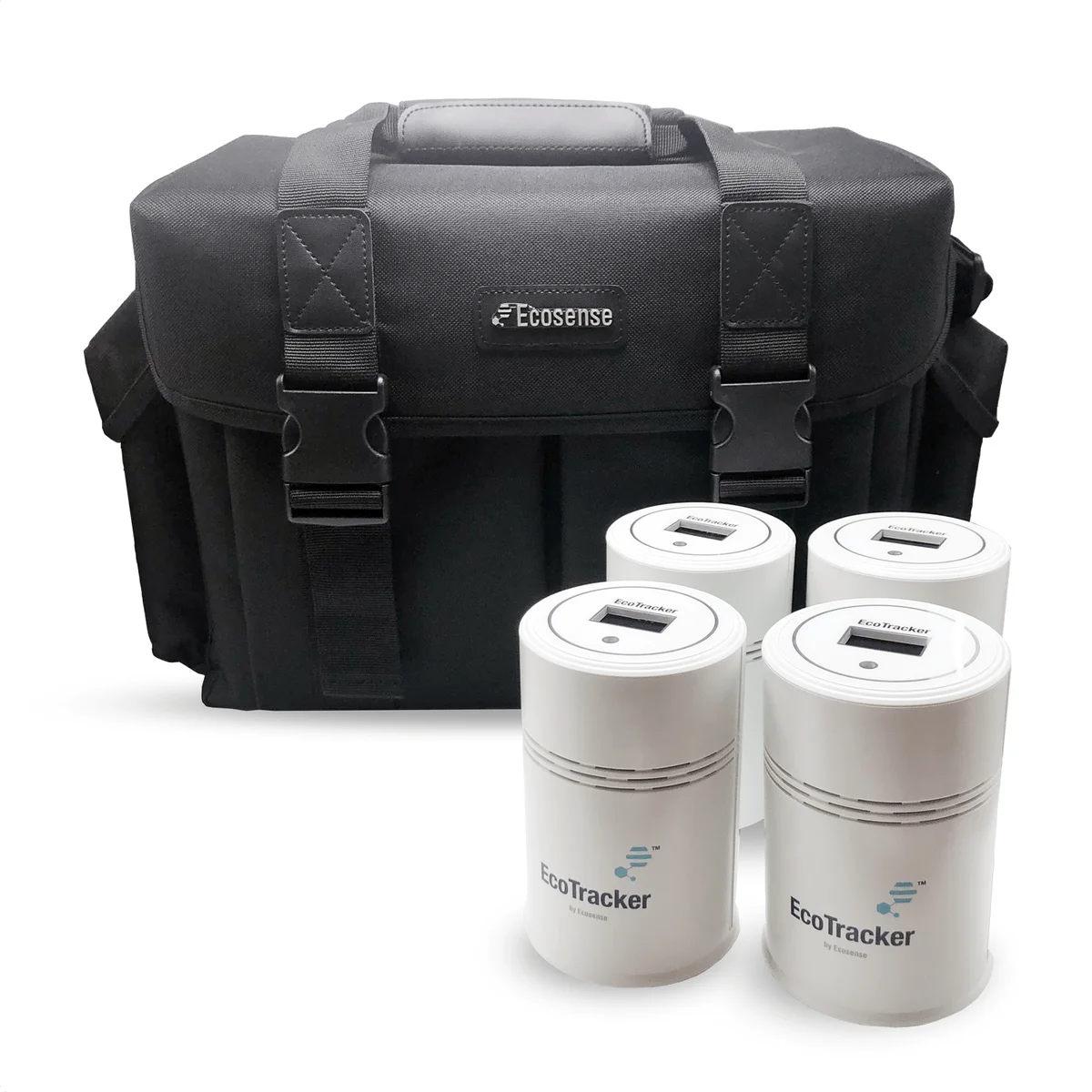
EcoTracker four-monitor radon diagnostic set for mitigators
- Plug-in
- Bluetooth
- Alarm
- Screen, app
First reading: Within 5 minutes
Pro monitor
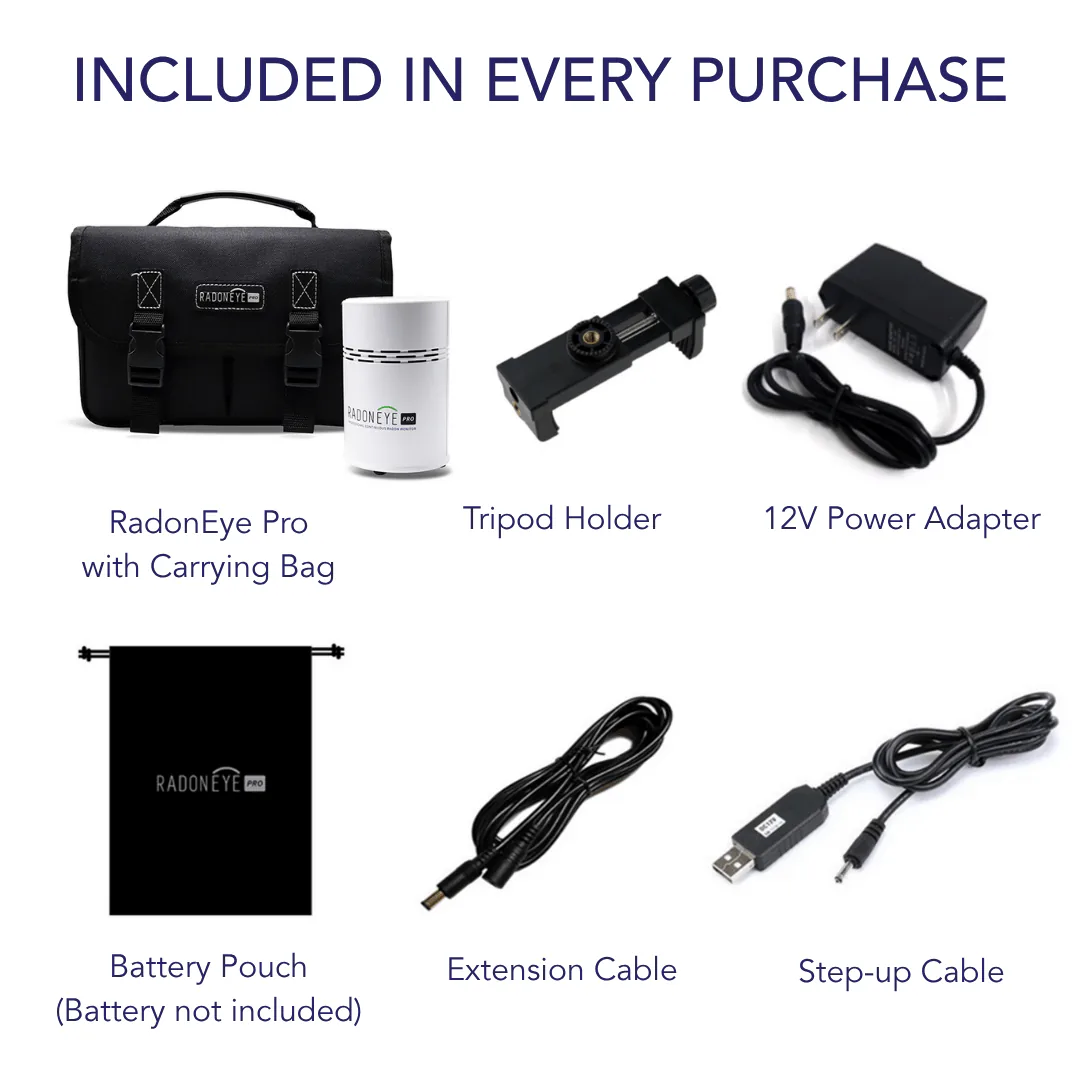
RadonEye Pro professional continuous radon monitor
- Plug-in
- Wi-Fi, Bluetooth
- Alarm
- Screen, app
Method: Ion chamber
First reading: Within 1 hour


The monitors in this section: 1 of 4
As an Amazon Associate, Radon411 earns from qualifying purchases.
How a professional monitor differs from a household one
The radon measurement itself can be similar. Airthings' household detectors and its Corentium Pro both use alpha spectrometry, and Ecosense's RadonEye Pro uses the same kind of pulsed ion chamber, with the same stated sensitivity of 30 counts per hour per
The first is calibration. Airthings says each Corentium Pro is calibrated by the manufacturer, that its calibration certificate is valid for one year, and that most jurisdictions require annual calibration for professional use. Ecosense says the RadonEye Pro requires annual calibration and offers it at its own calibration center. SunRADON says calibration is recommended or required annually for any professional radon monitor. A household monitor has no such cycle: C-NRPP says consumer devices cannot be professionally calibrated and are not approved by C-NRPP for use by radon measurement professionals.
The second is the test itself. A professional device is set up for a defined test, with a delay at the start and a fixed length, and its software records what happened during it. Airthings recommends at least 48 hours with a 4-hour delay for
The third is the report. Airthings' online Pro Dashboard holds a testing company's monitors, staff, certifications and report templates, and a technician can add photos and notes on deviations from protocol before a report is generated. Ecosense says the RadonEye Pro generates ANSI/AARST-compliant or standard reports from its app or web dashboard. A household monitor shows a number; a professional device ends in a document a buyer, seller or lender can read.
Airthings Corentium Pro
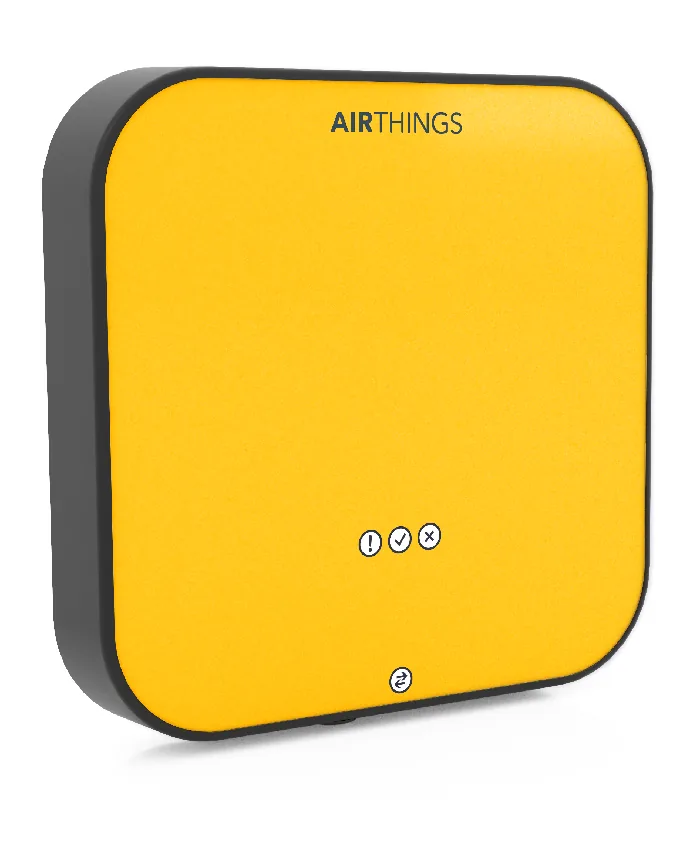
Airthings describes the Corentium Pro as a fully AARST-NRPP and
It has no screen and no on/off button, only status lights. Tests are started and finished in the Corentium Pro app over Bluetooth, and data sets go to the online Pro Dashboard for reports; Airthings notes there is no live, remote access to the monitor. It must sit horizontally, and has a tripod mount and a slot for a Kensington lock to keep it from being moved during a test. Its full specifications are on the Airthings Corentium Pro page.
| Item | Airthings' figure |
|---|---|
| Detection | Passive diffusion, alpha spectrometry, 4 chambers |
| Range | 0 to 2,700 pCi/L (0 to 100,000 Bq/m³) |
| Measurement uncertainty | About 7% ± 0.15 pCi/L after 24 hours; about 5% ± 0.06 pCi/L after 7 days |
| Also logs | Temperature, humidity, barometric pressure, motion events |
| Calibration | Certificate valid for one year |
| Short-term test | At least 48 hours, 4-hour delay, ending in 24-hour increments |
| Power | 3 AA alkaline batteries, about 15 months |
Show all 7 rows
Ecosense EcoTracker: a diagnostic set for mitigators
The EcoTracker is a different kind of tool. Ecosense describes it as four professional radon detectors combined into a diagnostic system that helps mitigators identify radon hotspots faster. By comparing four locations at once, a mitigator can work out where to put a suction point, check how radon responds as a system is adjusted, and confirm results on site. Ecosense says it suits vacant homes, new construction and pre- and
Each monitor has a pulsed ionization chamber and a 0.96-inch OLED display, and offers three modes: 5-minute and 10-minute Sniff Modes for finding hotspots quickly, and a Continuous Radon Monitoring (CRM) mode that stores hourly averages for professional testing. It talks to the EcoTracker app over Bluetooth Low Energy, with no Wi-Fi or cellular connection needed. Ecosense gives a service life of about 5 years. Its full specifications are on the Ecosense EcoTracker page.
| Mode | What it is for | Storage |
|---|---|---|
| 5-minute Sniff Mode | Rapid hotspot diagnostics | Up to 1 month |
| 10-minute Sniff Mode | Short-term evaluation | Up to 2 months |
| CRM mode | Longer measurements, hourly averages | Up to 1 year |
Ecosense RadonEye Pro
Ecosense describes the RadonEye Pro as an
It runs from a 12-volt adapter and has no battery backup; for portable use Ecosense describes a 5-volt battery pack with a step-up cable, lasting about 72 hours on a 20 Ah pack or 105 hours on a 30 Ah pack. Bluetooth handles on-site work and Wi-Fi is optional for remote access, though Ecosense notes that an inspection cannot be started or finished remotely. The device stores up to 10 inspection files. Ecosense includes free NRPP device-specific training. The National Radon Safety Board's July 2026 device list includes it as the FT Lab/Ecosense RadonEye Pro RD200P, and C-NRPP's professional device list names the Ecosense RadonEye PRO RD200P. Its full specifications are on the Ecosense RadonEye Pro page.
| Item | Ecosense's figure |
|---|---|
| Detection | Pulsed ion chamber, 30 counts per hour per pCi/L |
| Range | 0.2 to 255 pCi/L (7 to 9,435 Bq/m³) |
| Measurement | Every 10 minutes; 60-minute moving average |
| Also logs | Temperature, humidity, tampering |
| Calibration | Annual, required |
| Power | 12 V adapter; no battery backup |
| Connection | Bluetooth; optional Wi-Fi |
Show all 7 rows
SunRADON XP
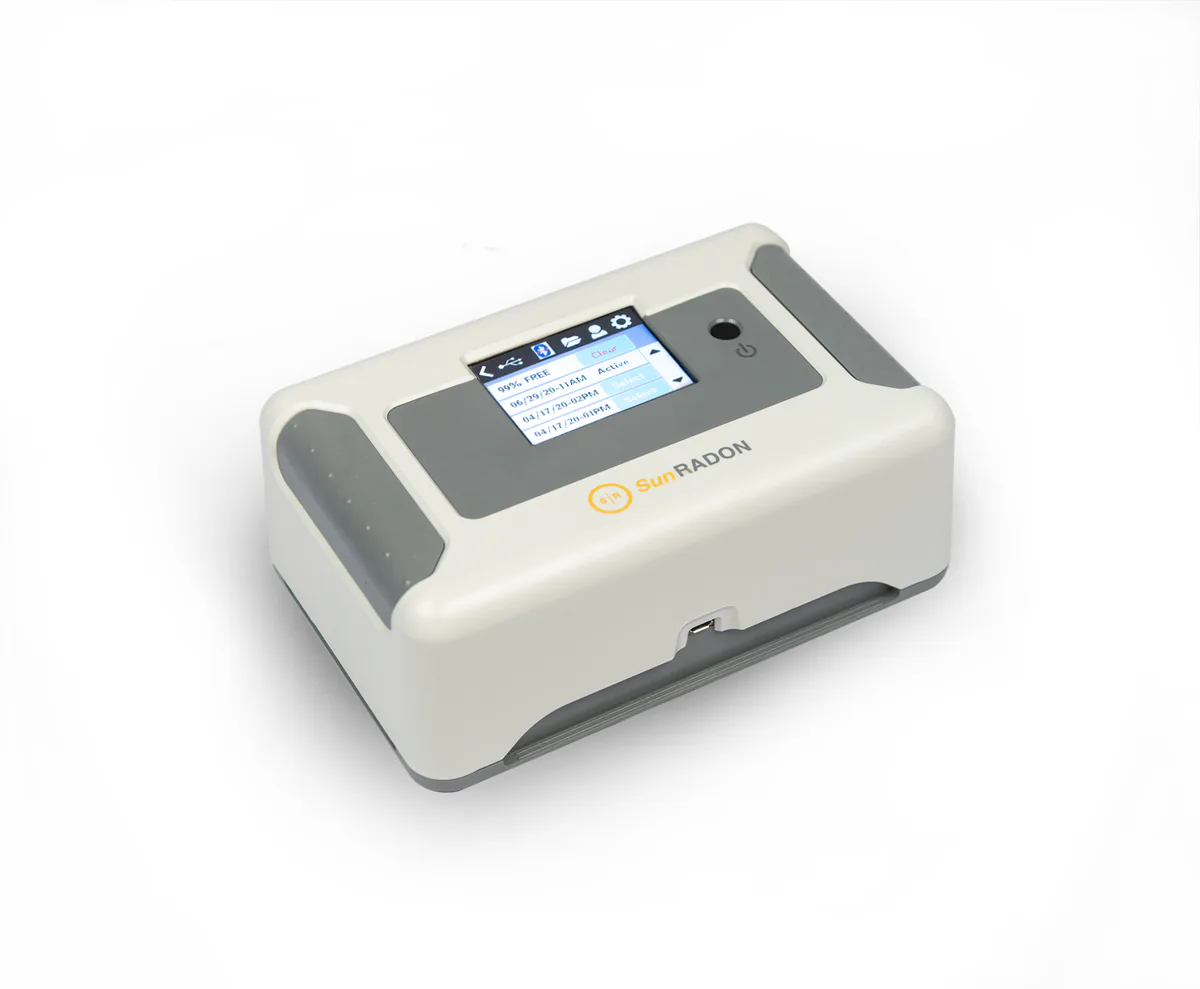
SunRADON's XP was sold until 2024 as the Model 1028 XP, the name under which the National Radon Safety Board's July 2026 device list and C-NRPP's professional device list still carry it. SunRADON describes it as NRPP, C-NRPP and NRSB certified. It counts radon with a single solid-state photodiode detector fed by passive airflow diffusion, states a range of 0.1 to 9,999 pCi/L and an uncertainty of 7% over one day, and has a 2.8-inch color touchscreen that shows the overall and EPA averages and a chart, which SunRADON says are protected from client view.
Tests run from 1 to 999 hours, with a start delay of up to 48 hours and a recording interval of 1 to 12 hours, and are started on the touchscreen or in SunRADON's OneRADON software, which connects over Bluetooth or USB-C and holds the full test data and report templates. The XP runs on four AA batteries for up to 300 hours or on USB power, records motion, and locks with a 4-digit PIN. The XP+ adds humidity, temperature and pressure, and the XP+ Cellular adds a cellular link for remote access. SunRADON says calibration is recommended or required annually. Its full specifications are on the SunRADON XP page.
| Item | SunRADON's figure |
|---|---|
| Detection | Solid-state photodiode detector, passive airflow diffusion, 1 detector |
| Range | 0.1 to 9,999 pCi/L |
| Uncertainty | 7% (1 day, 1 sigma) |
| Also logs | Motion; humidity, temperature and pressure on the XP+ and XP+ Cellular |
| Calibration | Recommended or required annually |
| Test setup | 1 to 999 hours; delay 0, 12, 24 or 48 hours; interval 1, 4, 8 or 12 hours |
| Power | 4 AA batteries, up to 300 hours, or USB-C |
| Connection | Bluetooth and USB-C; cellular on the XP+ Cellular |
Show all 8 rows
What to ask the person testing your home
If a radon test is part of a home sale, you are unlikely to choose the device, but you can ask about it. A tester should be able to answer these without hesitation.
Step 1 of 4:
Which device will you use?
A professional continuous monitor, or a laboratory-analyzed test kit; either can be used by a certified professional.
Step 2 of 4:
When was it last calibrated?
Airthings' certificate is valid for one year, Ecosense says the RadonEye Pro needs calibration every year, and SunRADON says calibration is recommended or required annually for any professional radon monitor.
Step 3 of 4:
Which protocol will you follow?
How long the test runs, how long the delay is, and how the home is kept closed while it runs.
Step 4 of 4:
What will the report show?
The average, the hourly readings, and any movement or interruptions recorded during the test.
To find a certified tester, see radon measurement professionals, and for the wider process, radon and buying a house. The EPA's guidance on a result applies whatever device produced it: fix a home at 4 pCi/L or more, and consider fixing between 2 and 4 pCi/L. If you want to watch radon in your own home over months, a household monitor is the tool for that; every one we cover is on continuous radon monitors.
Questions about professional radon monitors
What radon monitor do home inspectors use?
It varies. Some use a professional continuous radon monitor such as the Airthings Corentium Pro, the Ecosense RadonEye Pro or the SunRADON XP, which their makers sell as NRPP and NRSB certified for professional testing; others use laboratory-analyzed test kits. Ask your inspector which device they use and when it was last calibrated.
How is a professional radon monitor different from a home monitor?
Mainly in calibration, protocol and reporting. A professional device carries a yearly calibration, runs a defined test with a delay and a fixed length, logs movement or tampering, and produces a report. C-NRPP says household monitors cannot be professionally calibrated and are not approved for professional use.
Does a professional radon monitor need calibration?
Yes. Airthings says the Corentium Pro's calibration certificate is valid for one year and most jurisdictions require annual calibration for professional use; Ecosense says the RadonEye Pro requires annual calibration. SunRADON says calibration is recommended or required annually for any professional radon monitor.
How long does a professional radon test take?
Airthings recommends at least 48 hours with a 4-hour delay for short-term tests with the Corentium Pro. Ecosense's RadonEye Pro app asks for at least 46 valid hourly data points after the first 4 hours, which a 48-hour test after a 4-hour delay meets. Your state's protocol sets the rules.
Can I buy a professional radon monitor for my own home?
You can, but it is built for testing other people's homes: it may have no screen, it needs yearly calibration, and its software is designed around companies and reports. Owning one does not make your own test count for a home sale. For watching your own home over months, a household monitor is designed for the job.
What is the EcoTracker used for?
Diagnosing a home before and after mitigation. Ecosense sells it as four monitors used at once, with 5-minute and 10-minute Sniff Modes for finding where radon enters and a continuous mode for longer measurements, so a mitigator can choose a suction point and check the result on site.
Is one professional monitor more accurate than another?
We do not rank them. Their makers state their figures differently, and C-NRPP's 2024/25 evaluation covered consumer monitors, not professional devices. For a professional device, the current calibration certificate is the evidence to ask for.
Do professional monitors work without Wi-Fi?
Yes. The Corentium Pro and the EcoTracker connect over Bluetooth, and the RadonEye Pro uses Bluetooth on site with Wi-Fi optional for remote viewing. Ecosense notes that a RadonEye Pro inspection cannot be started or finished remotely. The SunRADON XP connects over Bluetooth and USB-C, with cellular on the XP+ Cellular.
What should I do with a professional test result?
Read it like any radon result. The EPA's guidance is to fix a home at 4 pCi/L or more and to consider fixing between 2 and 4 pCi/L.