 Ecosense
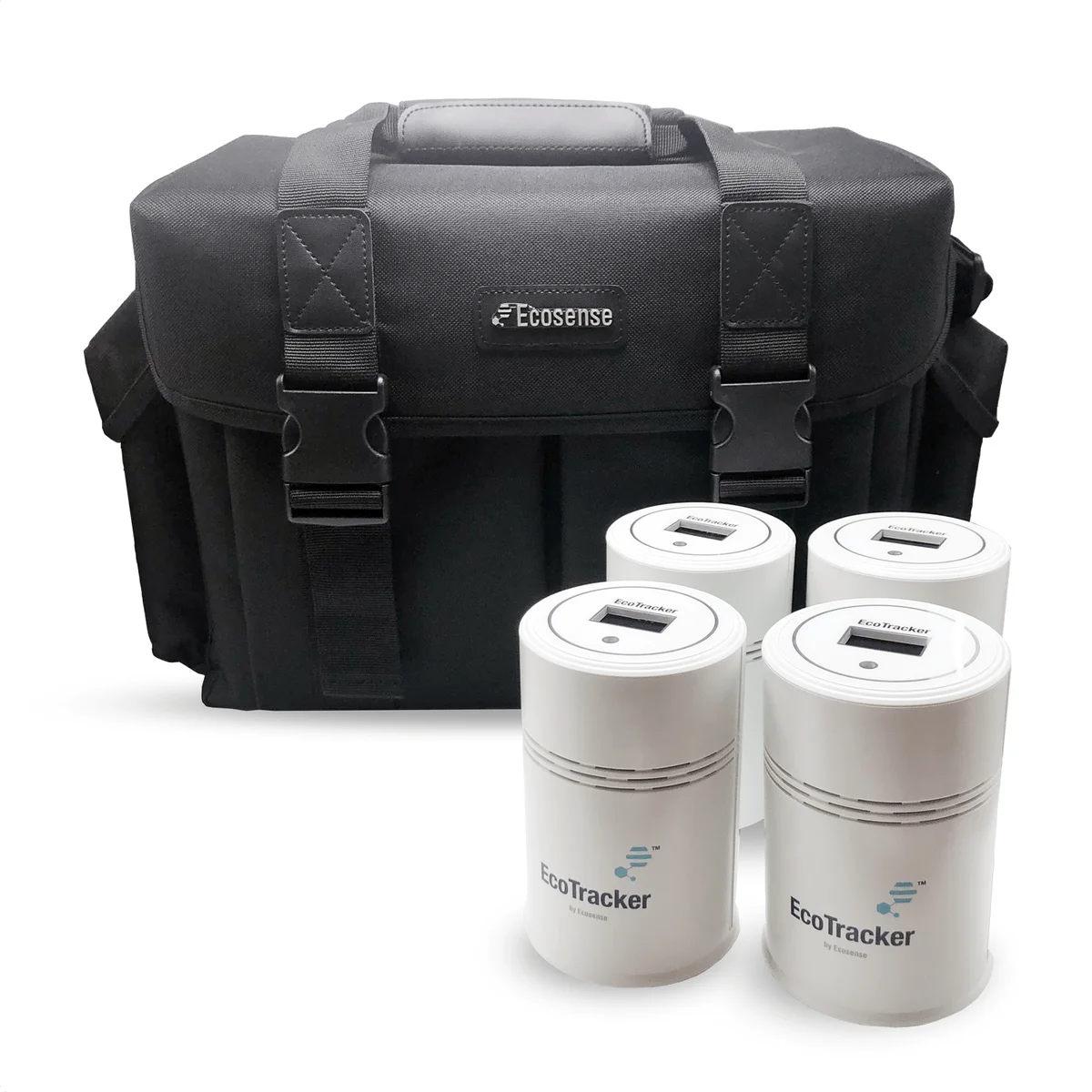
Ecosense EcoTracker
Four-monitor radon diagnostic set for mitigators
- Professional monitor
- Plug-in
- Screen and app
- Bluetooth
- First reading in 5 minutes
Photos: Ecosense
 (opens in a new tab)Check price on Amazon (opens in a new tab)
As an Amazon Associate, Radon411 earns from qualifying purchases.
Amazon and the Amazon logo are trademarks of Amazon.com, Inc. or its affiliates.
See ratings and reviews on Amazon (opens in a new tab)- PowerPlug-in
- ReadingsScreen and app
- First reading5 minutes
- Every figure checked against the specifications Ecosense publishes
- Independent test results shown the same way for every product, unranked
About this item
As Ecosense states it
- How it measures: Pulsed ion chamber in each of four monitors, 30 cph/pCi/L
- First reading: Within 5 minutes
- Reading updates: Sniff modes: every 5 or 10 minutes (30-minute moving average after the first points, firmware 1.03A or later); CRM mode: updated every 10 minutes, logged hourly
- Display and app: Built-in display, phone app, Bluetooth
- Power: Plug-in: 12 V DC adapter per monitor (DC 12V, 0.1A); no internal battery; optional 5 V battery pack with the 5 V to 12 V step-up cable, about 72 hours on 20 Ah or 105 hours on 30 Ah
- Units: pCi/L or Bq/m³, set in the app
The Ecosense EcoTracker (SKU ET100) is a set of four plug-in radon monitors that Ecosense sells to radon mitigators, who place them in different spots at once to find where radon is highest, choose a suction point and watch the levels respond while a system is adjusted. Each monitor counts radon with a pulsed ion chamber, shows readings on a small OLED screen and sends them over Bluetooth Low Energy to one app, with 5-minute and 10-minute Sniff Modes for diagnostics and a continuous mode that logs hourly. As a professional diagnostic set it sits outside C-NRPP's evaluation of consumer monitors.
What you get
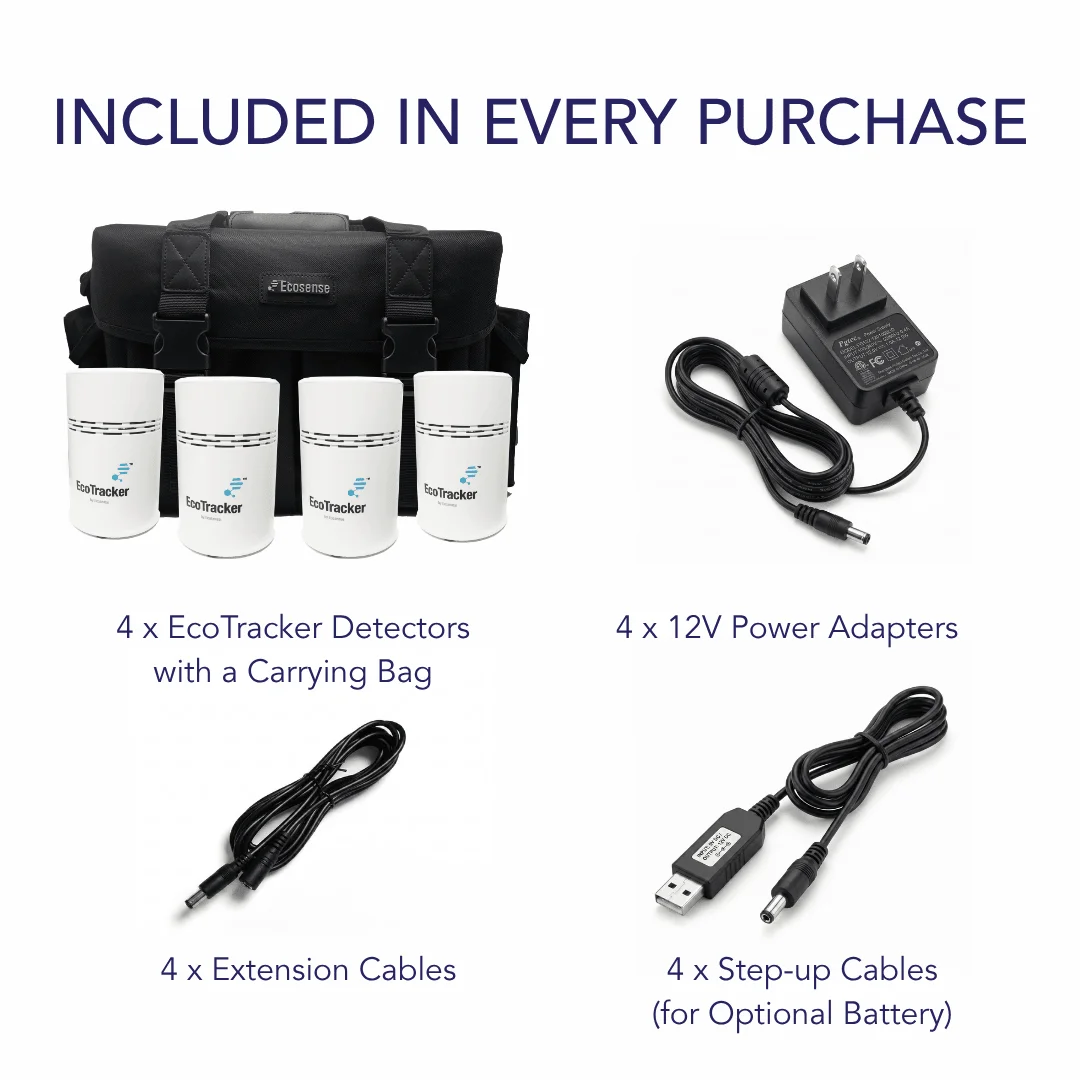
The user guide and the overview page list four EcoTrackers, a product quality certificate, a carrying bag, four power adapters, four step-up cables for an optional battery and four DC extension cables. The product page's FAQ gives the same set without the certificate; its shorter What's Included line leaves out the power adapters and adds access to the EcoTracker app. No battery pack is listed. Ecosense sells extension cables, step-up cables and 12 V power adapters for the EcoTracker as replacement accessories in the U.S.
In the box and running costsHow it works
What it measures and how
The sensor, the sampling and the readings, then who has checked it
How it works
In our words, from the maker's documents
Each of the four EcoTrackers holds a pulsed ion chamber. When radon in the chamber decays, it gives off alpha particles, and the monitor counts them. Ecosense states a sensitivity of 30 counts per hour per pCi/L and a measurement range of 0.2 to 255 pCi/L (7 to 9,435 Bq/m³). The user guide shows the counting at work: a line on the screen gives the alpha counts in the current and previous 10-minute cycles, and Ecosense explains that the larger the count, the higher the radon value. Above 255 pCi/L the screen reads OVER.
What sets the EcoTracker apart is how it reports. Ecosense describes three modes. The 5-minute Sniff Mode, the default, updates and logs a reading every 5 minutes, and the product page says the first reading appears 5 minutes after setup; the 10-minute Sniff Mode does the same every 10 minutes. Ecosense's firmware notes say that from version 1.03A each Sniff Mode averages its readings as they come in and, after six 5-minute or three 10-minute points, switches to a 30-minute moving average. The Continuous Radon Monitoring (CRM) mode updates every 10 minutes and logs once an hour, for measurements left in place over hours or days. Each monitor can be set to its own mode.
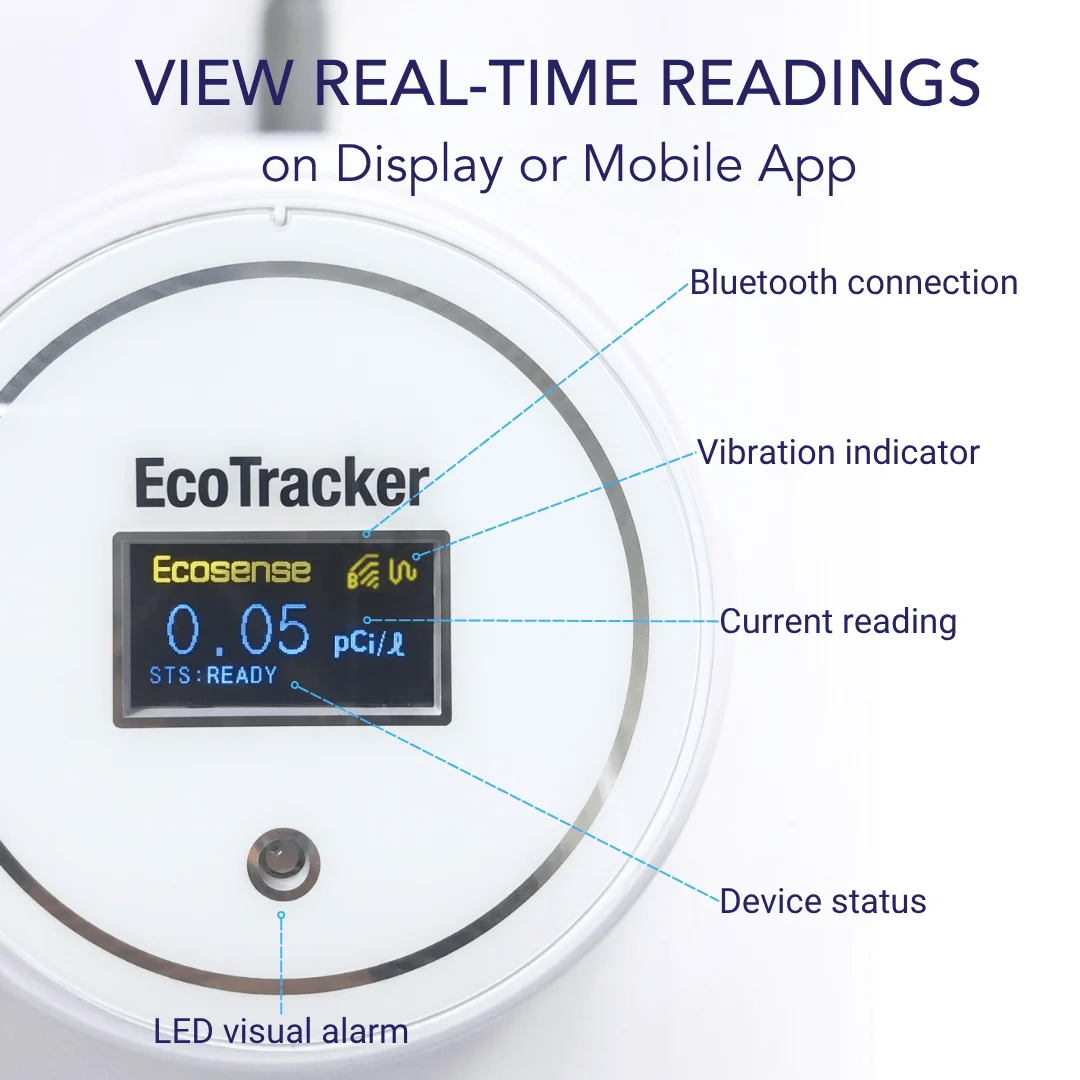
Each monitor has a 0.96-inch OLED screen that shows the current reading and mode, hourly, daily and monthly averages since power-on, the peak reading and the total measurement time, plus a Bluetooth symbol, an LED and a vibration indicator that lights if the monitor is moved from where it was placed. Those on-screen averages reset when a monitor is switched off and on again, while the logged data stays in the device. Storage depends on the mode: about 1 month in 5-minute Sniff Mode, 2 months in 10-minute Sniff Mode and 1 year in CRM mode. Switching between modes resets the data, and the app first asks whether to save it.
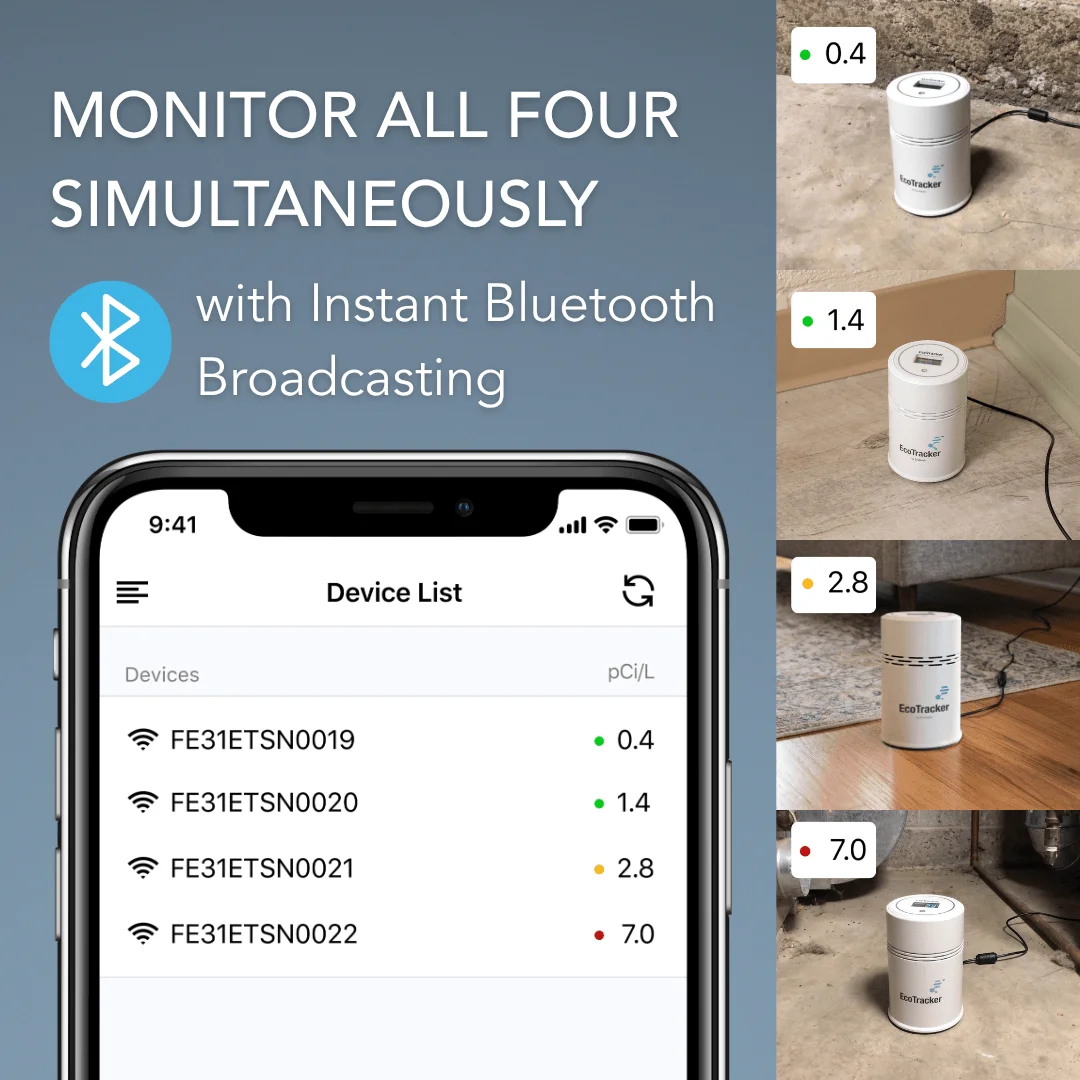
The four monitors talk to the EcoTracker by Ecosense app over Bluetooth Low Energy. Ecosense says no Wi-Fi, cellular connection or internet access is needed to view readings and manage the devices on site, and that the app shows all four detectors side by side, with historical data and charts. The guide lists iOS 13 and Android 5.0 or later. From the app a user sets each monitor's mode and units (pCi/L or Bq/m³), turns its audio alarm on or off with a threshold and interval, saves log files and exports them by email or text message. Ecosense's EcoTracker documents describe log files, not a web dashboard or a report generator.
Power comes from a 12 V DC adapter for each monitor, rated at 0.1 A. Ecosense says the EcoTracker has no internal battery backup; for portable use, a standard 5 V battery pack can run a monitor through the supplied 5 V to 12 V step-up cable, which Ecosense puts at about 72 hours on a 20 Ah pack and about 105 hours on a 30 Ah pack. The guide gives an operating range of 32 to 104°F (0 to 40°C) at relative humidity under 80%, and lists each monitor as Φ80 mm x 120 mm and 240 g.
On the independent side, neither the National Radon Safety Board's list of approved devices, dated July 2026, nor C-NRPP's list of approved professional-grade electronic radon monitors includes the EcoTracker; under Ecosense both name the RadonEye Pro (RD200P). Ecosense describes the CRM mode as intended for longer-term measurements for professional testing and analysis, but makes no listing or certification statement for the EcoTracker in its product page, overview or user guide. C-NRPP's 2024/25 evaluation covered consumer monitors, so the EcoTracker was not part of it.
What the manufacturer says
Ecosense's own statements, attributed
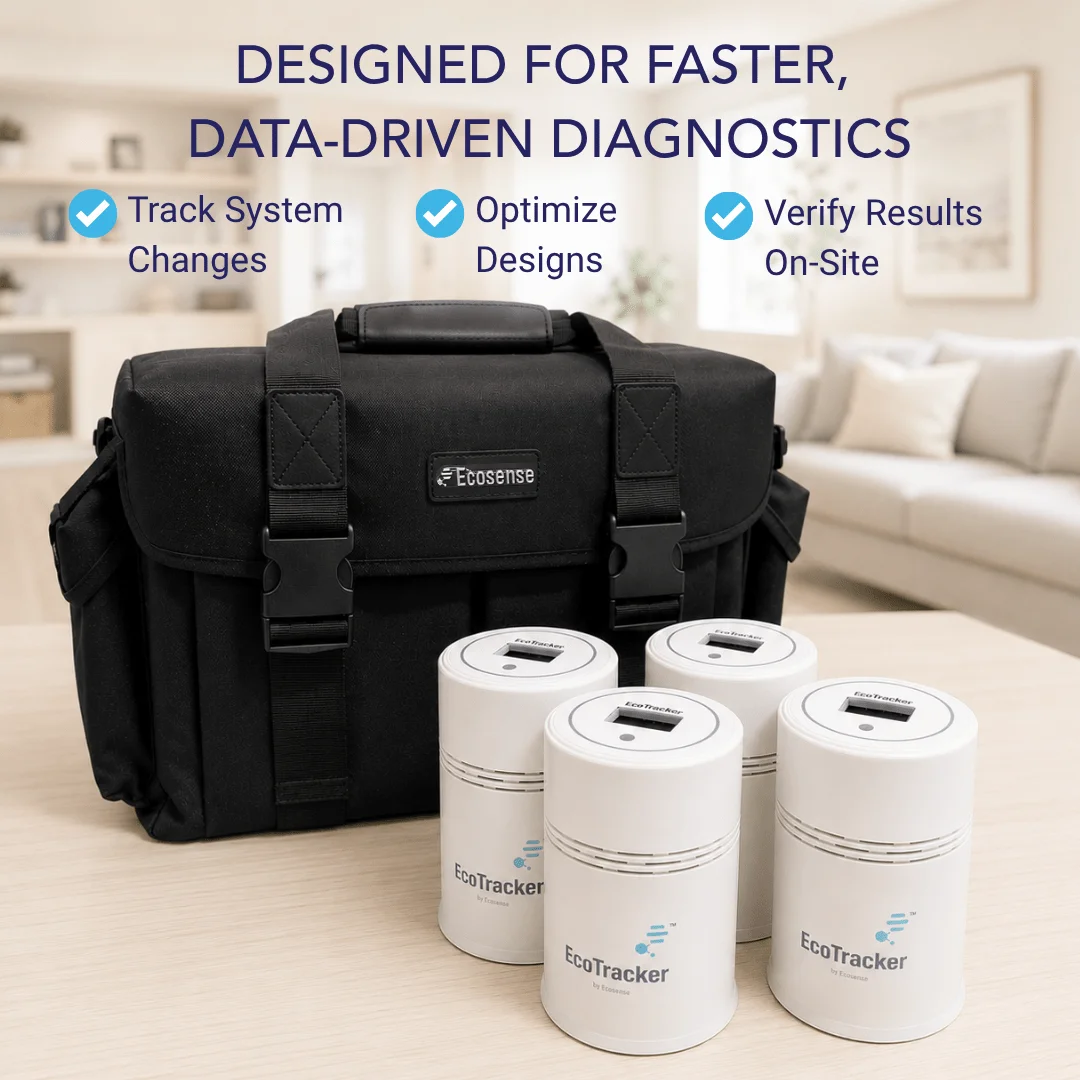
- Ecosense saysEcosense states that the EcoTracker combines four professional radon detectors into a diagnostic system that helps mitigators identify radon hotspots faster, and that comparing four locations at once helps optimize system design, verify results on site and prevent callbacks.
- Ecosense saysEcosense states that its patented 30 CPH/pCi/L sensor technology reacts quickly to changing radon conditions.
- Ecosense saysEcosense states an accuracy and precision of less than ±10% at 10 pCi/L after 10 hours, at a 95% confidence interval, applicable to CRM mode.
- Ecosense saysEcosense says the EcoTracker suits vacant homes, new construction and pre-mitigation diagnostics where internet access may not be available, and that it can help verify system performance after mitigation.
- Ecosense saysEcosense states that the EcoTracker is designed for a service life of approximately 5 years, depending on operating conditions, usage and maintenance.
These are Ecosense's own statements, attributed to it. They are not our findings, and we have not tested this product ourselves.
Independent evidence
Who checks a device like this
C-NRPP's 2024/25 evaluation compared consumer monitors, not professional devices, so it has no result for Ecosense EcoTracker. A professional device is checked by calibration instead: the maker's certification and calibration statements are under “What the manufacturer says”, and a tester can show you the device's current calibration certificate.
Specifications
Specifications
Every figure as the maker states it
The maker's figures
- Type
- Continuous monitor, professional diagnostic set, four plug-in monitors, pulsed ionization chamber, Bluetooth, audio alarm
- How it measures
- Pulsed ion chamber in each of four monitors, 30 cph/pCi/L
- First reading
- Within 5 minutes
- Reading updates
- Sniff modes: every 5 or 10 minutes (30-minute moving average after the first points, firmware 1.03A or later); CRM mode: updated every 10 minutes, logged hourly
- Display and app
- Built-in display, phone app, Bluetooth
- Power
- Plug-in: 12 V DC adapter per monitor (DC 12V, 0.1A); no internal battery; optional 5 V battery pack with the 5 V to 12 V step-up cable, about 72 hours on 20 Ah or 105 hours on 30 Ah
- Units
- pCi/L or Bq/m³, set in the app
What is in the box
The user guide and the overview page list four EcoTrackers, a product quality certificate, a carrying bag, four power adapters, four step-up cables for an optional battery and four DC extension cables. The product page's FAQ gives the same set without the certificate; its shorter What's Included line leaves out the power adapters and adds access to the EcoTracker app. No battery pack is listed. Ecosense sells extension cables, step-up cables and 12 V power adapters for the EcoTracker as replacement accessories in the U.S.
Ecosense's limited warranty runs twelve (12) months from the later of the date of purchase or delivery, and its product page shows a 1-year warranty. Its warranty page says the warranty is for the original end-user purchaser, covers both its consumer and commercial products, and applies to products bought from Ecosense or an Ecosense authorized seller. The same page lists exclusions including accidental damage, misuse, high humidity or water exposure, normal wear and tear and products used for commercial purposes, including leasing to consumers. Ecosense also states a 30-day return policy from the purchase date, and says EcoTracker orders ship with a signature requirement.
What it costs to run
There is no subscription in Ecosense's EcoTracker documents: the app is free to download and the set works without internet service. The monitors run on mains power through their 12 V adapters. Field work away from an outlet needs a 5 V battery pack for each monitor, used with the supplied step-up cables; no pack is in the box.
Lost or worn cables and adapters can be replaced from Ecosense's accessory shop, which lists extension cables, step-up cables and 12 V power adapters for the EcoTracker, for the U.S. only. Ecosense's calibration service is offered for the RadonEye Pro; its EcoTracker pages do not describe a calibration schedule or service for the EcoTracker. The longer-term cost is replacement: Ecosense gives a designed service life of about 5 years.
Fit and setup
Who it fits, and how to use it
The fit, then setup and placement as the guidance asks
Who it fits
Good fit if, and look elsewhere if
Good fit if
- You are a radon mitigator who wants to compare four spots in a house at the same moment before choosing a suction point.
- You want readings within minutes on site, from Sniff Modes that update every 5 or 10 minutes.
- You work in vacant homes or new construction with no Wi-Fi, since the set talks to the app over Bluetooth alone.
- You want to watch radon fall in several rooms while you adjust a new system, then leave a monitor logging hourly.
Look elsewhere if
- You need a device for formal real-estate or follow-up tests; the NRSB and C-NRPP professional lists name Ecosense's RadonEye Pro, not the EcoTracker.
- You want the device to produce a client report; Ecosense's EcoTracker documents describe saving and exporting log files, not reports.
- You want to watch radon in your own home over months; a single household monitor is built for that job.
- You need battery power for days at a time without buying a separate 5 V pack for each monitor.
Setup and placement
4 steps
- Setup is short. Plug each monitor's power adapter in to turn it on, install the EcoTracker by Ecosense app, and turn on Bluetooth; the app pairs with every monitor in range and, once they have booted, shows all four with their readings. On Android the app asks for file access, to export data, and location access, which Android requires for Bluetooth. Each monitor's mode, units and alarm are then set from the app's Device List. A new monitor starts in the 5-minute Sniff Mode, and its screen reads STS: READY until it saves the first reading.
- Ecosense's operating rules: use only the 12 V DC adapter supplied, and the supplied step-up cable when running from a lithium-ion battery pack (over 20 Ah); do not stack monitors with batteries, which Ecosense warns can lead to wrong readings being logged; avoid strong vibration and electromagnetic interference; and keep the monitors indoors, between 32 and 104°F, at humidity under 80% and away from condensation, direct sunlight and heat sources. The battery connector is 5.5 mm by 2.1 mm.
- Where the four monitors go depends on the house and the question being asked, and Ecosense leaves that to the mitigator: its page describes placing them in different locations, such as four spots in one basement, to see where radon is highest and how it shifts as a system is adjusted. A monitor that is moved shows the vibration indicator.
- For the homeowner's side of the job, the EPA recommends having a qualified radon mitigation contractor fix a home, notes that many states require radon professionals to be licensed, certified or registered, and says a test after mitigation should be done within 30 days of installation, but no sooner than 24 hours after the system is running. For a home test, the EPA's general guidance is the lowest lived-in level, at least 20 inches above the floor and away from drafts, high heat, high humidity and exterior walls.
For where any radon test or monitor should sit in a home, see where to place a radon test.
Compare
Compare with similar items
The same three rows for each, and the one difference that matters
This page
Ecosense EcoTracker
- How it measures
- Pulsed ion chamber in each of four monitors
- Power
- Plug-in
- C-NRPP 2024/25
- Not evaluated (professional device)
This page: The Ecosense EcoTracker (SKU ET100) is a set of four plug-in radon monitors that Ecosense sells to radon mitigators, who place them in different spots at once to find where radon is highest, choose a suction point and watch the levels respond while a system is adjusted.
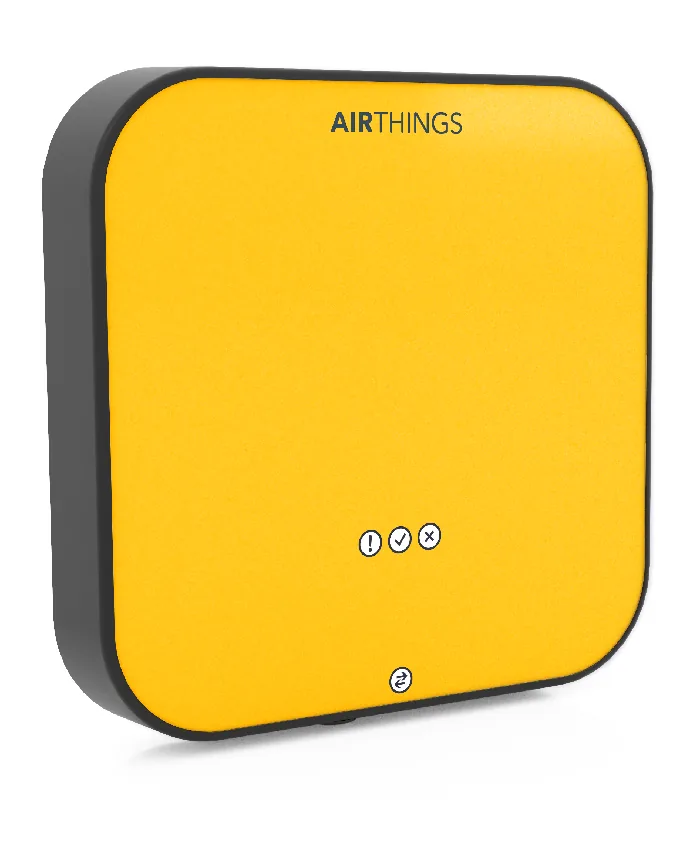
Airthings
- How it measures
- Alpha spectrometry
- Power
- Battery
- C-NRPP 2024/25
- Not evaluated (professional device)
The difference: Airthings' professional monitor: one device with 4 radon chambers read by alpha spectrometry, on 3 AA alkaline batteries for about 15 months, with status lights instead of a screen.
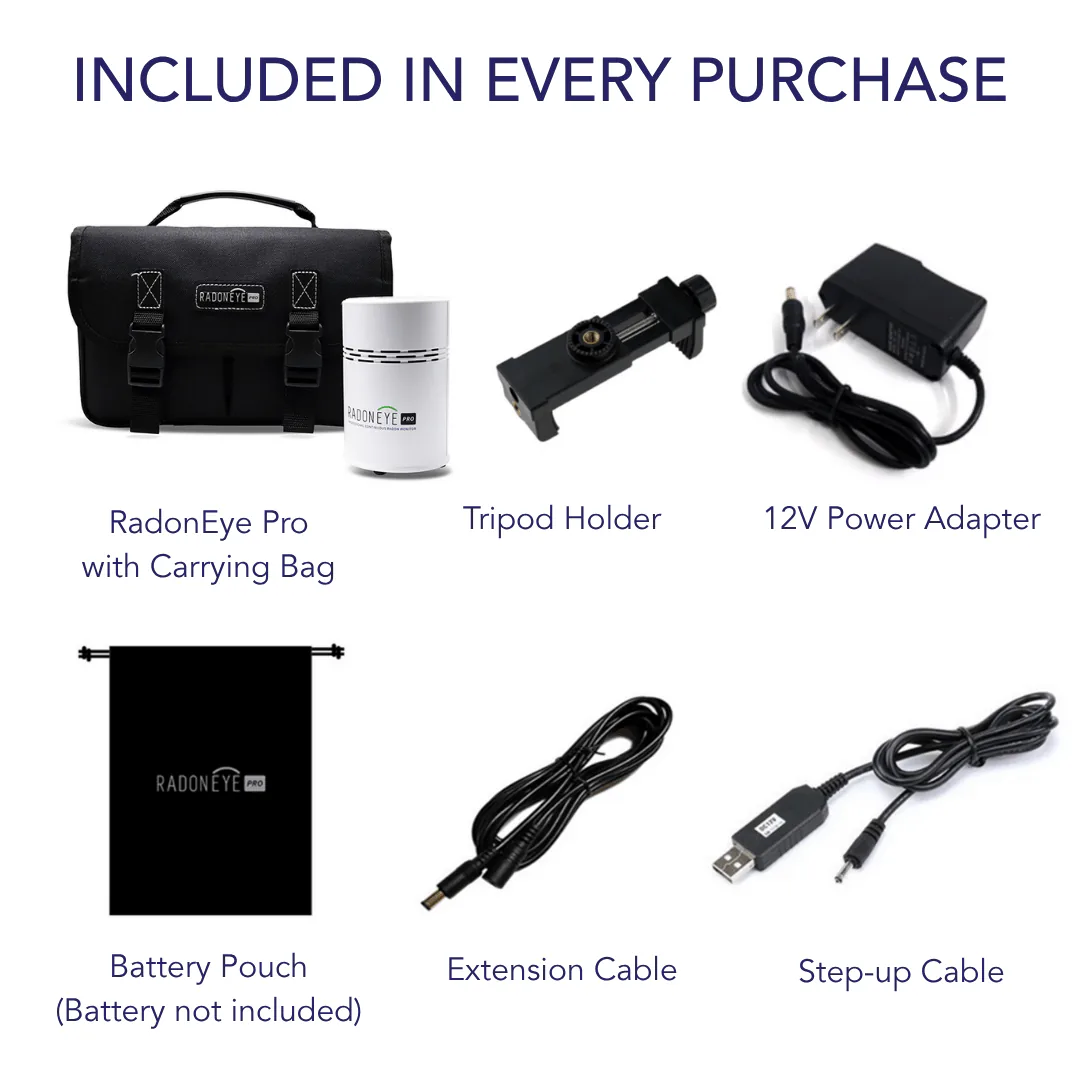
Ecosense
- How it measures
- Ion chamber
- Power
- Plug-in
- C-NRPP 2024/25
- Not evaluated (professional device)
The difference: Ecosense's single-unit professional monitor: the same kind of pulsed ion chamber at 30 counts per hour per pCi/L, one 12 V device with an OLED display, Bluetooth on site and optional Wi-Fi for remote access, ANSI/AARST-compliant reports, and annual calibration, which Ecosense says it requires.
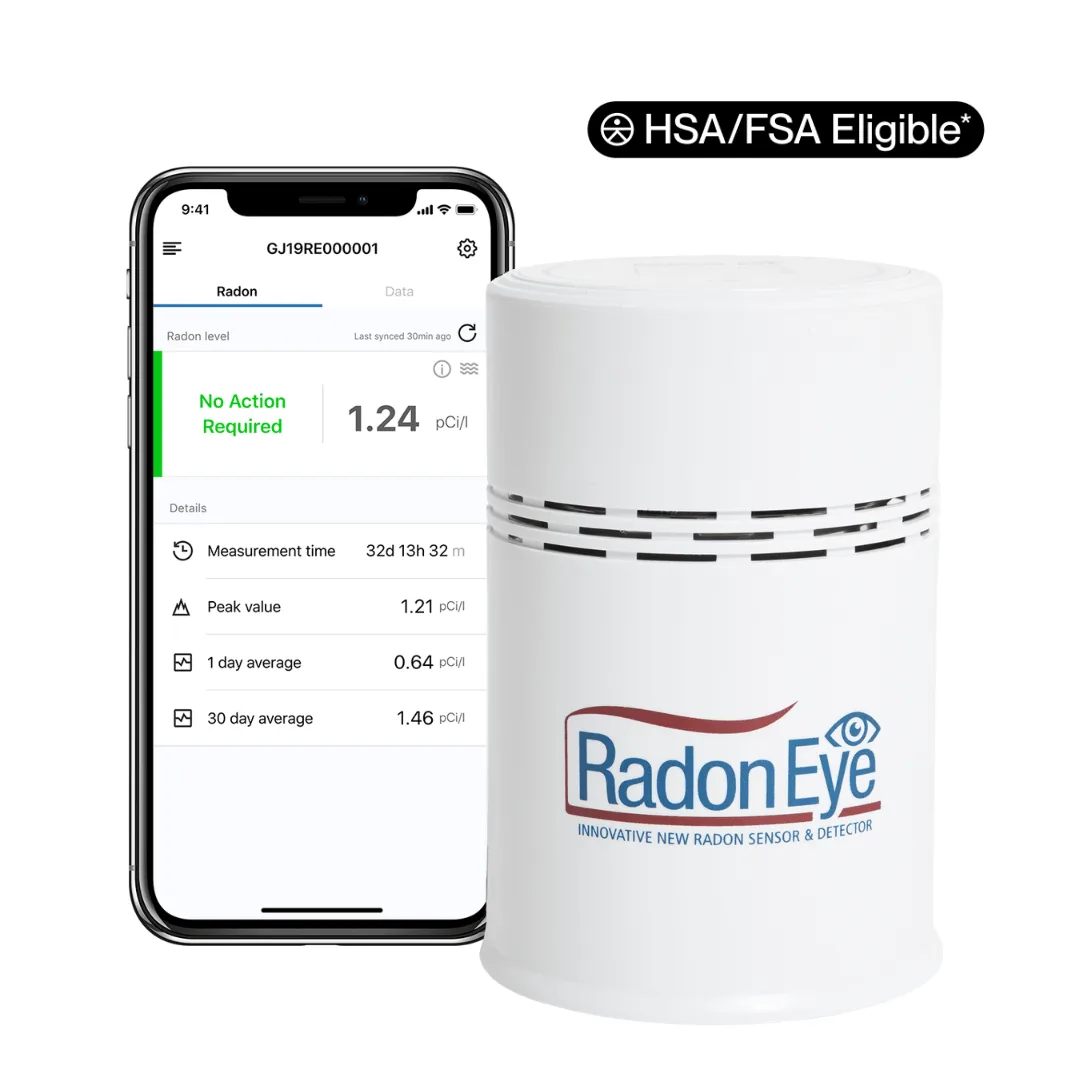
Ecosense
- How it measures
- Ion chamber
- Power
- Plug-in
- C-NRPP 2024/25
- Approved
The difference: Ecosense's household monitor: the same kind of pulsed ionization chamber, one plug-in unit with an OLED display and a Bluetooth app, a first reading in 10 minutes and updates every 10 minutes; approved in C-NRPP's 2024/25 consumer evaluation.
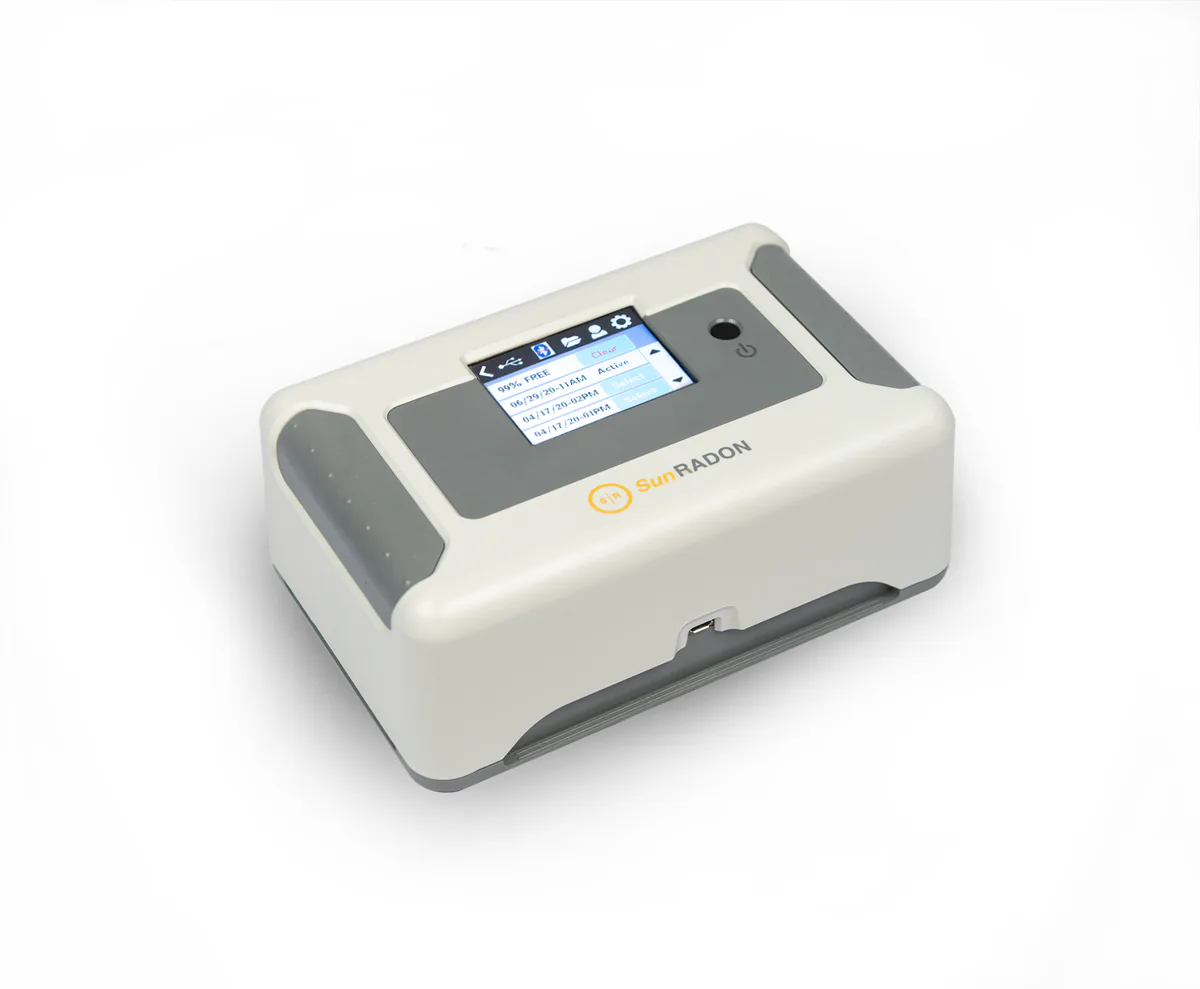
SunRADON
- How it measures
- Solid state photodiode detector
- Power
- Battery
- C-NRPP 2024/25
- Not evaluated (professional device)
The difference: SunRADON's professional monitor, formerly the Model 1028 XP: one solid-state photodiode detector with a color touchscreen, four AA batteries for up to 300 hours, and OneRADON software for client reports.
Compared with similar products: 1 of 5
More professional radon monitors3
All professional radon monitorsPro monitor
RadonEye Pro professional continuous radon monitor
- Plug-in
- Wi-Fi, Bluetooth
- Alarm
- Screen, app
Method: Ion chamber
First reading: Within 1 hour
- All professional radon monitorsMore professional radon monitors


More professional radon monitors: 1 of 3
Questions
Questions people ask
5 questions about the Ecosense EcoTracker, answered
Asked about the EcoTracker
What is the EcoTracker used for?
Diagnosing a building before, during and after mitigation. A mitigator sets the four monitors in different places at the same time, reads them side by side in one app, and uses the differences to decide where to put a suction point and to check that radon drops as the system is adjusted. Ecosense mentions homes, schools, daycare centers and commercial buildings.
Can an EcoTracker reading be used for a home sale?
Do not count on it. A test for a home sale follows your state's rules, and a diagnostic monitor does not stand in for a certified measurement unless those rules allow it. Ecosense pitches the EcoTracker mainly at diagnostics, and the NRSB and C-NRPP professional device lists name Ecosense's RadonEye Pro rather than the EcoTracker. Check your state's rules and ask the tester which device they use.
How fast does the EcoTracker give a reading?
Ecosense says the first reading appears 5 minutes after setup in the 5-minute Sniff Mode, with a new reading every 5 minutes after that. With firmware 1.03A or later, the Sniff Modes move to a 30-minute moving average once enough points are in. For a steadier figure, Ecosense's accuracy statement applies to CRM mode after 10 hours.
Does the EcoTracker need Wi-Fi or batteries?
No Wi-Fi: Ecosense says the set talks to the app over Bluetooth Low Energy and needs no Wi-Fi, cellular connection or internet access on site. No built-in battery either: each monitor runs from its 12 V adapter, and Ecosense says a standard 5 V battery pack can power one through the supplied 5V-to-12V step-up cable.
Is the Amazon listing the same product?
The Amazon listing linked on this page carries the model code ET100, which is the SKU on Ecosense's own product record for the EcoTracker. Ecosense's warranty covers products bought from Ecosense or an Ecosense authorized seller, so it is worth confirming the seller before buying.
What to do next
- See how professional monitors differCalibration, test protocols and reports, and the devices testers use.
- Hire a testerFind radon measurement professionals in our directory.
- Monitor your own homeConsumer monitors, each with its independent evidence.
- Read your resultWhat a number in pCi/L means and what the EPA says to do next.
Updated October 8, 2026