 Ecosense
Ecosense RadonEye Pro
Professional continuous radon monitor
- Professional monitor
- Plug-in
- Screen and app
- Wi-Fi and Bluetooth
- First reading in 1 hour
Photos: Ecosense
 (opens in a new tab)Check price on Amazon (opens in a new tab)
As an Amazon Associate, Radon411 earns from qualifying purchases.
Amazon and the Amazon logo are trademarks of Amazon.com, Inc. or its affiliates.
See ratings and reviews on Amazon (opens in a new tab)- PowerPlug-in
- ReadingsScreen and app
- First reading1 hour
- Every figure checked against the specifications Ecosense publishes
- Independent test results shown the same way for every product, unranked
About this item
As Ecosense states it
- How it measures: Pulsed ionization chamber
- First reading: Within 1 hour
- Reading updates: Every 10 minutes; reports a 60-minute moving average
- Display and app: Built-in display, phone app, Bluetooth, Wi-Fi
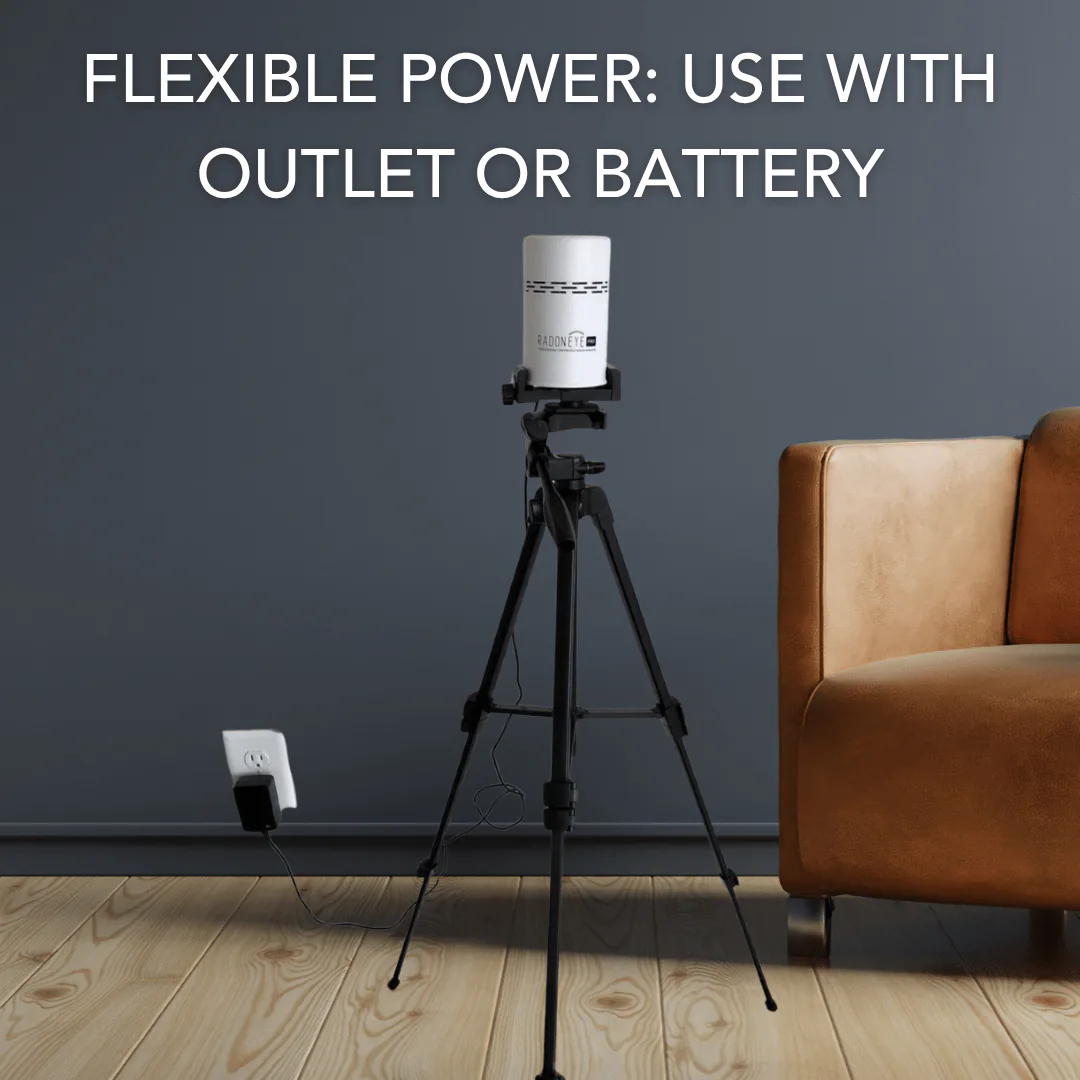
- Power: Plug-in: 12V, 1A DC adapter (power consumption 12V DC, 100mA); no battery back-up; runs from a 5-volt battery pack through the included step-up cable, about 72 hours on 20 Ah or 105 hours on 30 Ah
- Units: pCi/L or Bq/m³, chosen in the app
The Ecosense RadonEye Pro (SKU RD200P) is a continuous radon monitor for radon testers and home inspectors: a pulsed ionization chamber in a small cylinder with an OLED display, run from a 12-volt adapter or a battery pack, and set up, finished and turned into a client report from Ecosense's app or web dashboard. Ecosense says it needs calibration every year. It is outside C-NRPP's evaluation of consumer monitors; the National Radon Safety Board's July 2026 device list and C-NRPP's professional device list both include it.
What you get
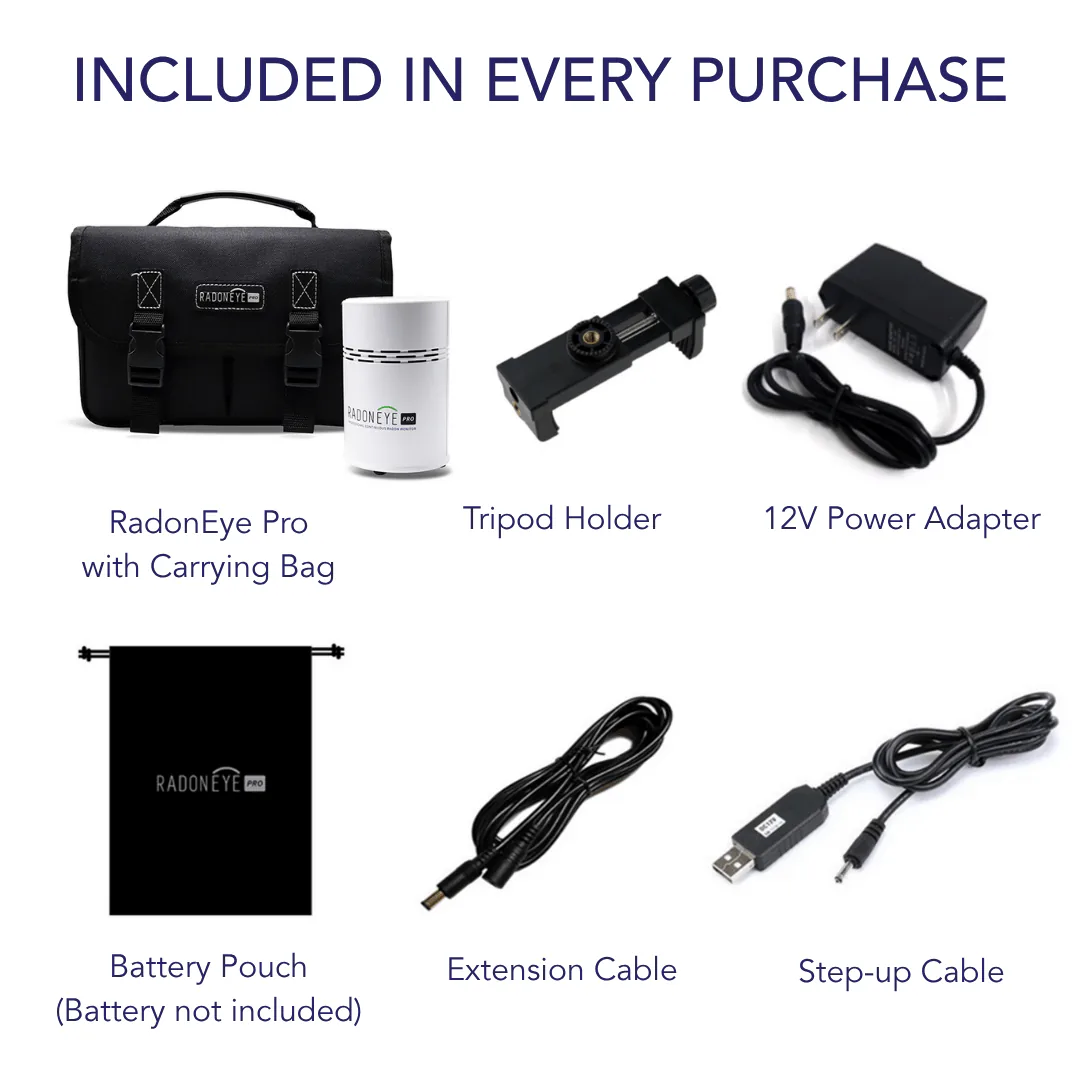
Ecosense's product page lists the device, a protective carrying case, the 12V power adapter, an extension cable, a step-up cable, a battery pouch (battery sold separately), a tripod holder and a calibration certificate, plus the free mobile app and dashboard. The brochure's list adds a quick guide manual, and Ecosense's answer on the same page says the tripod and the portable battery are not included. Ecosense gives the size as 2.83 by 2.83 by 2.44 inches on its product page and as 80 mm across by 120 mm in its brochure, and the weight as 240 g (0.529 lb) in both.
In the box and running costsHow it works
What it measures and how
The sensor, the sampling and the readings, then who has checked it
How it works
In our words, from the maker's documents
Ecosense's brochure gives the detection type as a pulsed ionization chamber. Radon decays inside the chamber and the monitor counts the alpha particles it gives off; Ecosense's guide says the display shows the count for the current 10 minutes and the previous 10 minutes, and that higher counts mean more radon. Ecosense states a sensitivity of 30 counts per hour per pCi/L (0.5 counts per minute per pCi/L), a minimum detectable concentration of 0.18 pCi/L and a range of 0.2 to 255 pCi/L (7 to 9,435 Bq/m³).
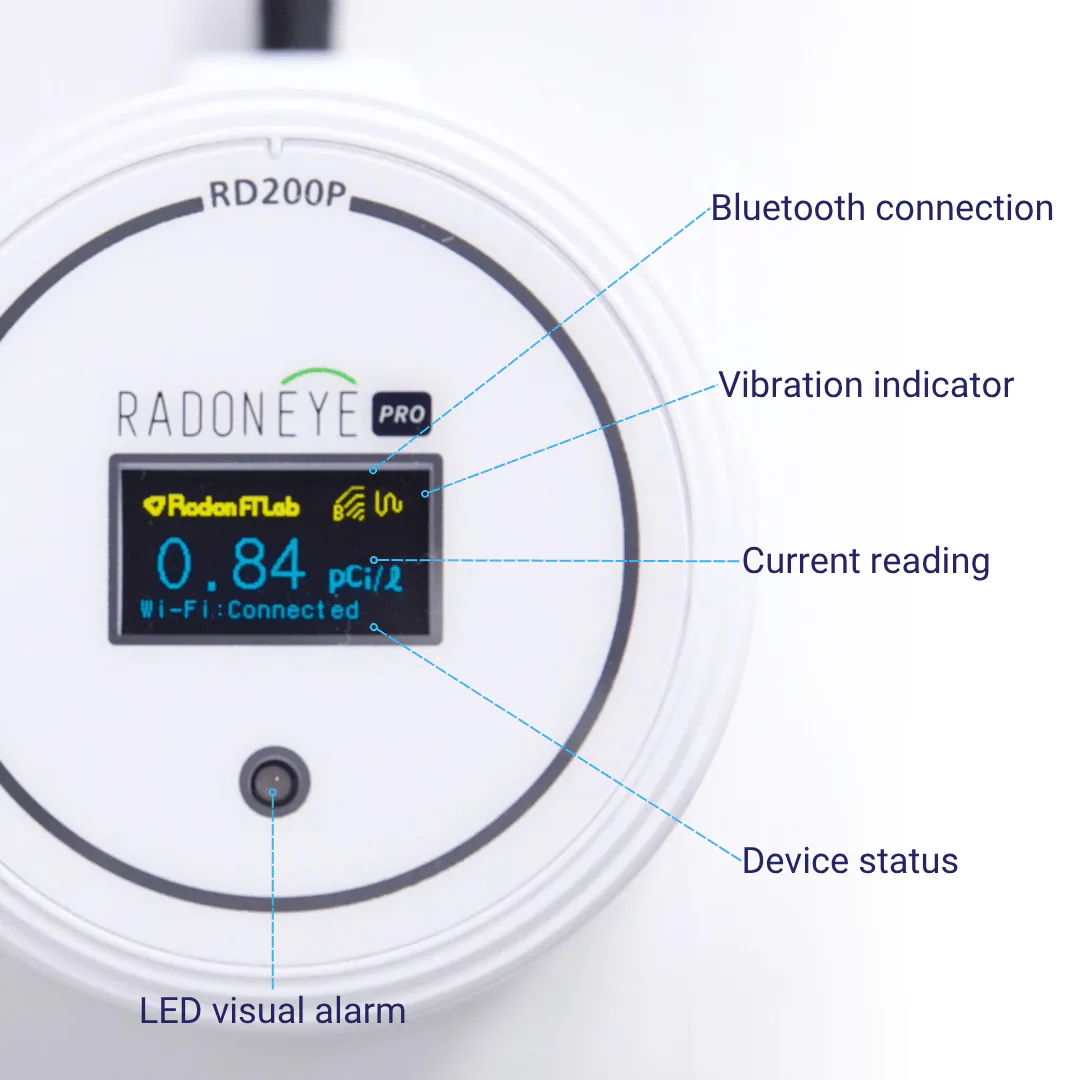
The monitor measures every 10 minutes and reports a 60-minute moving average. Ecosense's brochure gives the first reliable data within an hour, and its guide says the screen reads READY about an hour after power-on, when it is ready to start collecting and saving data. The 0.96-inch OLED screen shows the status, an average for the first 24 hours, a 30-day average once 30 days have passed, the time since power-on and the alpha counts; the guide notes that these on-screen figures reset whenever the monitor is switched off and on, while the measurements stay saved in the app and the device's memory. Radon units (pCi/L or Bq/m³), temperature units, beeps and an alarm threshold are set in the app, and the screen can be turned off during a test.
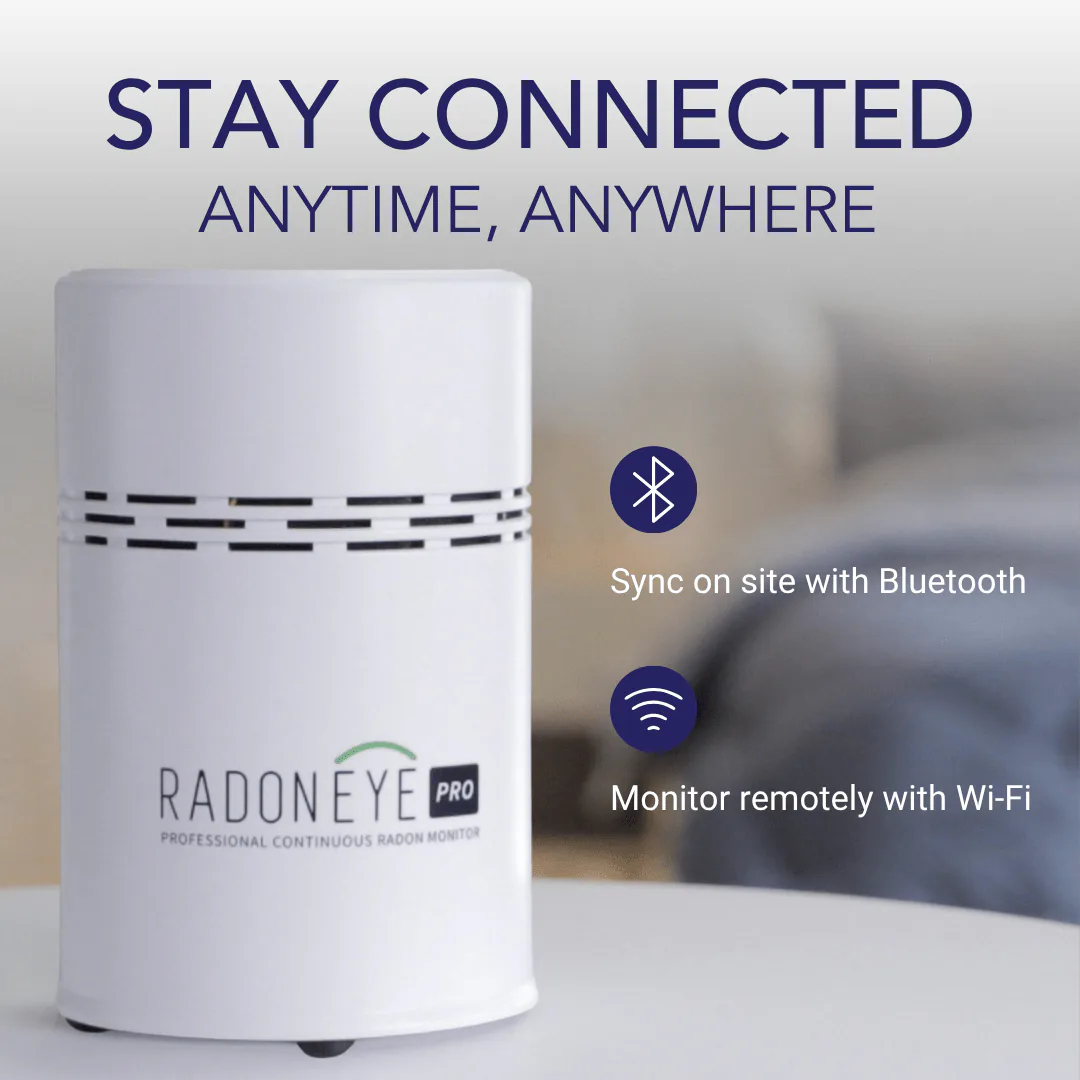
Tests are run from the RadonEye Pro app. A technician pairs the monitor over Bluetooth, starts a New Inspection with a delay and a duration, and later finishes it, again over Bluetooth: Ecosense's guide says an inspection cannot be started or finished remotely. Wi-Fi is optional and adds real-time data and automatic upload to Ecosense's cloud. The app asks for at least 46 valid hourly data points after the first 4 hours are discarded (44 in Illinois), which Ecosense says a 4-hour delay and a 48-hour test meet, as does a test of at least 50 hours with no delay. The monitor also records temperature and humidity, and an accelerometer time-stamps any tampering in the raw data and the app.
The report is the other half of the system. Ecosense says the app and web dashboard produce a standard report or one built to ANSI/AARST requirements, and its update of November 2022 describes a template that meets the MAH-2019 report requirements, pre-configured templates an administrator sets up for technicians, state reporting details filled in from the test location, and a reminder 30 days before calibration is due. Ecosense's sample report lists the device as FTLab and RD200P, with its serial number and calibration date, the tester's certification or state licence number, a duplicate device for QA, the overall average and the hourly readings. The web dashboard lets an administrator register devices, invite employees and put the company name and logo on every report.
Data is kept in two ways. Ecosense's brochure gives an inspection mode that holds up to 240 hours across 10 inspections (2,400 data points) and a continuous mode that holds 300 days (7,200 data points). Its product page says there is no reset function and that the oldest data is overwritten once storage is full, while the guide says to delete old inspection files once 10 are stored before starting a new one. Reports and raw data are saved in the app and, with an internet connection, on the web dashboard.
Two independent programs list the RadonEye Pro by its model number. The National Radon Safety Board's list of approved radon measurement devices, dated July 2026, includes the FT Lab/Ecosense RadonEye Pro RD200P as continuous radon monitor 31827; NRSB adds that approving a device does not imply accreditation or certification of its maker. C-NRPP, the Canadian program, names the Ecosense RadonEye PRO RD200P on its list of approved professional-grade electronic radon monitors, which it describes as different from consumer-grade monitors.
What the manufacturer says
Ecosense's own statements, attributed
- Ecosense saysEcosense describes the RadonEye Pro as an NRPP/NRSB-certified continuous radon monitor designed specifically for professionals.
- Ecosense saysEcosense states a radon sensitivity 15 times the U.S. standard, and lists 30 counts per hour per pCi/L.
- Ecosense saysEcosense's brochure gives an accuracy, after 10 hours and at a 95% confidence interval, of under ±10% with a minimum error under ±0.5 pCi/L, and a precision of under ±10% at 10 pCi/L.
- Ecosense saysEcosense says its calibration is done in its own NRPP-certified radon chamber, and that its calibration center updates the firmware when an update is available.
- Ecosense saysEcosense says it includes free NRPP device-specific training for the RadonEye Pro, available on demand.
These are Ecosense's own statements, attributed to it. They are not our findings, and we have not tested this product ourselves.
Independent evidence
Who checks a device like this
C-NRPP's 2024/25 evaluation compared consumer monitors, not professional devices, so it has no result for Ecosense RadonEye Pro. A professional device is checked by calibration instead: the maker's certification and calibration statements are under “What the manufacturer says”, and a tester can show you the device's current calibration certificate.
Specifications
Specifications
Every figure as the maker states it
The maker's figures
- Type
- Continuous monitor, professional, pulsed ionization chamber, OLED display, 12 V adapter or external battery pack
- How it measures
- Pulsed ionization chamber
- First reading
- Within 1 hour
- Reading updates
- Every 10 minutes; reports a 60-minute moving average
- Display and app
- Built-in display, phone app, Bluetooth, Wi-Fi
- Power
- Plug-in: 12V, 1A DC adapter (power consumption 12V DC, 100mA); no battery back-up; runs from a 5-volt battery pack through the included step-up cable, about 72 hours on 20 Ah or 105 hours on 30 Ah
- Units
- pCi/L or Bq/m³, chosen in the app
What is in the box
Ecosense's product page lists the device, a protective carrying case, the 12V power adapter, an extension cable, a step-up cable, a battery pouch (battery sold separately), a tripod holder and a calibration certificate, plus the free mobile app and dashboard. The brochure's list adds a quick guide manual, and Ecosense's answer on the same page says the tripod and the portable battery are not included. Ecosense gives the size as 2.83 by 2.83 by 2.44 inches on its product page and as 80 mm across by 120 mm in its brochure, and the weight as 240 g (0.529 lb) in both.
The product page shows a 1 Year Warranty. Ecosense's warranty page gives a limited warranty of twelve months from purchase or delivery, for the original purchaser only, on products bought from Ecosense or an authorized seller, and says it applies to both consumer and commercial products; the same page lists products used for commercial purposes among its exclusions, so a professional buyer may want to ask Ecosense how that applies. For returns, Ecosense's product page offers returns within 30 days of purchase, and its return policy adds a restocking fee of 15% for items that have been opened and used.
What it costs to run
The recurring cost is calibration, and the time the monitor spends away for it. Ecosense's own calibration center in Irvine, California, which serves U.S. customers, gives a turnaround of about 7 to 10 business days and returns the monitor with a new 12-month calibration certificate. Ecosense says it updates the firmware during calibration when an update is available, offers discounts for several devices and charges return shipping separately. A business with a single monitor may want a second one, or a booking gap, for that week or two.
Power is the other cost. The monitor has no battery back-up, so field use away from an outlet needs a 5-volt battery pack, which is sold separately; the runtimes Ecosense gives are in the questions below. Ecosense describes the app and the web dashboard as free, and sells replacement carrying bags, tripod holders, extension cables, step-up cables and power adapters, some of them for the U.S. only.
Fit and setup
Who it fits, and how to use it
The fit, then setup and placement as the guidance asks
Who it fits
Good fit if, and look elsewhere if
Good fit if
- You test homes for clients and want the monitor's own app to produce an ANSI/AARST-style report.
- You run a testing company and want one web dashboard for devices, technicians and report templates.
- You test where there is an outlet, or carry a battery pack, and want a small, light monitor on a tripod.
- You want Wi-Fi to watch a test from elsewhere, while still starting and finishing it on site over Bluetooth.
Look elsewhere if
- You want to watch radon in your own home; a consumer monitor is built for that, and C-NRPP evaluates those.
- You need a monitor that runs on its own batteries; Ecosense says the RadonEye Pro has no battery back-up.
- You do not want to plan for yearly calibration, which Ecosense says the RadonEye Pro requires.
- You need a result for a home sale but are not a certified tester; hire a radon measurement professional.
Setup and placement
3 steps
- Plug the monitor into the 12-volt adapter, or a battery pack through the step-up cable. Ecosense's guide says the light flashes green and red while it starts, the screen shows the serial number and then READY once it is initialized, and that the app should be downloaded and an account created first; the account details fill in the report. To work where there is no cellular or Wi-Fi network, Ecosense says to install the app, log in and register the device to the tester's account before going to the site, stay logged in, and start and finish the inspection over Bluetooth.
- The RadonEye Pro comes with a tripod holder that fits most standard tripods; the tripod itself is not included. Ecosense's brochure gives an operating range of 0 to 40 °C (32 to 104 °F) and relative humidity under 80%. Its guide covers the device and the app rather than where to put the monitor; a professional test follows the protocol required where it takes place, and C-NRPP's professional device page defines a short-term radon test as one lasting at least 48 hours but less than 3 months.
- For a homeowner, the EPA's general guidance for a home test is the lowest lived-in level of the home, at least 20 inches above the floor, away from drafts, high heat, high humidity and exterior walls. The EPA says to fix a home at 4 pCi/L or more and to consider fixing between 2 and 4 pCi/L. The questions worth asking a tester are which device they use, when it was last calibrated, and which protocol they follow.
For where any radon test or monitor should sit in a home, see where to place a radon test.
Compare
Compare with similar items
The same three rows for each, and the one difference that matters
This page
Ecosense RadonEye Pro
- How it measures
- Ion chamber
- Power
- Plug-in
- C-NRPP 2024/25
- Not evaluated (professional device)
This page: The Ecosense RadonEye Pro (SKU RD200P) is a continuous radon monitor for radon testers and home inspectors: a pulsed ionization chamber in a small cylinder with an OLED display, run from a 12-volt adapter or a battery pack, and set up, finished and turned into a client report from Ecosense's app or web dashboard.
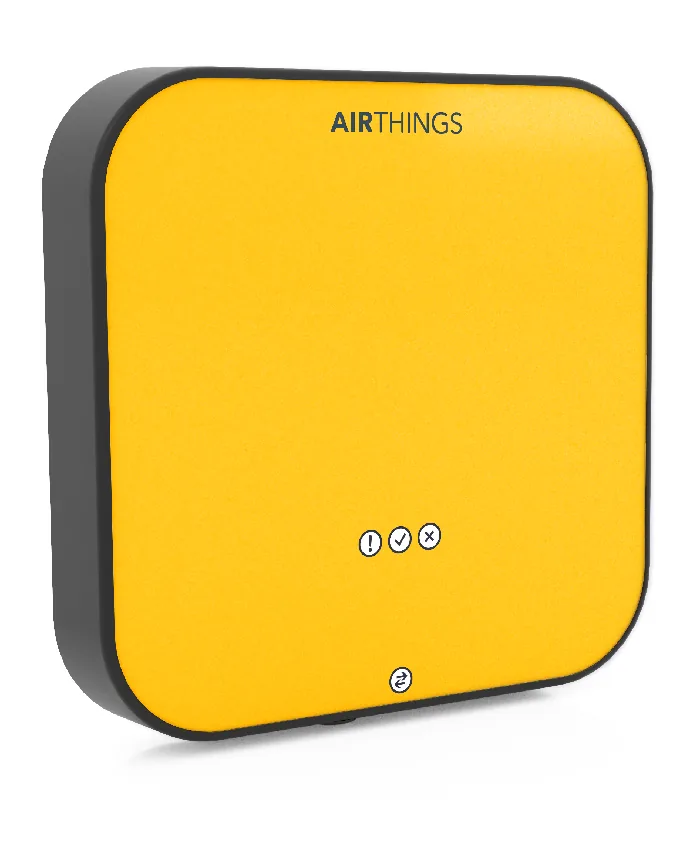
Airthings
- How it measures
- Alpha spectrometry
- Power
- Battery
- C-NRPP 2024/25
- Not evaluated (professional device)
The difference: Airthings' professional monitor: 4 radon chambers read by alpha spectrometry, status lights and no on/off button, about 15 months on 3 AA alkaline batteries, and tests run from the Corentium Pro app and online Pro Dashboard.
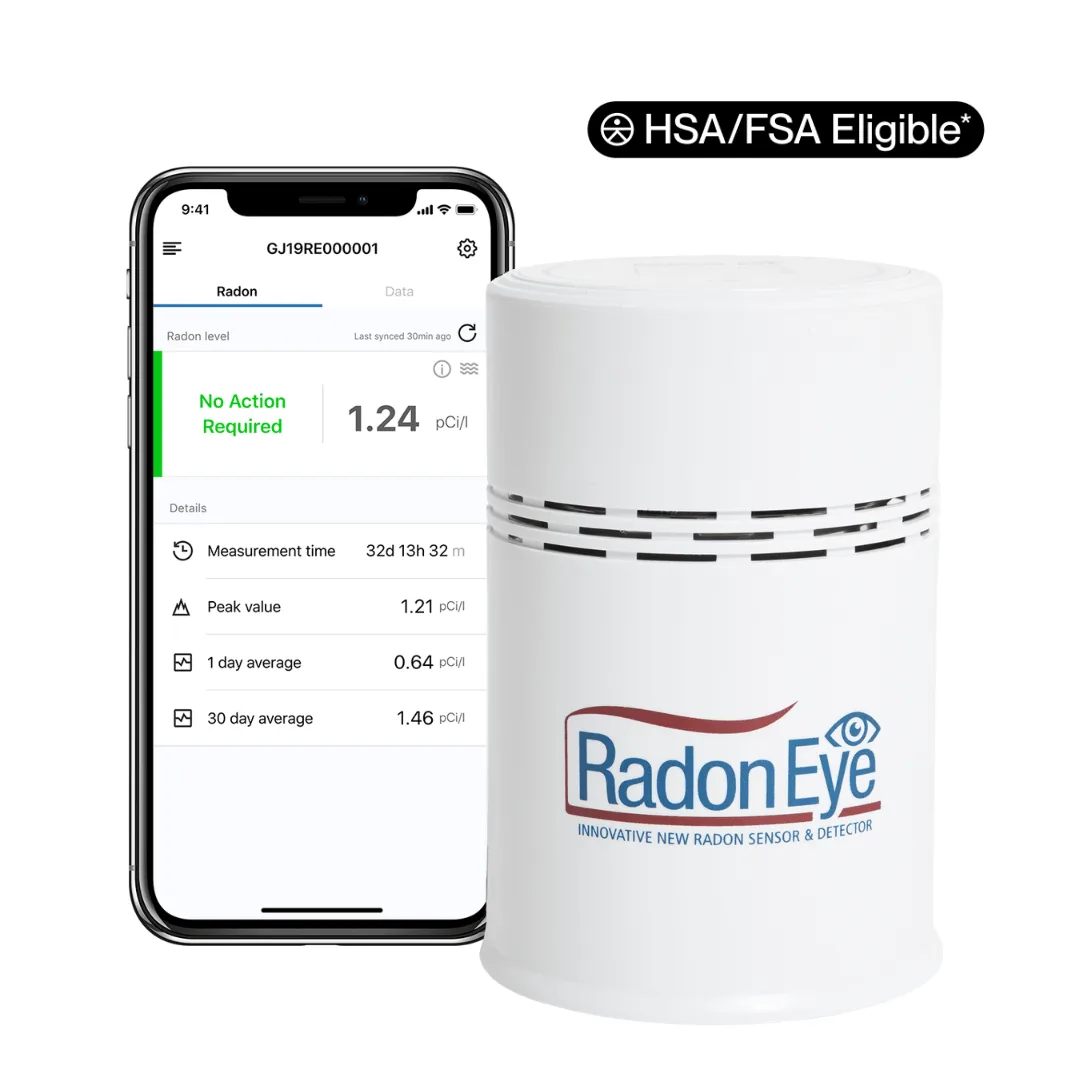
Ecosense
- How it measures
- Ion chamber
- Power
- Plug-in
- C-NRPP 2024/25
- Approved
The difference: Ecosense's plug-in household monitor with the same kind of pulsed ionization chamber: a Bluetooth app for watching one home, results updated every 10 minutes and a first reading in 10 minutes; approved in C-NRPP's 2024/25 consumer evaluation.
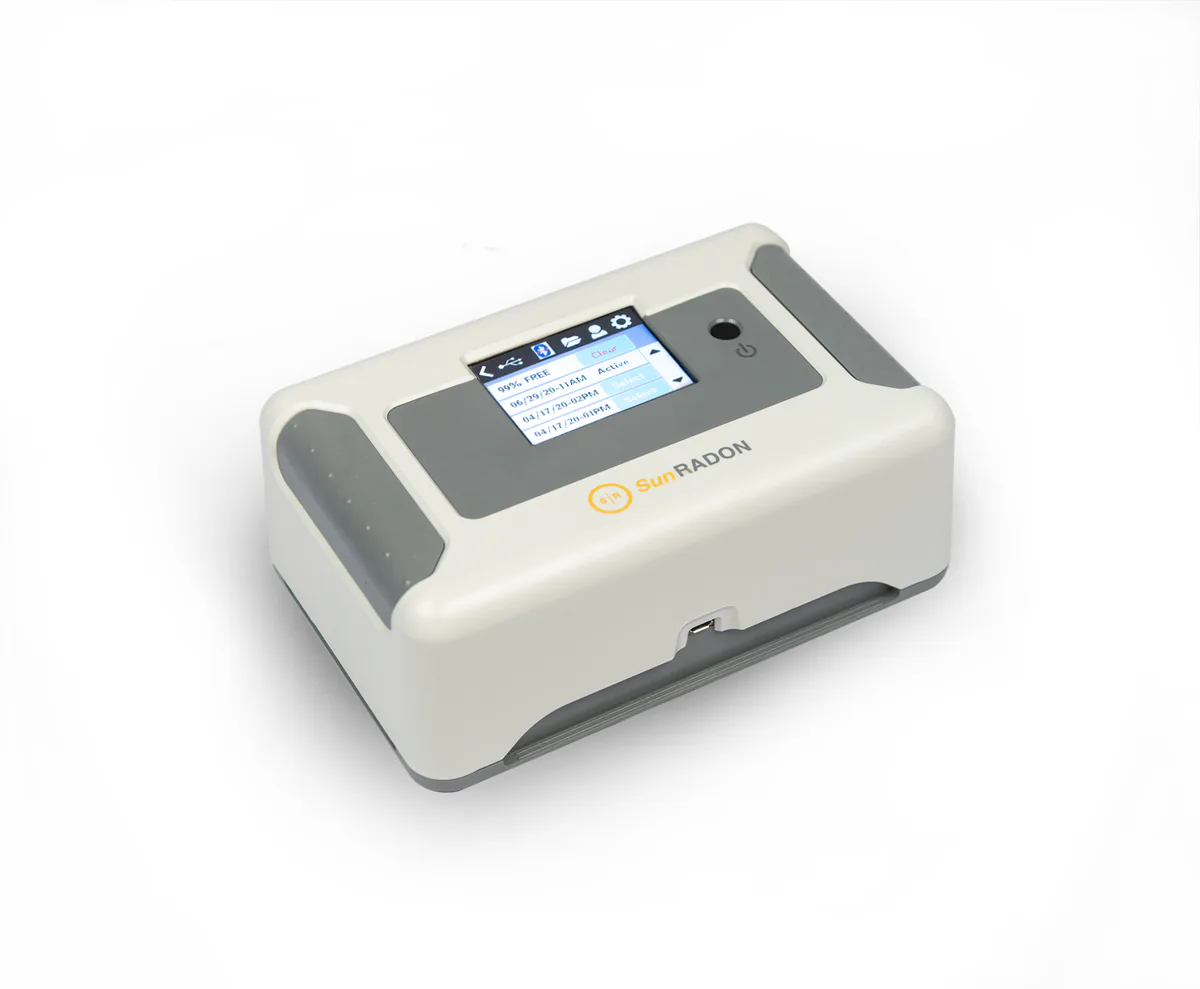
SunRADON
- How it measures
- Solid state photodiode detector
- Power
- Battery
- C-NRPP 2024/25
- Not evaluated (professional device)
The difference: SunRADON's professional monitor, formerly the Model 1028 XP: a solid-state photodiode detector, a 2.8-inch color touchscreen, Bluetooth and USB-C to its OneRADON software, and four AA batteries for up to 300 hours.
Compared with similar products: 1 of 4
More professional radon monitors3
All professional radon monitors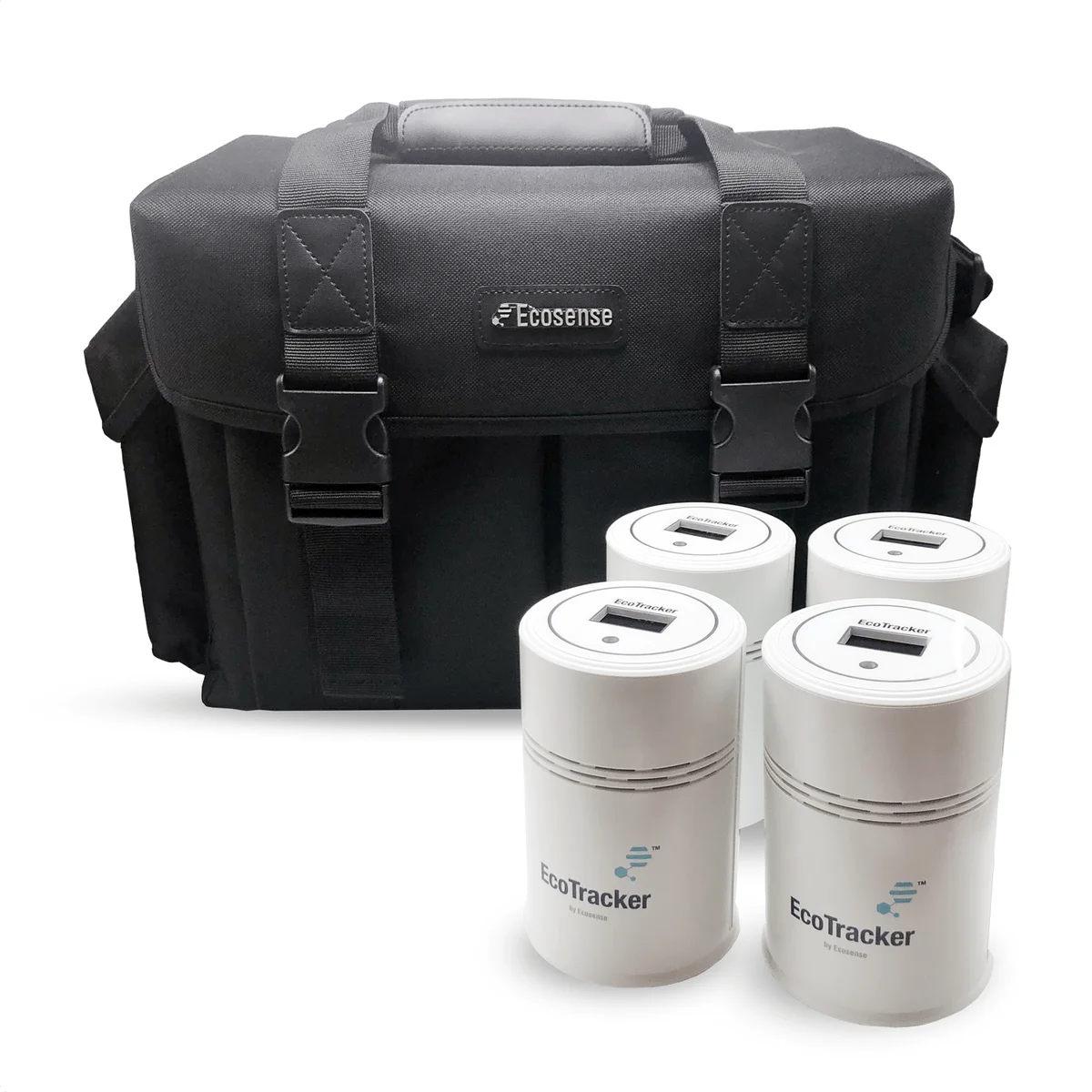
Pro monitor
EcoTracker four-monitor radon diagnostic set for mitigators
- Plug-in
- Bluetooth
- Alarm
- Screen, app
First reading: Within 5 minutes
- All professional radon monitorsMore professional radon monitors


More professional radon monitors: 1 of 3
Questions
Questions people ask
6 questions about the Ecosense RadonEye Pro, answered
Asked about the RadonEye Pro
Is the RadonEye Pro the same as the RD200P?
Yes. Ecosense's own store record gives the RadonEye Pro the SKU RD200P, its sample report names the device as FTLab and RD200P, and the National Radon Safety Board and C-NRPP list it as the RadonEye Pro RD200P. The household RadonEye is a different monitor, the RD200, which C-NRPP lists among consumer monitors.
Who is the RadonEye Pro for?
Radon testing professionals and home inspectors. Ecosense describes it as designed specifically for professionals, built around an app that starts and finishes inspections and a dashboard that holds a company's devices, staff and reports. Owning one does not make a test official: a real-estate test depends on the tester's certification, the device's calibration and the protocol required where the test takes place.
How often does the RadonEye Pro need calibration?
Once a year. Ecosense's guide ties the yearly recalibration to NRPP, NRSB and provincial rules, and C-NRPP says professional-grade devices need to be calibrated annually by the manufacturer. In the U.S., Ecosense points to its own calibration center or to Bowser-Morner and Kansas State University as authorized partners; in Canada, to the Radiation Safety Institute of Canada.
Can the RadonEye Pro run on batteries?
Only from an external pack. Ecosense says it has no battery back-up and needs a 12-volt input, and that a standard 5-volt battery pack works through the included step-up cable: about 72 hours on a 20 Ah pack and about 105 hours on a 30 Ah pack. The battery pouch is in the box; the battery is not.
Does the RadonEye Pro need Wi-Fi?
No. Bluetooth does the on-site work and Wi-Fi is an extra for watching a test from elsewhere. Because an inspection is always started and finished over Bluetooth, Wi-Fi saves no trips; it only lets the technician see readings between them.
Is the warranty valid if I buy the RadonEye Pro on Amazon?
Ecosense's limited warranty covers products bought directly from Ecosense or from an Ecosense authorized seller, for the original purchaser, and Ecosense reserves the right to deny claims for products bought from unauthorized sellers. A valid proof of purchase is required. Check that the seller is one Ecosense authorizes before buying.
What to do next
- See how professional monitors differCalibration, test protocols and reports, and the devices testers use.
- Hire a testerFind radon measurement professionals in our directory.
- Monitor your own homeConsumer monitors, each with its independent evidence.
- Read your resultWhat a number in pCi/L means and what the EPA says to do next.
Updated October 8, 2026