 RadonAway
 Air Flow Alarm
Battery radon system air flow alarm
- System indicator
- Battery air flow alarm
- Air Flow Alarm
Best for, and skip if
Best for you if
- Your system's pipe is 3 or 4 inches, the sizes RadonAway lists for this alarm.
- There is no outlet near the pipe; RadonAway lists the alarm as battery operated, and its sheet rates the battery at 5 years.
Skip it if
- Your pipe is 2 or 6 inches; RadonAway lists this alarm for 3 or 4 inch pipe, and its RSA1 for 2 to 6 inch pipe or a wall.
- Your system moves very little air, as a high-suction fan can; the alarm acts at 10 CFM in a 3 inch pipe and 15 CFM in a 4 inch pipe.
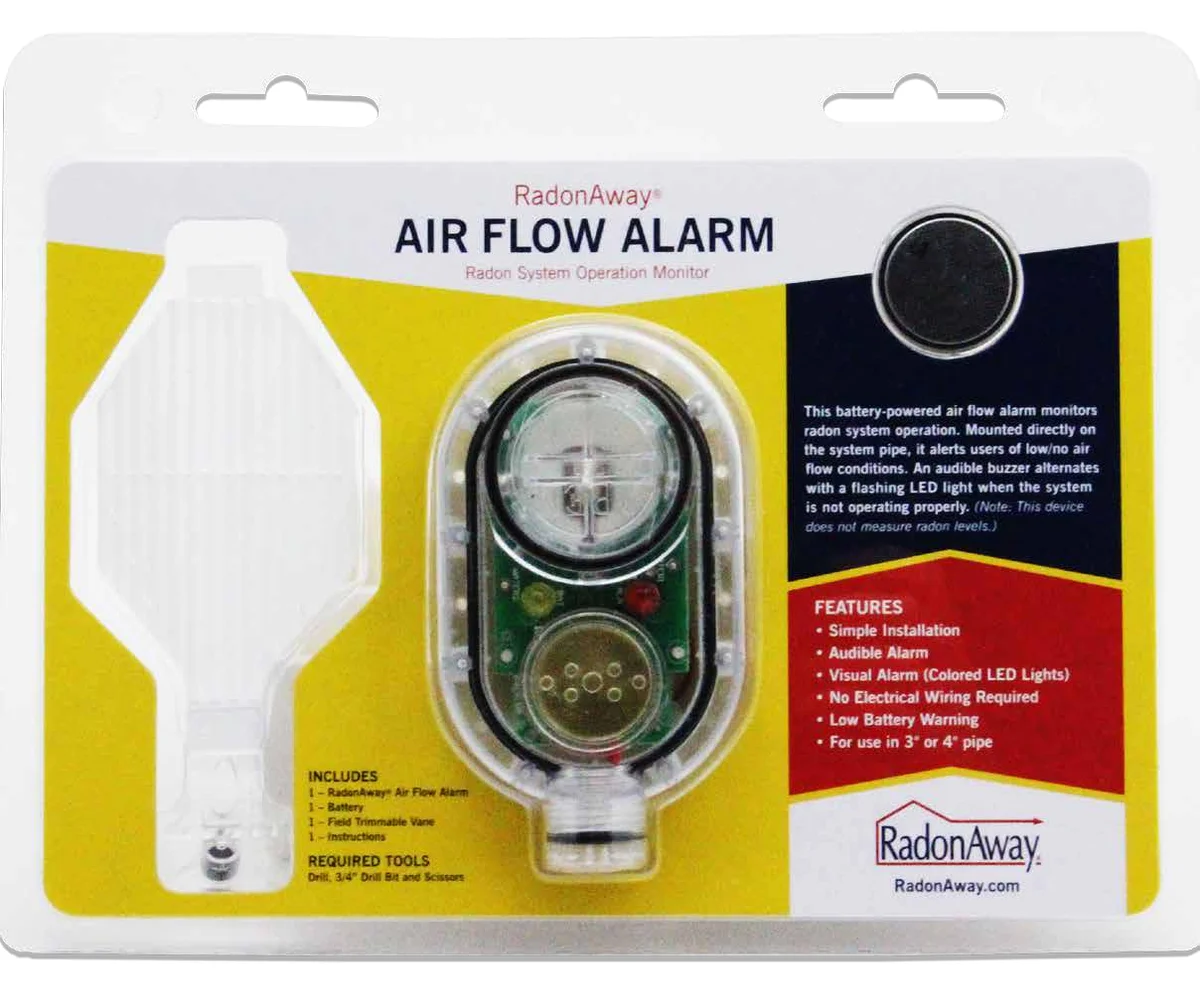
Photos: RadonAway
 (opens in a new tab)Check price on Amazon (opens in a new tab)

As an Amazon Associate, Radon411 earns from qualifying purchases.
Amazon and the Amazon logo are trademarks of Amazon.com, Inc. or its affiliates.
See ratings and reviews on Amazon (opens in a new tab)- Made ofBattery air flow alarm
- PackageAir Flow Alarm
- Every figure checked against the specifications RadonAway publishes
- The maker's own figures and limits, shown the same way for every part, unranked
About this item
As RadonAway states it
- What it reads: Air flow in the radon system's pipe, sensed by a thin, field-trimmable vane installed within the pipe; does not measure radon
- Range: Actuation point 15 CFM (4" pipe) / 10 CFM (3" pipe) on decrease in flow; for 3" or 4" pipe
- Made of: Battery air flow alarm: audible buzzer of at least 85 dB at 1 foot, red LED no-flow alarm, yellow LED low battery; wetted materials ABS, polycarbonate and a rare earth magnet; 4 oz (113.4 g)
- Package: Air Flow Alarm, battery, field trimmable vane, installation instructions and alarm information sticker
The Air Flow Alarm is RadonAway's battery-powered alarm for a radon mitigation system: it mounts directly on a 3 or 4 inch system pipe and watches the air moving up it with a thin vane that sits inside the pipe. RadonAway says it alerts with an audible buzzer alternating with a flashing red light when the flow drops to a low or no air flow condition, which its sheet puts at 10 CFM in a 3 inch pipe and 15 CFM in a 4 inch pipe. It reports on the fan and the pipe: RadonAway says it does not measure radon levels.
What you get
RadonAway lists the package as the Air Flow Alarm, a battery, a field-trimmable vane, installation instructions and an alarm information sticker; its 2023/2024 catalog gives the same contents for P/N 28421 and says it provides audible and visual alerts to low air flow conditions.
In the box and running costsHow it works
What it does and how
What it is made of and the job it does in a system, then who has checked it
How it works
In our words, from the maker's documents
Most radon system alarms watch suction, the vacuum the fan pulls in the pipe. This one watches movement. RadonAway says the alarm mounts directly onto the system pipe and alerts the homeowner of a low or no air flow condition through a thin, field-trimmable vane installed within the pipe; its 2023/2024 catalog says the vane senses the air flow rate. Field-trimmable means it is cut to fit on site, and RadonAway sells a replacement vane, P/N 28610.
The trip point is a flow, not a pressure. RadonAway's page says the alarm operates in air flow as low as 10 CFM in a 3 inch pipe and 15 CFM in a 4 inch pipe, and its sheet gives the same figures as the actuation point on a decrease in flow. When the flow falls that far, an audible buzzer alternates with a bright, flashing red LED; a yellow LED warns of a low battery. The sheet rates the buzzer at no less than 85 dB at 1 foot.
Air flow and suction move in opposite directions on a fan curve, which is worth knowing before you choose this kind of alarm. RadonAway's own performance table for its high-suction GP301c fan, for example, gives 64 CFM at 1.0 inch of water column and 4 CFM at 2.5 inches. A system that normally runs near the alarm's 10 or 15 CFM actuation point would leave it little margin; ask your installer what your system moves.
It is the active half of a pair. Minnesota's health department requires every radon mitigation system to have two fan monitors, a U-tube manometer and an active notification monitor, the kind that alerts you with a visual light and/or audible noise if the system stops working. RadonAway's fan instructions list the Air Flow Alarm by its part number, 28421, among the audible alarms that can serve as the required system monitor.
What it cannot do is the point most worth keeping, and it is why this is a system alarm, not a radon alarm. A radon alarm, built into some digital monitors, sounds at a radon reading; this one sounds when the air stops moving. RadonAway's page and sheet both say the monitor does not measure radon levels, and Minnesota says the same of a U-tube gauge, which shows suction in the pipe. Air moving up the pipe means the fan is working; only a radon test shows the level in the home.
What the manufacturer says
RadonAway's own statements, attributed
- RadonAway saysRadonAway describes its battery-powered air flow alarm as ideal for monitoring radon mitigation systems.
- RadonAway saysRadonAway states the alarm operates in air flow as low as 10 CFM in a 3 inch pipe and 15 CFM in a 4 inch pipe.
- RadonAway saysRadonAway lists the features as easy installation (indoor use only), use on 3 or 4 inch pipe, battery operation, a red LED visual alarm, an audible alarm and a yellow LED low battery warning.
- RadonAway saysRadonAway's sheet gives a battery life of 5 years steady state and 48 hours during an alarm condition, from a lithium CR2450 battery.
- RadonAway saysRadonAway's sheet specifies temperature limits of 32 to 122°F (0 to 50°C) and lists corrosive environments under its application limits.
These are RadonAway's own statements, attributed to it. They are not our findings, and we have not tested this product ourselves.
Independent evidence
Who checks a device like this
C-NRPP's consumer evaluation covers electronic radon monitors, not the parts of a mitigation system, so it has no result for RadonAway Air Flow Alarm. The standards and results the maker states are under “What the manufacturer says”, and what shows whether radon in your home is lower is a radon test after the work is done.
RadonAway Air Flow Alarm
Check price on Amazon (opens in a new tab)Specifications
Specifications
Every figure as the maker states it
The maker's figures
- Type
- System indicator, Battery radon system air flow alarm with a vane in the pipe
- What it reads
- Air flow in the radon system's pipe, sensed by a thin, field-trimmable vane installed within the pipe; does not measure radon
- Range
- Actuation point 15 CFM (4" pipe) / 10 CFM (3" pipe) on decrease in flow; for 3" or 4" pipe
- Made of
- Battery air flow alarm: audible buzzer of at least 85 dB at 1 foot, red LED no-flow alarm, yellow LED low battery; wetted materials ABS, polycarbonate and a rare earth magnet; 4 oz (113.4 g)
- Package
- Air Flow Alarm, battery, field trimmable vane, installation instructions and alarm information sticker
- Warranty
- Not stated by the manufacturer
What is in the box
RadonAway lists the package as the Air Flow Alarm, a battery, a field-trimmable vane, installation instructions and an alarm information sticker; its 2023/2024 catalog gives the same contents for P/N 28421 and says it provides audible and visual alerts to low air flow conditions.
RadonAway's sheet adds the figures: wetted materials of ABS, polycarbonate and a rare earth magnet, a lithium CR2450 battery, and a weight of 4 oz (113.4 g). Neither the page nor the sheet states a warranty for the alarm; the five-year line on RadonAway's trade pages is about its fans. RadonAway's retail page names Lowes, Home Depot, Menards and Amazon as retail outlets for a limited line of its products, without saying which.
What it costs to run
The running cost is the battery and, now and then, a vane. RadonAway's sheet gives the CR2450 battery a life of 5 years steady state but 48 hours during an alarm condition, so an alarm that goes off while no one is home may be silent again within two days; a yellow light warns of a low battery before then. A replacement vane is P/N 28610, which RadonAway's catalog says is field trimmable and senses the air flow rate.
The fan it watches runs all the time: the EPA says the fan should never be turned off and that fans may last for five years or more. Minnesota asks that the active monitor's power source be checked monthly, since it could be plugged in or use batteries.
The ongoing cost is testing. The EPA says it is a good idea to retest your home at least every two years, and RadonAway's fan instructions call for a system label that tells the occupants regular radon tests are needed. An alarm that stays quiet does not replace those tests.
Fit and setup
Who it fits, and installation
The fit, then how it goes on and what the standards ask
Who it fits
Good fit if, and look elsewhere if
Good fit if
- Your system's pipe is 3 or 4 inches, the sizes RadonAway lists for this alarm.
- There is no outlet near the pipe; RadonAway lists the alarm as battery operated, and its sheet rates the battery at 5 years.
- Your system has a U-tube gauge and no alarm, and you want the active monitor Minnesota requires beside it.
- Your installer confirms the system moves well over 10 CFM in a 3 inch pipe or 15 CFM in a 4 inch pipe.
Look elsewhere if
- Your pipe is 2 or 6 inches; RadonAway lists this alarm for 3 or 4 inch pipe, and its RSA1 for 2 to 6 inch pipe or a wall.
- Your system moves very little air, as a high-suction fan can; the alarm acts at 10 CFM in a 3 inch pipe and 15 CFM in a 4 inch pipe.
- The pipe runs through an unheated attic or outdoors; RadonAway says indoor use only, and its sheet gives limits of 32 to 122°F.
- You want to know your radon level; the alarm reports on air flow, and only a radon test shows radon.
Installation
3 steps
- RadonAway's product page links a specification sheet and an installation video, and the package includes printed installation instructions and an alarm information sticker; the page does not post the installation sheet itself, so the hole size and the way the vane is trimmed come from the instructions in the box. What RadonAway does state: the alarm mounts directly onto the system pipe, 3 or 4 inch, for indoor use only, with the vane inside the pipe. Its sheet gives temperature limits of 32 to 122°F (0 to 50°C) and lists corrosive environments among its application limits.
- Where it goes matters as much as how. The EPA's 1994 Radon Mitigation Standards say every active system needs a mechanism to monitor system performance and warn of failure, simple to read and placed where occupants can easily see or hear it. The EPA's consumer guide says the warning device must be placed where it can be seen or heard easily and recommends a qualified radon mitigation contractor for the system itself, and RadonAway's retail page says that installing a radon fan or system yourself is not intended to take the place of installation by a qualified radon professional.
- RadonAway's fan instructions ask the installer to verify the system vacuum with a manometer, to keep it within the normal operating range and below the fan's maximum recommended operating pressure, and to place a system label where the occupants can see it. Minnesota adds two checks that apply to a battery alarm in particular: the active monitor's power source should be checked monthly, and both fan monitors should be checked monthly to make sure the system is working.
For how the sealing, the gauge and the fan work together, see radon mitigation systems, and to find someone to design and install one, radon mitigation professionals.
Compare
Compare with similar items
The same three rows for each, and the one difference that matters
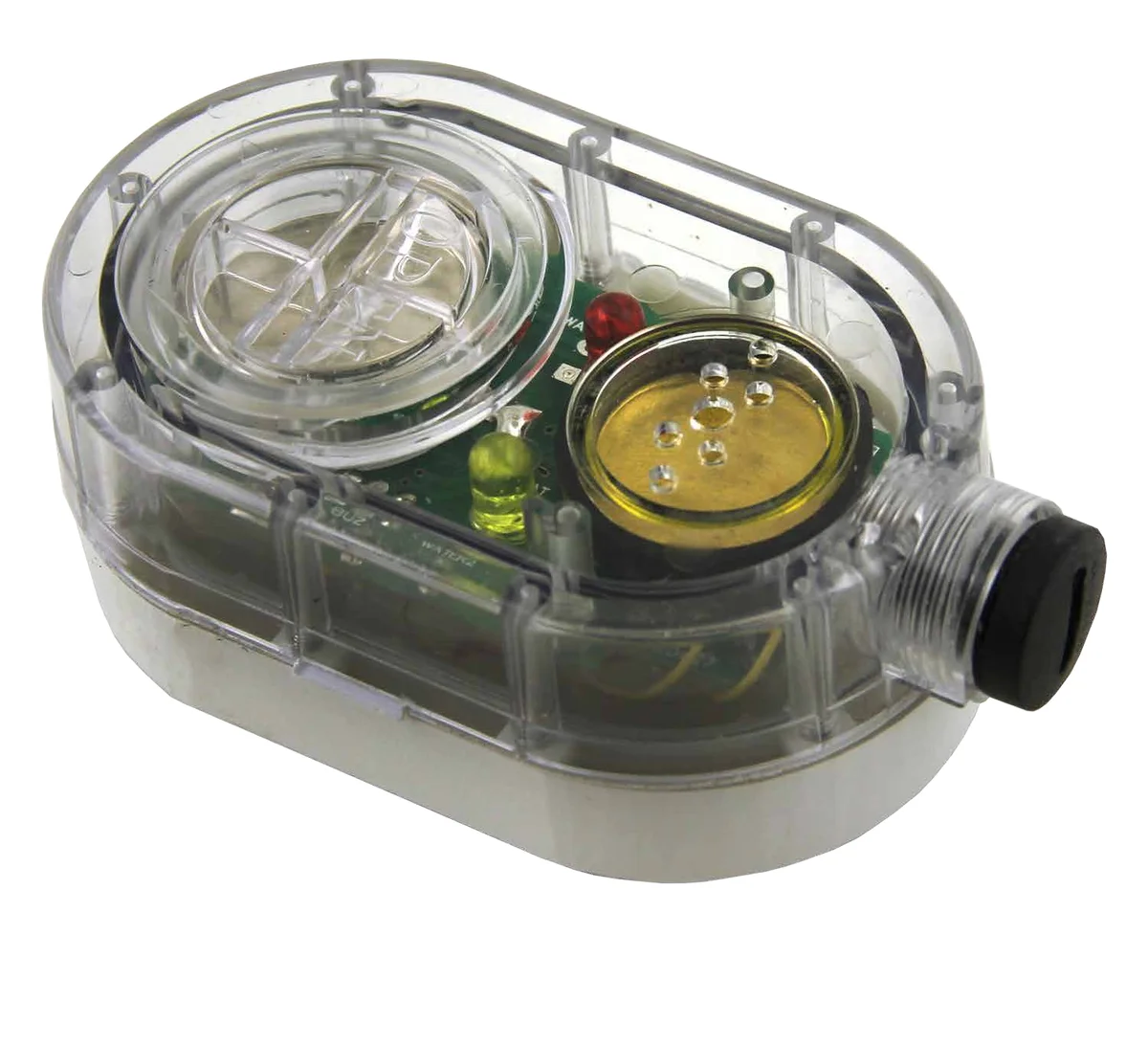
This page
RadonAway Air Flow Alarm
- What it is
- Battery air flow alarm
- Power
- Not stated
- C-NRPP 2024/25
- Not applicable (system part)
This page: The Air Flow Alarm is RadonAway's battery-powered alarm for a radon mitigation system: it mounts directly on a 3 or 4 inch system pipe and watches the air moving up it with a thin vane that sits inside the pipe.
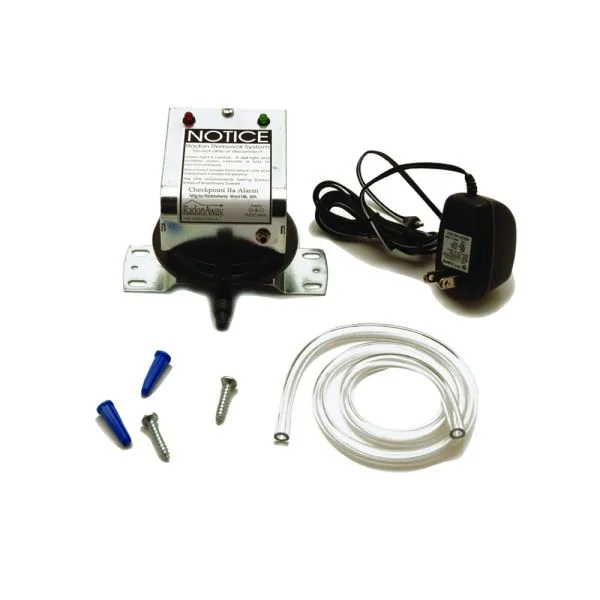
RadonAway
- What it is
- Fan alarm
- Power
- Not stated
- C-NRPP 2024/25
- Not applicable (system part)
The difference: RadonAway's plug-in vacuum alarm, with an AC to DC transformer, factory preset to activate at .25" WC vacuum pressure.
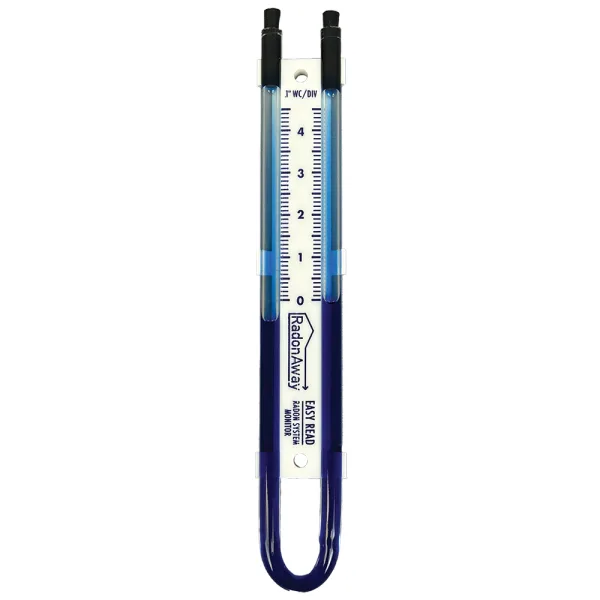
RadonAway
- What it is
- U-tube manometer with non-toxic fluid, adjustable zero and a molded scale curved to fit the system pipe
- Power
- Not stated
- C-NRPP 2024/25
- Not applicable (system part)
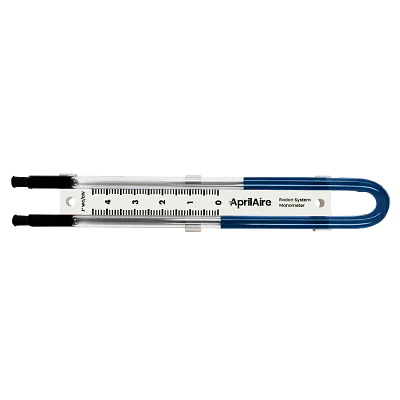
The difference: RadonAway's U-tube gauge, read rather than heard: 0 to 4.5" WC with non-toxic fluid and an adjustable zero.
RadonAway
- What it is
- Battery vacuum alarm
- Power
- Not stated
- C-NRPP 2024/25
- Not applicable (system part)
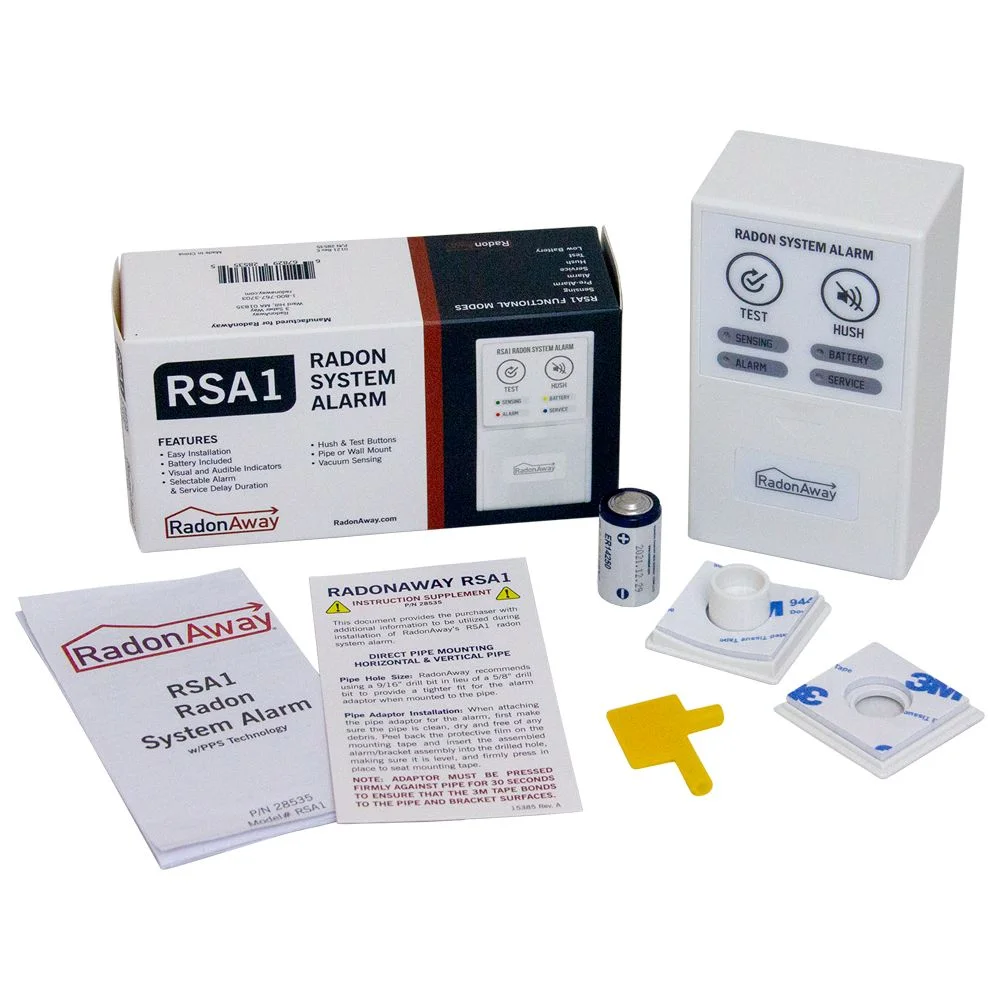
The difference: RadonAway's battery vacuum alarm for 2", 3", 4" or 6" pipe or a wall, which sets its alarm from the system's own baseline pressure and sounds after a delay of 48 hours, 7 days or 30 days.
Compared with similar products: 1 of 4
More radon manometers4
All radon manometersSystem indicator
Easy Read U-Tube Manometer U-tube radon system manometer
U-tube radon system manometer
- All radon manometers More radon manometers
More radon manometers: 1 of 4
Questions
Questions people ask
5 questions about the RadonAway Air Flow Alarm, answered
Asked about the Air Flow Alarm
Does the Air Flow Alarm detect radon?
No. RadonAway says the monitor does not measure radon levels. Its vane senses the air moving up the pipe, which tells you whether the fan is working. Only a radon test shows the level, and the EPA says it is a good idea to retest at least every two years.
When does it sound?
When the air flow in the pipe falls to RadonAway's actuation point, 10 CFM in a 3 inch pipe or 15 CFM in a 4 inch pipe, on a decrease in flow. An audible buzzer then alternates with a bright, flashing red LED. A yellow LED is the low battery warning.
How is it different from the RSA1?
Both run on a battery and sit on the pipe, but they watch different things. The Air Flow Alarm senses air flow with a vane inside a 3 or 4 inch pipe. The RSA1 senses vacuum with a pressure sensor, mounts on 2 to 6 inch pipe or on a wall with tubing, sets its alarm from the system's own baseline pressure, and shows lights only for a delay of 48 hours, 7 days or 30 days before it sounds.
Do I still need a U-tube gauge?
Minnesota requires both: every radon mitigation system needs a U-tube manometer and an active notification monitor. RadonAway's fan instructions accept either a manometer or an audible alarm as the required system monitor, and the EPA's 1994 standards ask that a manometer be marked with the range of readings the system had when it was first activated.
What should I check if it goes off?
Minnesota's checks for a system that seems to have stopped: make sure the monitor tubing is connected to the pipe and not kinked, and that power is being supplied to the fan. In cold weather it also warns of system freeze-up, ice in the pipe that stops radon venting properly; then the U-tube fluid will be even and the active monitor should alert you. Since RadonAway rates the battery at 48 hours in an alarm condition, act on it soon. For the system itself, the EPA recommends a qualified radon mitigation contractor.
What to do next
- See how a radon system fits togetherThe suction point, the pipe, the fan, the gauge and the sealing, and what each one does.
- Find a mitigation professionalMost systems are designed and installed by one; some states require a license.
- Read a radon manometerWhat even or uneven fluid means, and what the gauge cannot tell you.
- Test after the workA short-term test afterwards shows whether radon in the home is lower.
Updated November 27, 2026