 RadonAway
 Easy Read U-Tube Manometer
U-tube radon system manometer
- System indicator
Best for, and skip if
Best for you if
- Your system's U-tube gauge is cracked, faded or missing and you want a replacement from the maker of the RP fans whose manual names it.
- Your system's normal suction sits inside 0 to 4.5 inches of water column, the range RadonAway prints for the 50017.
Skip it if
- Your system pulls more than 4.5 inches of water column; RadonAway says this gauge is not suitable above that, and lists a 0 to 6.5 inch model.
- You want to be told when the fan stops without looking; a U-tube has to be read, which is why Minnesota requires an active alarm as well.
Photos: RadonAway
 (opens in a new tab)Check price on Amazon (opens in a new tab)

As an Amazon Associate, Radon411 earns from qualifying purchases.
Amazon and the Amazon logo are trademarks of Amazon.com, Inc. or its affiliates.
See ratings and reviews on Amazon (opens in a new tab)- Every figure checked against the specifications RadonAway publishes
- The maker's own figures and limits, shown the same way for every part, unranked
About this item
As RadonAway states it
- What it reads: Suction (vacuum) in the radon system's pipe, shown by fluid levels in a U-tube; does not measure radon
- Made of: U-tube manometer with non-toxic fluid, adjustable zero and a molded scale curved to fit the system pipe
- Package: Manometer with tubing and 2 self-tap screws, installation instructions, system and component labels, a 10-page OM&M and system information document, and a clear plastic bag with twist tie
The Easy Read U-Tube Manometer is RadonAway's gauge for a radon mitigation system: a U-tube of non-toxic fluid on a molded scale that curves to fit the system's pipe and reads 0 to 4.5 inches of water column. RadonAway sells it in a packet with tubing, screws, labels and a system information document, and its fan manual names it as a system monitor. Like any U-tube gauge, it shows whether the fan is pulling suction in the pipe, not how much radon is in the home.
What you get
RadonAway lists the packet's contents: the Easy Read u-tube manometer with tubing and 2 self-tap screws, installation instructions, system and component labels, a 10-page OM&M and system information document, and a clear plastic bag with a twist tie. Radon.com's list for the same part number names the radon system information brochure, the tubing, non-toxic fluid and 2 self-tap screws, the installation instructions, and the radon system and component labels.
In the box and running costsHow it works
What it does and how
What it is made of and the job it does in a system, then who has checked it
How it works
In our words, from the maker's documents
A U-tube manometer is colored fluid in a U-shaped tube. Minnesota's health department describes how it works on a radon system: a small tube connects to a hole in the radon pipe, and the suction from the fan pulls the fluid up, so the two sides stand at different heights. Radon.com, RadonAway's homeowner store, puts the rule in plain words: if the fluid is being drawn up the tube on one side, the radon system is operating; if the fluid stays at equal levels on the left and right, the system may not be operating as it should and you may need to contact a professional.
RadonAway lists four features for the 50017: it reads 0 to 4.5 inches of water column, the fluid is non-toxic, the zero is adjustable, and the scale is molded and curved to fit the system pipe. RadonAway also states its limit: the gauge is not suitable for use with system pressures above 4.5 inches of water column. Its trade store lists a second gauge of the same name with a 0 to 6.5 inch scale (P/N 50036), and a blue gauge oil (P/N 20011) sold on its own.
RadonAway's RP Series fan instructions treat a gauge as part of the system, not an extra. Under System Monitor and Label they say a system monitor, such as a manometer (P/N 50017) or an audible alarm (P/N 28001-2), is required to notify the occupants of a fan system malfunction, and that a system label, provided with the 50017, must be placed where the occupants frequent and can see it. That label carries the installing contractor's contact details and the reminder that the occupants need regular radon tests.
What the gauge cannot do is the point most worth keeping. RadonAway's own pages say it twice: the trade page says the device does not measure radon levels, and Radon.com says it is not a radon system alarm and does not measure radon levels. Minnesota's guidance says the same of any U-tube: it shows there is suction in the pipe. A steady reading means the fan is pulling as it did when the system was set up, not that the radon level is low, which only a radon test can show.
What the manufacturer says
RadonAway's own statements, attributed
- RadonAway saysRadonAway states the Easy Read U-tube Manometer lets the homeowner know at a glance whether the radon system is operating.
- RadonAway saysRadonAway lists its features as reads 0-4.5" WC, non-toxic fluid, adjustable zero, and a molded scale curved to fit the system pipe.
- RadonAway saysRadonAway states the gauge is not suitable for use with system pressures above 4.5" WC.
- RadonAway saysRadonAway says its 10-page operation, maintenance and monitoring (OM&M) and system information document meets current AARST OM&M requirements.
- RadonAway saysRadon.com, RadonAway's homeowner store, states the manometer is an essential component within a radon mitigation system.
These are RadonAway's own statements, attributed to it. They are not our findings, and we have not tested this product ourselves.
Independent evidence
Who checks a device like this
C-NRPP's consumer evaluation covers electronic radon monitors, not the parts of a mitigation system, so it has no result for RadonAway Easy Read U-Tube Manometer. The standards and results the maker states are under “What the manufacturer says”, and what shows whether radon in your home is lower is a radon test after the work is done.
RadonAway Easy Read U-Tube Manometer
Check price on Amazon (opens in a new tab)Specifications
Specifications
Every figure as the maker states it
The maker's figures
- Type
- System indicator, U-tube manometer for a radon system's vent pipe
- What it reads
- Suction (vacuum) in the radon system's pipe, shown by fluid levels in a U-tube; does not measure radon
- Range
- Not stated by the manufacturer
- Made of
- U-tube manometer with non-toxic fluid, adjustable zero and a molded scale curved to fit the system pipe
- Package
- Manometer with tubing and 2 self-tap screws, installation instructions, system and component labels, a 10-page OM&M and system information document, and a clear plastic bag with twist tie
- Warranty
- Not stated by the manufacturer
What is in the box
RadonAway lists the packet's contents: the Easy Read u-tube manometer with tubing and 2 self-tap screws, installation instructions, system and component labels, a 10-page OM&M and system information document, and a clear plastic bag with a twist tie. Radon.com's list for the same part number names the radon system information brochure, the tubing, non-toxic fluid and 2 self-tap screws, the installation instructions, and the radon system and component labels.
Neither RadonAway page states a warranty for the gauge; the trade store's five-year line is about RadonAway's fans. Radon.com, RadonAway's homeowner store at 3 Saber Way in Ward Hill, Massachusetts, sells the 50017, and RadonAway's retail page says a limited line of its products is available at retail outlets.
What it costs to run
The gauge has no stated running cost: RadonAway's pages mention no batteries, power or service for it. The fluid is the one part that can need replacing, and RadonAway's trade store lists a blue U-tube gauge oil for that. What the gauge asks for is attention: the EPA says the fan should never be turned off and that fans may last for five years or more, and the gauge is how you notice when that changes.
The ongoing cost is testing. The EPA says it is a good idea to retest your home at least every two years, and the system label RadonAway provides with the 50017 tells the occupants that regular radon tests are needed. Minnesota asks for both of a system's monitors to be checked monthly.
Fit and setup
Who it fits, and installation
The fit, then how it goes on and what the standards ask
Who it fits
Good fit if, and look elsewhere if
Good fit if
- Your system's U-tube gauge is cracked, faded or missing and you want a replacement from the maker of the RP fans whose manual names it.
- Your system's normal suction sits inside 0 to 4.5 inches of water column, the range RadonAway prints for the 50017.
- Your mitigator is fitting a system and wants a liquid gauge on the pipe, one of the warning devices the EPA's guide lists.
- You want the gauge to arrive with labels and a system information document for the house records, which RadonAway packs with it.
Look elsewhere if
- Your system pulls more than 4.5 inches of water column; RadonAway says this gauge is not suitable above that, and lists a 0 to 6.5 inch model.
- You want to be told when the fan stops without looking; a U-tube has to be read, which is why Minnesota requires an active alarm as well.
- You want to know your radon level; the gauge shows suction in the pipe, and only a radon test shows radon.
- You already have a working gauge and only want an alert; an alarm such as RadonAway's Checkpoint IIA does that job.
Installation
3 steps
- RadonAway's packet holds the gauge with its tubing and two self-tap screws, installation instructions, the system and component labels, the system information document and a clear plastic bag with a twist tie for hanging that information on the system. Radon.com says the screws are to adhere the gauge to PVC pipe. Minnesota's guidance explains why the first reading matters: when a system is installed, the manometer reading is taken and written on a sticker next to the gauge, and a reading that is even, or significantly different from the one at installation, means the system may not be working properly.
- RadonAway's fan instructions ask the installer to verify the system vacuum with a manometer and to make sure it is within the normal operating range and less than the fan's maximum recommended operating pressure. If the fluid goes level later, Minnesota's first checks are that the gauge's tubing is connected to the pipe and not kinked, and that power is reaching the fan.
- The EPA's rules for any system gauge point the same way. Its 1994 Radon Mitigation Standards say every active system needs a mechanism to monitor system performance and warn of failure, simple to read and placed where occupants can easily see or hear it, and that a manometer type gauge shall be clearly marked with the range or zone of readings that existed when the system was first activated. The EPA's consumer guide says to look at your warning device, usually a manometer, on a regular basis, and recommends a qualified radon mitigation contractor for the system itself.
For how the sealing, the gauge and the fan work together, see radon mitigation systems, and to find someone to design and install one, radon mitigation professionals.
Compare
Compare with similar items
The same three rows for each, and the one difference that matters
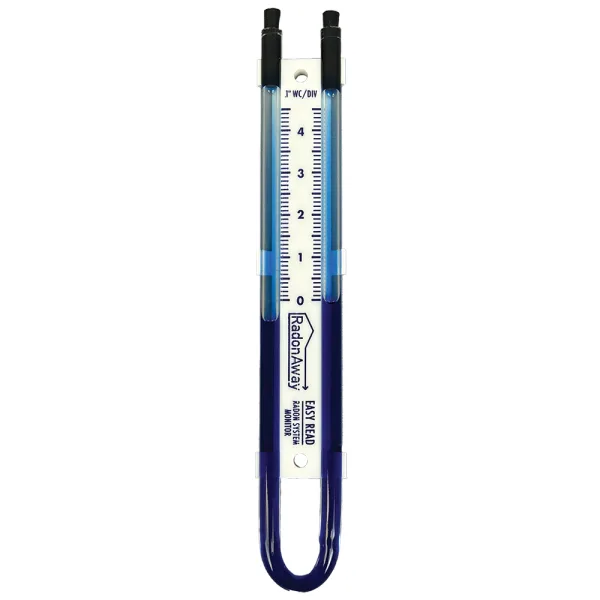
This page
RadonAway Easy Read U-Tube Manometer
- What it is
- U-tube manometer with non-toxic fluid, adjustable zero and a molded scale curved to fit the system pipe
- Power
- Not stated
- C-NRPP 2024/25
- Not applicable (system part)
This page: The Easy Read U-Tube Manometer is RadonAway's gauge for a radon mitigation system: a U-tube of non-toxic fluid on a molded scale that curves to fit the system's pipe and reads 0 to 4.5 inches of water column.
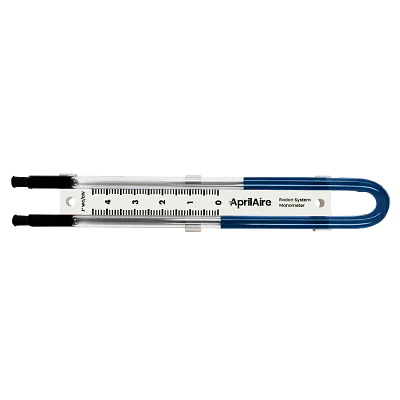
AprilAire
- What it is
- Passive U-tube manometer
- Power
- Not stated
- C-NRPP 2024/25
- Not applicable (system part)
The difference: AprilAire's U-tube gauge, which AprilAire says mounts to the outside of the PVC pipe and measures vacuum pressure in real time, and which it packs in its ARN15K, ARN25K and ARNHPK kits.
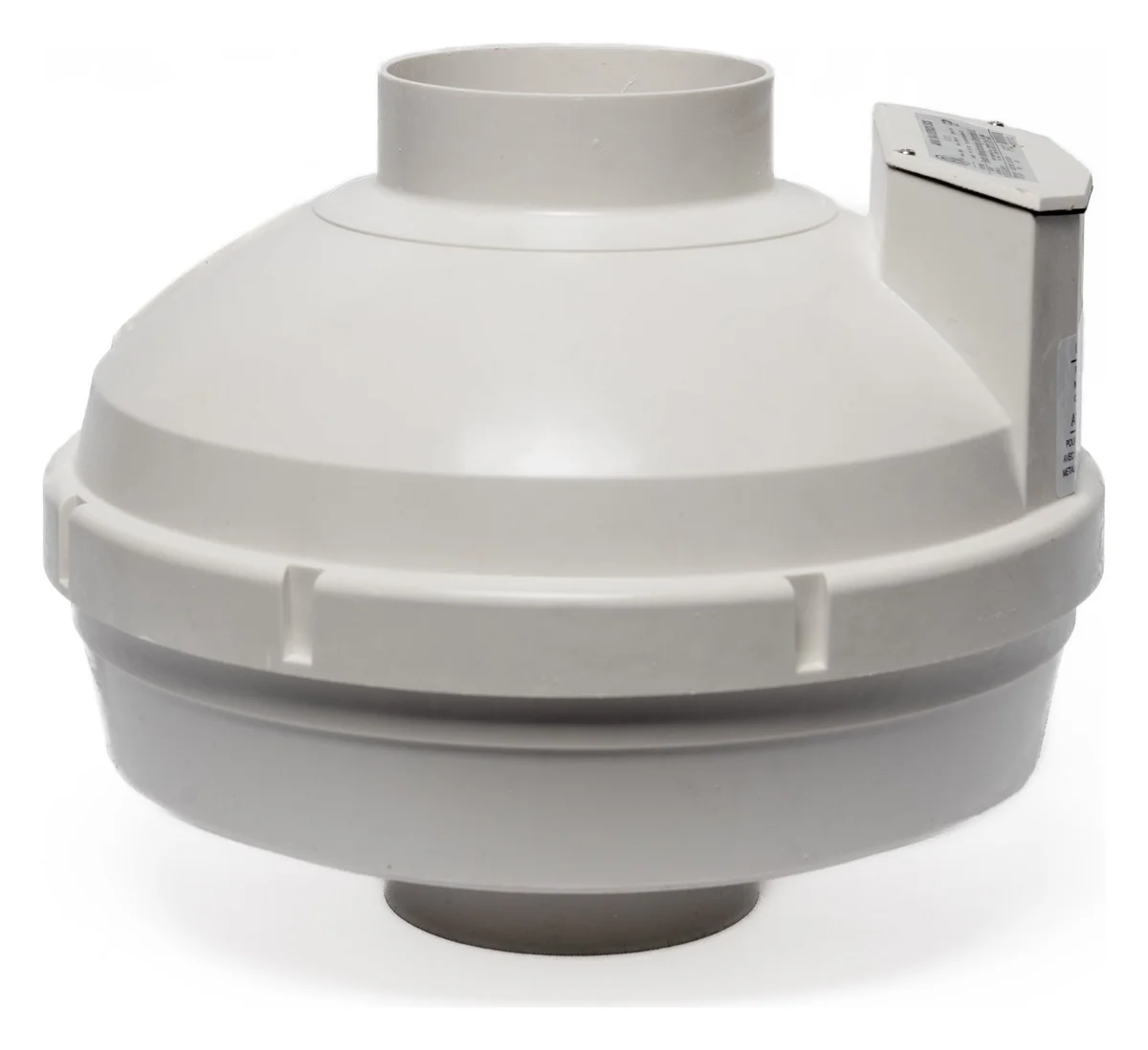
Festa
- What it is
- Moves up to 260 CFM
- Power
- Up to 66 W
- C-NRPP 2024/25
- Not applicable (mitigation fan)
The difference: A fan whose maker sells a kit with its own gauge: Festa lists the Maverick's installation kit with two couplers, a green 5.5 inch radon system manometer, a line cord and system labels.
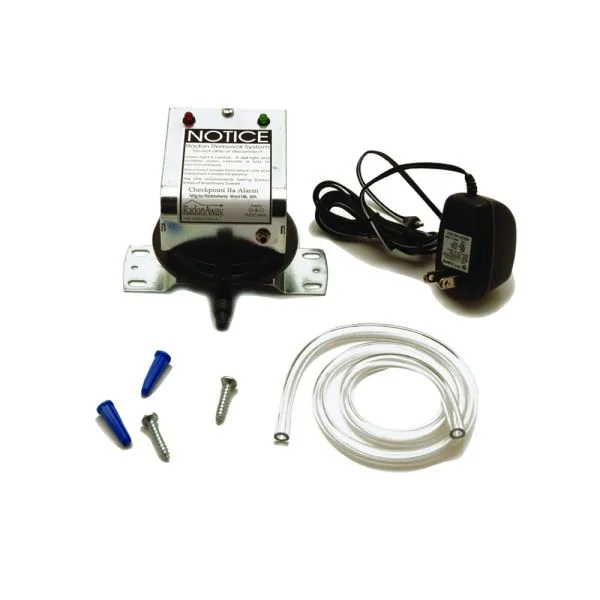
RadonAway
- What it is
- Fan alarm
- Power
- Not stated
- C-NRPP 2024/25
- Not applicable (system part)
The difference: RadonAway's alarm for the same job: an audible alarm with green and red LED lights, factory preset to activate at .25" WC vacuum pressure.
Compared with similar products: 1 of 4
More radon manometers4
All radon manometers
System indicator
Air Flow Alarm battery radon system air flow alarm
- Air Flow Alarm
Made of: Battery air flow alarm
- All radon manometers More radon manometers
More radon manometers: 1 of 4
Questions
Questions people ask
5 questions about the RadonAway Easy Read U-Tube Manometer, answered
Asked about the Easy Read U-Tube Manometer
Does the RadonAway Easy Read manometer measure radon?
No. RadonAway says the device does not measure radon levels, and Radon.com adds that it is not a radon system alarm. It shows the suction the fan pulls in the pipe. Only a radon test shows the level in the home, and the EPA says it is a good idea to retest at least every two years.
What range does it read?
RadonAway prints 0 to 4.5 inches of water column for the 50017 and says it is not suitable for system pressures above 4.5 inches. Its trade store lists a 0 to 6.5 inch version (P/N 50036). The EPA's standards ask that a manometer be marked with the range of readings the system had when it was first activated, so the number that matters for your system is the one recorded at installation.
How do I read it?
In Radon.com's words, fluid drawn up the tube on one side means the system is operating, and fluid at equal levels on both sides may mean it is not. Compare the reading with the one recorded when the system was installed: Minnesota says a reading that is even, or significantly different from that one, means the system may not be working properly.
Do I need an alarm as well as the gauge?
Minnesota requires every radon mitigation system to have two fan monitors, a U-tube manometer and an active notification monitor. RadonAway's fan manual names either a manometer or an audible alarm as the required system monitor. The EPA's guide lists a liquid gauge, a sound alarm, a light indicator and a dial gauge as examples of warning devices, and says the device must be placed where it can be seen or heard easily.
Is the 50018 the same gauge?
RadonAway lists the 50018 under the same name, Easy Read U-Tube Manometer, beside the 50017 on its trade store, and Radon.com sells the 50017 as the blue one. The facts on this page are from the 50017's own pages; the 50018's range and contents were not read for it.
What to do next
- See how a radon system fits togetherThe suction point, the pipe, the fan, the gauge and the sealing, and what each one does.
- Find a mitigation professionalMost systems are designed and installed by one; some states require a license.
- Read a radon manometerWhat even or uneven fluid means, and what the gauge cannot tell you.
- Test after the workA short-term test afterwards shows whether radon in the home is lower.
Updated November 27, 2026