 RadonAway
 RSA1
Battery radon system vacuum alarm
- System indicator
- Battery vacuum alarm
- RSA1 alarm
Best for, and skip if
Best for you if
- Your system has a U-tube gauge and no alarm, and you want the active monitor Minnesota requires beside it.
- There is no outlet near the pipe; RadonAway lists the RSA1 as battery operated, with no wiring required.
Skip it if
- You want to know your radon level; the RSA1 reports on the system's vacuum, and only a radon test shows radon.
- The alarm would sit outdoors or in unheated space; RadonAway says it is for conditioned indoor installations only, and that outdoor installation voids the warranty.
Photos: RadonAway
 (opens in a new tab)Check price on Amazon (opens in a new tab)

As an Amazon Associate, Radon411 earns from qualifying purchases.
Amazon and the Amazon logo are trademarks of Amazon.com, Inc. or its affiliates.
See ratings and reviews on Amazon (opens in a new tab)- Made ofBattery vacuum alarm
- PackageRSA1 alarm
- Every figure checked against the specifications RadonAway publishes
- The maker's own figures and limits, shown the same way for every part, unranked
About this item
As RadonAway states it
- What it reads: Vacuum in the radon system's pipe, by a piezoresistive pressure sensor (PPS) joined to the pipe by a silicone elbow or tubing; self-calibrates to the system's baseline pressure when the battery is installed; does not measure radon
- Range: Sensing range -0.1" WC to -20" WC; alarm at a 90% or greater reduction of the baseline pressure; overpressure +/- 20" WC
- Made of: Battery vacuum alarm: piezoresistive pressure sensor, green sensing, red alarm, blue service and yellow low battery LEDs, an audible alarm of about 85 dBA, Hush and Test buttons; 2.19" x 3.75" x 1.37" (W x H x D)
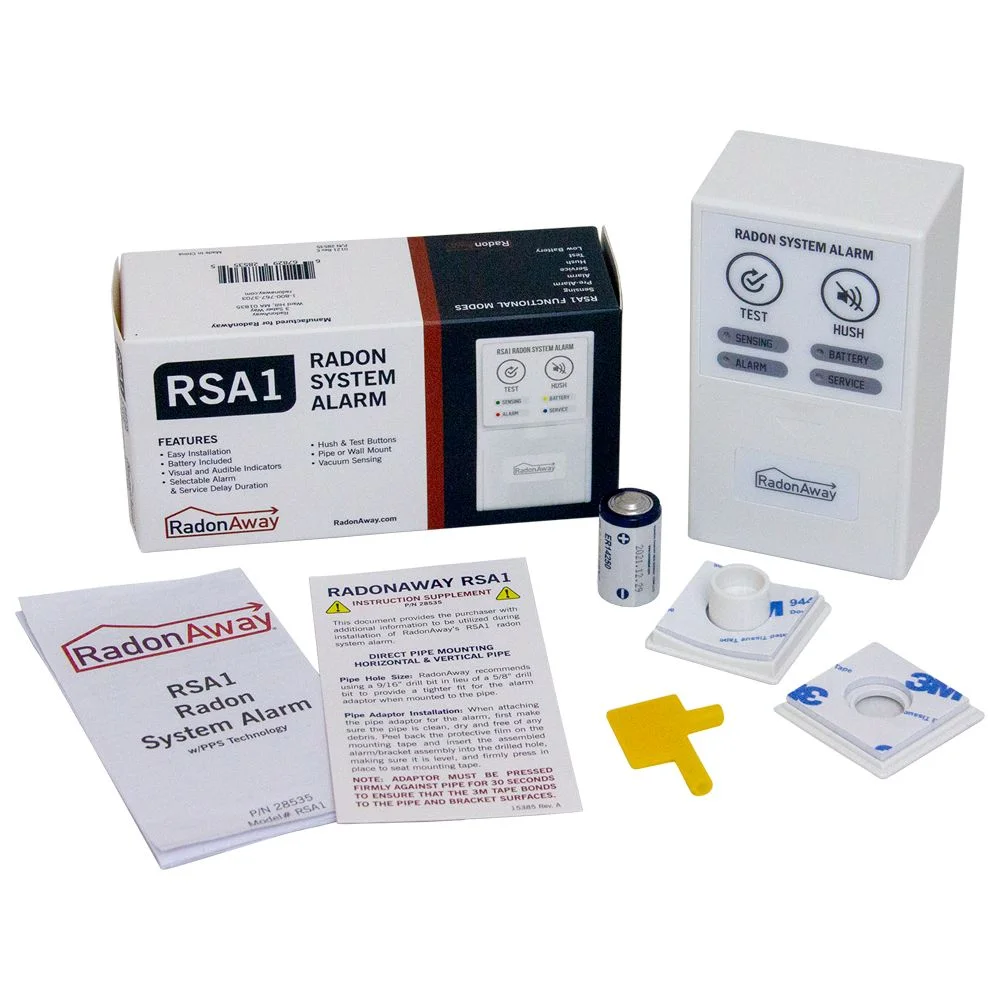
- Package: RSA1 alarm, wall mount adapter (flat), pipe mount adapter (curved), silicone alarm/pipe connector elbow, battery, product instructions and two adapter mounting screws; tubing for a wall mount sold separately
- Warranty: 2 years from the date of purchase, against defective material and workmanship, contingent on installation in accordance with the instructions; outdoor installation voids it (IN098 Rev H)
The RSA1 is RadonAway's battery-powered alarm for a radon mitigation system. It mounts on the system's pipe, or on a wall with tubing to the pipe, and senses the vacuum the fan pulls with a piezoresistive pressure sensor, which RadonAway calls PPS technology. It learns the system's own pressure when the battery goes in and warns with lights, then a buzzer, when that vacuum falls by 90 percent or more. It reports on the fan and the pipe: RadonAway says it does not measure the radon levels in a home.
What you get
RadonAway's instructions list the box as the RSA1 alarm, a flat wall mount adapter, a curved pipe mount adapter, a silicone alarm-to-pipe connector elbow, a battery, the product instructions and two adapter mounting screws. The tubing for a wall mount is not in the box. The alarm measures 2.19 by 3.75 by 1.37 inches, and RadonAway's sheet says it uses a 3.6 V 1/2 AA battery.
In the box and running costsHow it works
What it does and how
What it is made of and the job it does in a system, then who has checked it
How it works
In our words, from the maker's documents
RadonAway describes the RSA1 as a vacuum monitoring device that uses a piezoresistive pressure sensor (PPS). A silicone elbow joins the alarm to a port on an adapter fixed over a hole in the radon pipe, so the sensor reads the suction inside. The instructions say the alarm gives audible and visual indication when the radon system's vacuum pressure has dropped below the preset operating limit, leaving too little pressure to be effective, and RadonAway's page says it is compatible with any active radon fan.
The trip point is the system's own. The instructions say the RSA1 calibrates itself when the battery is installed: it runs a 20-second initialization to measure the system's baseline operating pressure, its green sensing light flashing, and a single beep says it is active. RadonAway gives a sensing range of -0.1 to -20 inches of water column and an alarm at a 90 percent or greater reduction of that baseline. That is the main difference from a fixed-point alarm such as RadonAway's plug-in Checkpoint IIA, which its page says is factory preset to activate at .25 inches of water column.
Low suction does not set off the buzzer at once. In RadonAway's description of the modes, the red alarm light first blinks every 60 seconds, lights only; if the pressure is not restored within the delay the owner has chosen, the buzzer beeps and the red light flashes, then a 60-second pause, over and over until Hush is pressed or the system is serviced. The delay is 48 hours by default, or 7 or 30 days. Three pre-alarms within the delay bring on the blue service light and the buzzer instead, and a yellow light with one chirp every 5 minutes marks a low battery. RadonAway's page sums it up: a visual alert only during the first 48 hours, 7 days or 30 days, depending on the delay selected.
That makes the RSA1 the active half of a pair. Minnesota's health department requires every radon mitigation system to have two fan monitors, a U-tube manometer and an active notification monitor, the kind that alerts you with a visual light and/or audible noise if the system stops working. RadonAway's fan instructions list the RSA1 by its part number, 28535, among the audible alarms that can serve as the required system monitor.
What it cannot do is the point most worth keeping, and it is why the RSA1 is a system alarm, not a radon alarm. A radon alarm, the kind built into some digital monitors, sounds at a radon reading. The RSA1 sounds at a loss of suction, and RadonAway's page, sheet and 2023/2024 catalog each say it does not measure radon levels. Minnesota says the same of a U-tube gauge: it shows there is suction in the pipe. A quiet RSA1 means the fan is still pulling; only a radon test shows the level in the home.
What the manufacturer says
RadonAway's own statements, attributed
- RadonAway saysRadonAway states the RSA1 provides audible and visual indicators to the homeowner when the active radon system has insufficient air pressure to operate properly.
- RadonAway saysRadonAway states the RSA1 is compatible with any active radon fan.
- RadonAway saysRadonAway lists the battery as included, with a life of 2 to 3 years.
- RadonAway saysRadonAway describes the RSA1 as an easy-to-read, easy-to-use system monitor that requires no interpretation.
- RadonAway saysRadonAway states the RSA1 satisfies the current ANSI/AARST Radon Mitigation Standards.
- RadonAway saysRadonAway lists the audible alarm as about 85 dBA in its instructions, and the silence from the Hush button as 7 days.
These are RadonAway's own statements, attributed to it. They are not our findings, and we have not tested this product ourselves.
Independent evidence
Who checks a device like this
C-NRPP's consumer evaluation covers electronic radon monitors, not the parts of a mitigation system, so it has no result for RadonAway RSA1. The standards and results the maker states are under “What the manufacturer says”, and what shows whether radon in your home is lower is a radon test after the work is done.
RadonAway RSA1
Check price on Amazon (opens in a new tab)Specifications
Specifications
Every figure as the maker states it
The maker's figures
- Type
- System indicator, Battery radon system vacuum alarm
- What it reads
- Vacuum in the radon system's pipe, by a piezoresistive pressure sensor (PPS) joined to the pipe by a silicone elbow or tubing; self-calibrates to the system's baseline pressure when the battery is installed; does not measure radon
- Range
- Sensing range -0.1" WC to -20" WC; alarm at a 90% or greater reduction of the baseline pressure; overpressure +/- 20" WC
- Made of
- Battery vacuum alarm: piezoresistive pressure sensor, green sensing, red alarm, blue service and yellow low battery LEDs, an audible alarm of about 85 dBA, Hush and Test buttons; 2.19" x 3.75" x 1.37" (W x H x D)
- Package
- RSA1 alarm, wall mount adapter (flat), pipe mount adapter (curved), silicone alarm/pipe connector elbow, battery, product instructions and two adapter mounting screws; tubing for a wall mount sold separately
- Warranty
- 2 years from the date of purchase, against defective material and workmanship, contingent on installation in accordance with the instructions; outdoor installation voids it (IN098 Rev H)
What is in the box
RadonAway's instructions list the box as the RSA1 alarm, a flat wall mount adapter, a curved pipe mount adapter, a silicone alarm-to-pipe connector elbow, a battery, the product instructions and two adapter mounting screws. The tubing for a wall mount is not in the box. The alarm measures 2.19 by 3.75 by 1.37 inches, and RadonAway's sheet says it uses a 3.6 V 1/2 AA battery.
RadonAway warrants the RSA1 against defective material and workmanship for two years from the date of purchase, provided it was installed by the instructions. The warranty does not cover installation or removal costs; a claim needs the purchase receipt and a return authorization number, and the customer pays shipping to and from the factory. The five-year warranty on RadonAway's trade pages is for its fans.
RadonAway also packs the RSA1 with its fans. Its 2023/2024 catalog offers the RP145 and RP265 Pro Packs with or without the RSA1, and the GX3 and GX4 packs without it; its trade page now also lists GX3 and GX4 Pro Packs with the RSA1 alarm.
What it costs to run
The running cost is the battery. RadonAway gives the included battery a life of 2 to 3 years, its sheet names a 3.6 V 1/2 AA cell, and the low battery light comes on below 3.35 volts. To change it, the instructions say to remove the old battery, hold Test for 15 seconds so the alarm is de-energized, check that the fan is running and the tubing still connected, then fit the new one, which starts the 20-second calibration again.
Minnesota asks that both fan monitors be checked monthly, and the active monitor's power source too, since it could be plugged in or use batteries. On the RSA1, the Test button sounds the alarm and lights the LEDs. The fan itself runs all the time: the EPA says the fan should never be turned off and that fans may last for five years or more.
The ongoing cost is testing. The EPA says it is a good idea to retest your home at least every two years, and RadonAway's fan instructions call for a system label that tells the occupants regular radon tests are needed. An alarm that stays quiet does not replace those tests.
Fit and setup
Who it fits, and installation
The fit, then how it goes on and what the standards ask
Who it fits
Good fit if, and look elsewhere if
Good fit if
- Your system has a U-tube gauge and no alarm, and you want the active monitor Minnesota requires beside it.
- There is no outlet near the pipe; RadonAway lists the RSA1 as battery operated, with no wiring required.
- The pipe runs where no one goes, and you would rather mount the alarm on a wall people pass, up to 50 feet away on tubing.
- You want the alarm set to your system's own suction, which the RSA1 measures at start-up, rather than one factory setting.
Look elsewhere if
- You want to know your radon level; the RSA1 reports on the system's vacuum, and only a radon test shows radon.
- The alarm would sit outdoors or in unheated space; RadonAway says it is for conditioned indoor installations only, and that outdoor installation voids the warranty.
- You want it to sound the moment suction drops; by design the first 48 hours, 7 days or 30 days are lights only.
- You would rather never change a battery; RadonAway's plug-in Checkpoint IIA runs from an included transformer instead.
Installation
4 steps
- RadonAway's instructions set the rules. The RSA1 is for conditioned indoor installations only, meaning living space or other space that is temperature and humidity controlled, placed where the occupants will readily see it; outdoor installation voids the warranty. Every installation needs a drill with 9/16 inch and 1/16 inch bits. On the pipe, the adapter goes on the suction side of the radon fan, at least 12 inches from it, over a 9/16 inch hole. It is held by double-sided tape, pressed firmly against the pipe for 30 seconds, and by two screws at the 9 and 3 o'clock positions, and the alarm slides onto it standing upright.
- For a wall mount, the adapter still goes on the pipe and the alarm hangs on a wall within 50 feet, joined by tubing that is sold separately: RadonAway's page names 1/8 inch inside-diameter flexible tubing, P/N 68162, in 10, 25, 50 and 100 foot lengths, and its 2023/2024 catalog says tubing is not included. The mounting tape is permanent; RadonAway suggests dental floss or wire, pulled back and forth, to split it if the alarm must come off.
- To start it, make sure both ends of the elbow are connected and the fan is running, then seat the battery; the 20-second calibration follows on its own. To move from the 48-hour default, hold Hush for 5 seconds for a 7-day delay or 10 seconds for 30 days, and let go when the lights show your choice.
- Where it goes matters as much as how. The EPA's 1994 Radon Mitigation Standards say every active system needs a mechanism to monitor system performance and warn of failure, simple to read and placed where occupants can easily see or hear it. The EPA's consumer guide says the warning device must be placed where it can be seen or heard easily and recommends a qualified radon mitigation contractor for the system itself, and RadonAway's retail page says that installing a radon fan or system yourself is not intended to take the place of installation by a qualified radon professional.
For how the sealing, the gauge and the fan work together, see radon mitigation systems, and to find someone to design and install one, radon mitigation professionals.
Compare
Compare with similar items
The same three rows for each, and the one difference that matters
This page
RadonAway RSA1
- What it is
- Battery vacuum alarm
- Power
- Not stated
- C-NRPP 2024/25
- Not applicable (system part)
This page: The RSA1 is RadonAway's battery-powered alarm for a radon mitigation system.
RadonAway
- What it is
- Battery air flow alarm
- Power
- Not stated
- C-NRPP 2024/25
- Not applicable (system part)
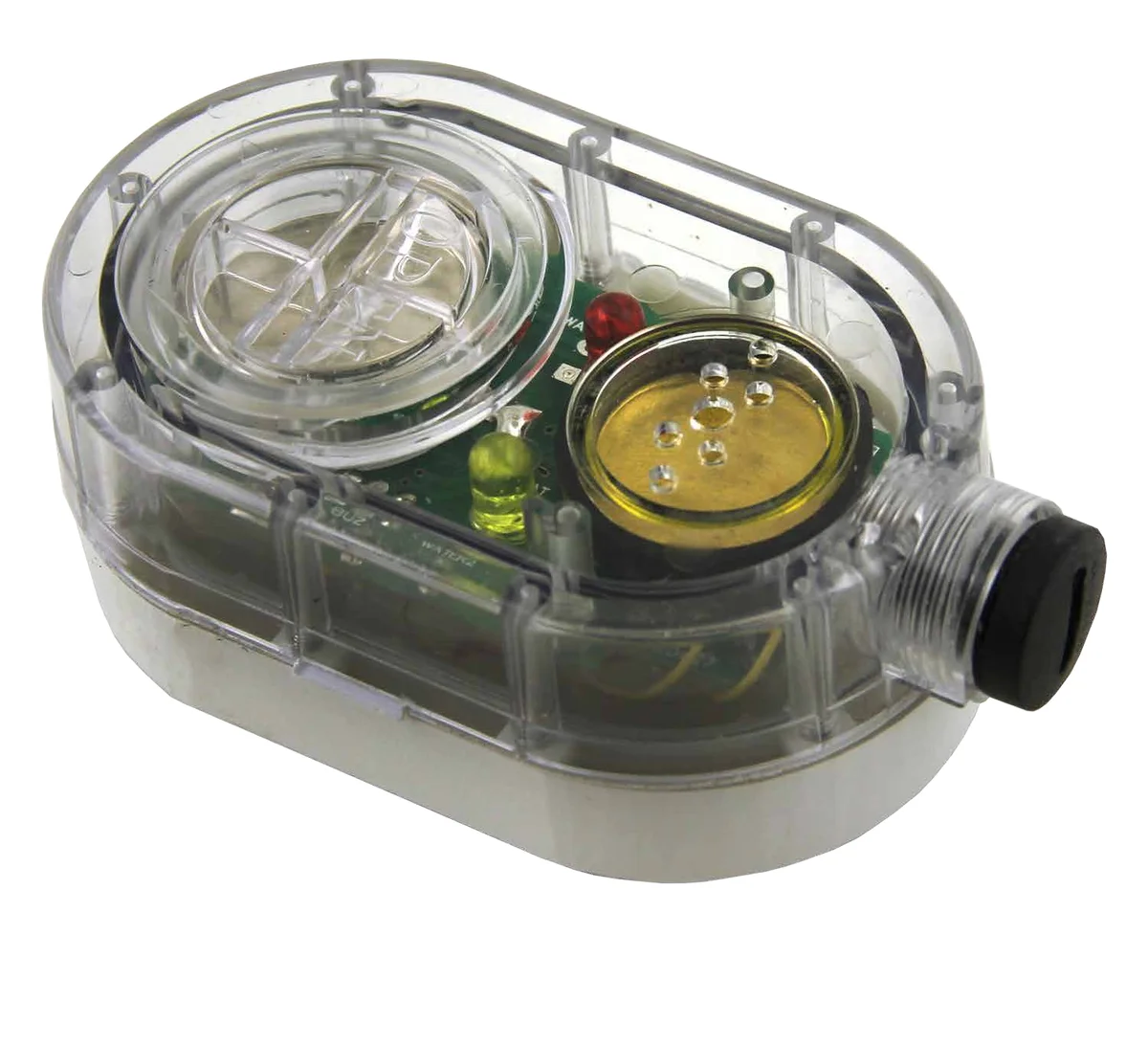
The difference: RadonAway's other battery alarm, which senses air flow with a vane inside a 3 or 4 inch pipe instead of vacuum, down to 10 CFM in a 3 inch pipe and 15 CFM in a 4 inch pipe.
RadonAway
- What it is
- Fan alarm
- Power
- Not stated
- C-NRPP 2024/25
- Not applicable (system part)
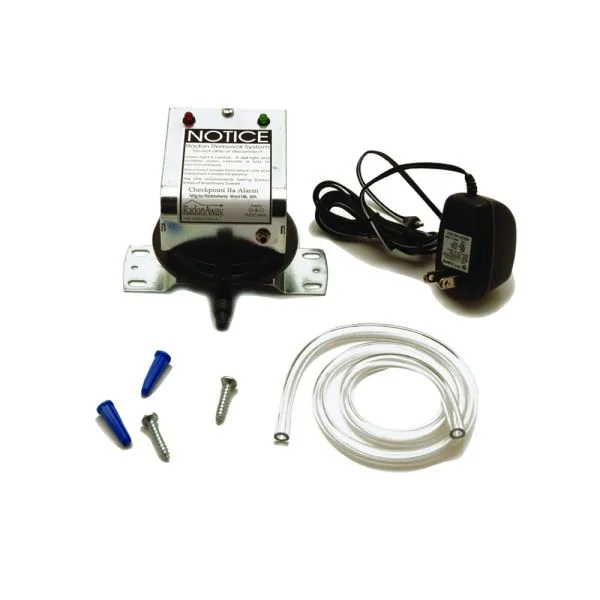
The difference: RadonAway's plug-in alarm, with an AC to DC transformer instead of a battery, factory preset to activate at .25" WC vacuum pressure.
RadonAway
- What it is
- U-tube manometer with non-toxic fluid, adjustable zero and a molded scale curved to fit the system pipe
- Power
- Not stated
- C-NRPP 2024/25
- Not applicable (system part)
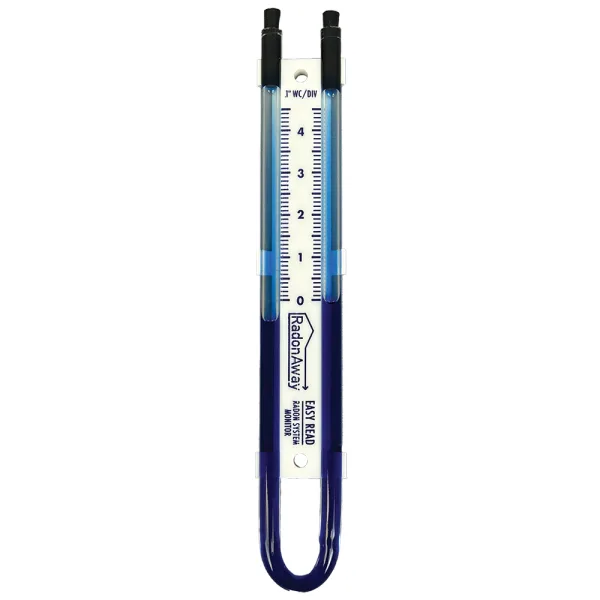
The difference: The U-tube gauge in every RadonAway Pro Pack, read rather than heard: 0 to 4.5" WC with non-toxic fluid and an adjustable zero.
Compared with similar products: 1 of 4
More radon manometers4
All radon manometersSystem indicator
Air Flow Alarm battery radon system air flow alarm
- Air Flow Alarm
Made of: Battery air flow alarm
System indicator
Easy Read U-Tube Manometer U-tube radon system manometer
U-tube radon system manometer
- All radon manometers More radon manometers
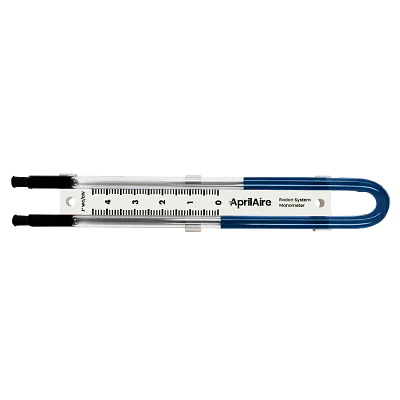
More radon manometers: 1 of 4
Questions
Questions people ask
5 questions about the RadonAway RSA1, answered
Asked about the RSA1
Does the RSA1 detect radon?
No. RadonAway says the alarm does not measure the radon levels in a home. It senses the vacuum in the radon pipe, which tells you whether the fan is pulling. Only a radon test shows the level, and the EPA says it is a good idea to retest at least every two years.
When does it sound?
When the vacuum has fallen by 90 percent or more from the baseline it measured at start-up and stayed there past the delay you chose. For the first 48 hours, 7 days or 30 days the red light blinks every 60 seconds with no sound; after that the buzzer beeps and the red light flashes about once a minute until Hush is pressed or the system is serviced. Hush silences the sound for 7 days.
How is it different from the Checkpoint IIA?
Three ways, by RadonAway's own descriptions. The RSA1 runs on a battery and needs no wiring, while the Checkpoint IIA plugs in through an AC to DC transformer. The RSA1 sets its alarm from the system's own baseline pressure, while the Checkpoint is factory preset at .25" WC. And the RSA1 waits through a delay of 48 hours, 7 days or 30 days before it sounds.
Do I still need a U-tube gauge?
Minnesota requires both: every radon mitigation system needs a U-tube manometer and an active notification monitor. RadonAway's fan instructions accept either a manometer or an audible alarm as the required system monitor, and the EPA's 1994 standards ask that a manometer be marked with the range of readings the system had when it was first activated.
What should I check if it goes off?
Minnesota's checks for a system that seems to have stopped: make sure the monitor tubing is connected to the pipe and not kinked, and that power is being supplied to the fan. In cold weather it also warns of system freeze-up, ice in the pipe that stops radon venting properly; then the U-tube fluid will be even and the active monitor should alert you. On the RSA1 a flashing blue light means service mode, three pre-alarms within the delay, and a flashing yellow light a low battery. For the system itself, the EPA recommends a qualified radon mitigation contractor.
What to do next
- See how a radon system fits togetherThe suction point, the pipe, the fan, the gauge and the sealing, and what each one does.
- Find a mitigation professionalMost systems are designed and installed by one; some states require a license.
- Read a radon manometerWhat even or uneven fluid means, and what the gauge cannot tell you.
- Test after the workA short-term test afterwards shows whether radon in the home is lower.
Updated November 27, 2026