Monitor
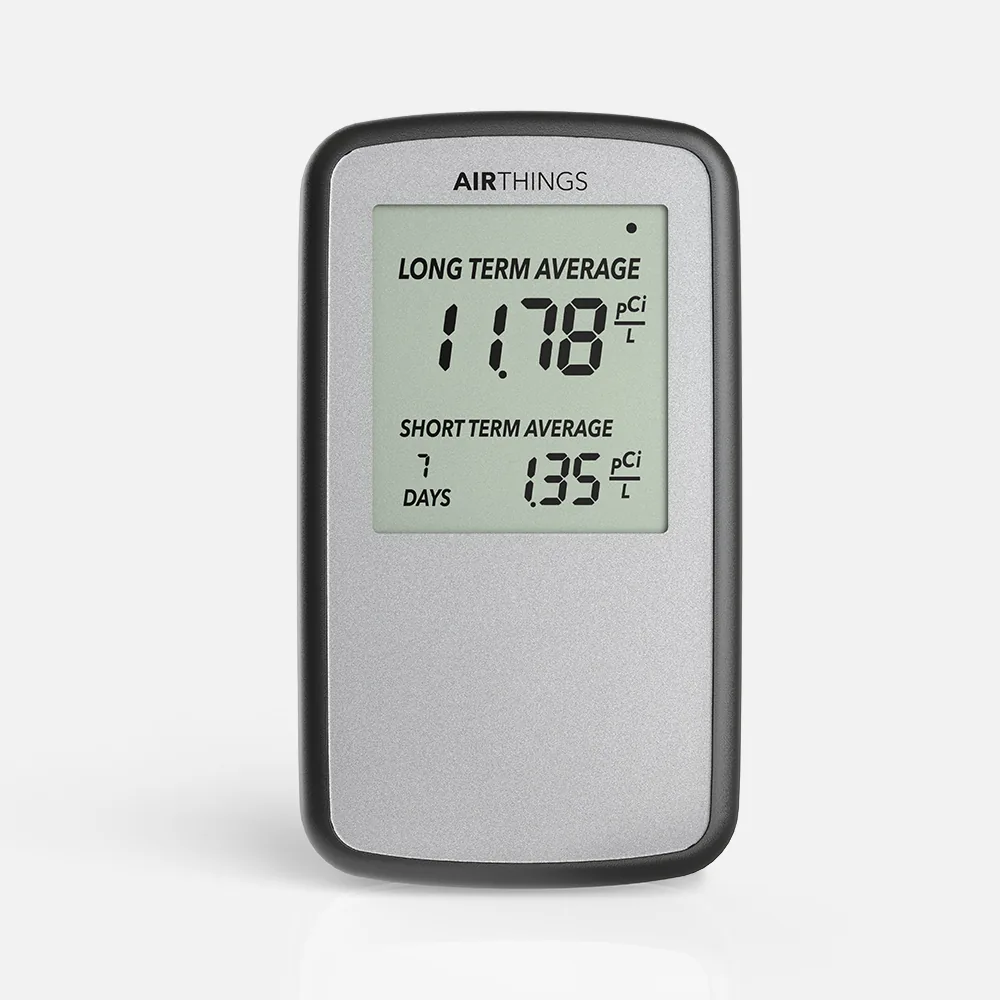
Corentium Home battery digital radon detector
- C-NRPP 2024/25: Approved
- Battery
- Screen
Method: Alpha spectrometry
ProductsCompare
Short answer
The Aranet Radon Plus and the Airthings Corentium Home are battery radon monitors that C-NRPP's 2024/25 evaluation approved with an A in all four rounds, so the choice comes down to how you will use one. The Aranet shows a first number after 10 minutes, adds temperature and humidity and an optional Bluetooth app, while the Corentium Home takes 24 hours for a first reading and has no app at all.
The Aranet Radon Plus and the Corentium Home are two battery radon monitors that C-NRPP's 2024/25 evaluation approved with an A in every round, so on the independent record they start level. They differ in how they count radon, how quickly they show a number, what the screen shows, and whether a phone is involved. This page sets those differences side by side in Aranet's, Airthings' and C-NRPP's own figures, and ends with the one we would pick for each use. Nothing here comes from a test of our own.
| Compared | Aranet Radon Plus | Corentium Home |
|---|---|---|
| How it measures | Alpha decay events in an ionization chamber, filled by air diffusion | Passive diffusion chamber, alpha spectrometry |
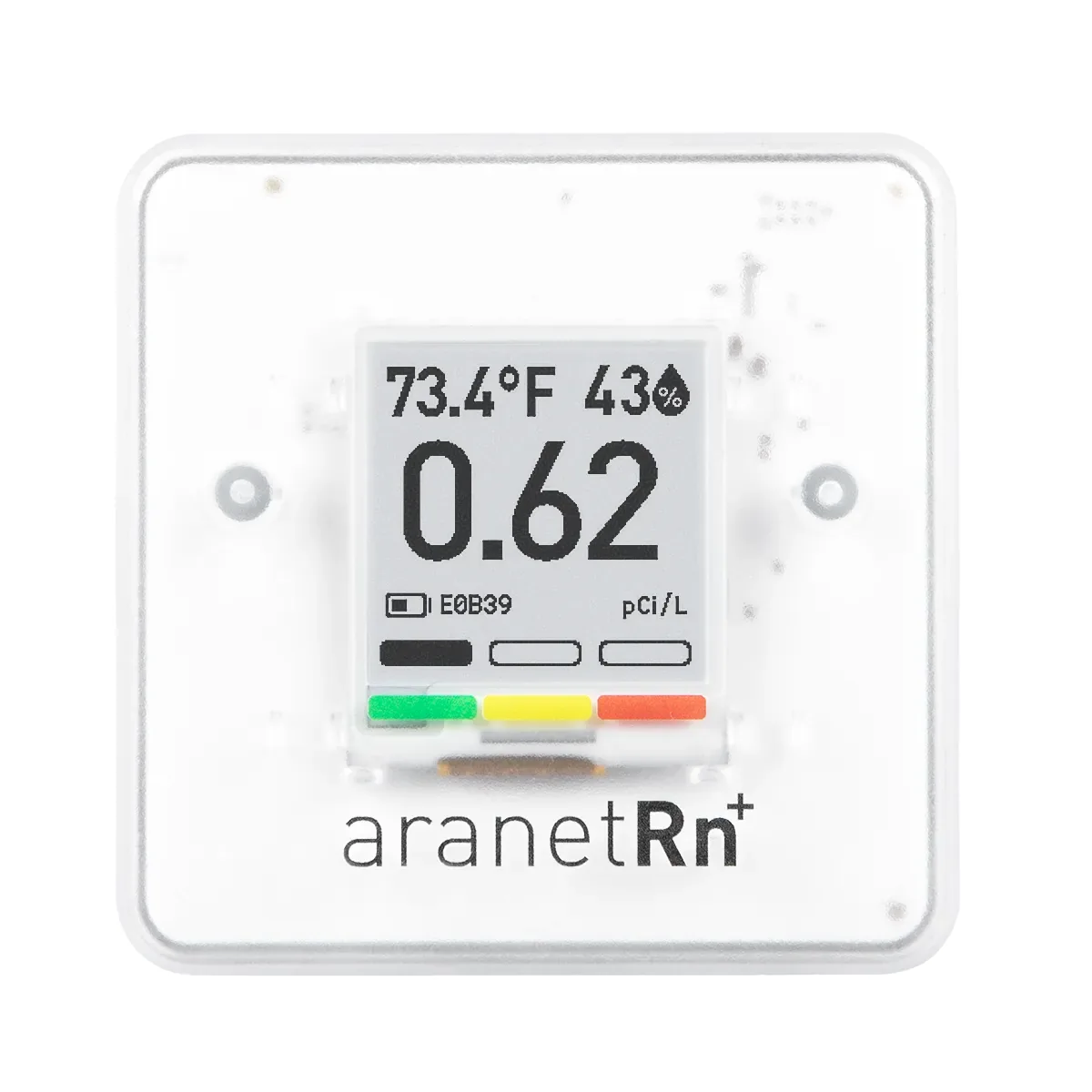
| On the device | E-Ink screen: 10-minute reading or 24-hour, 7-day and 30-day averages | LCD screen: rolling short-term and long-term averages |
| Phone app | Aranet Home over Bluetooth, optional | None |
| First reading | After 10 minutes; full accuracy after 1 hour | After 24 hours, as C-NRPP lists it |
| Batteries | 2 AA, alkaline included; lithium supported | 3 AAA alkaline |
| Other readings on the screen | Temperature and relative humidity | None |
| C-NRPP 2024/25 | Approved as "Aranet RN+": A, A, A, A | Approved: A, A, A, A |
Aranet's datasheet describes the Aranet Radon Plus's detector as alpha decay event detection with an ionization chamber, filled by air diffusion. There is no pump: air drifts into a 137 cm³ chamber through a spunbound polyester filter that keeps out radon's decay products, and Aranet rates the counting efficiency at 1 count per minute at 2.3
Airthings describes the Corentium Home's radon sampling as a passive diffusion chamber and its detection method as alpha spectrometry. Air drifts in on its own, and the sensor counts the alpha particles that radon and its decay products give off. Neither device sends anything to a laboratory; Airthings points out that the Corentium Home has no lab fees.
| Compared | Aranet Radon Plus | Corentium Home |
|---|---|---|
| Range | 0 to 214 pCi/L (0 to 7,900 Bq/m³) | 0 to 500 pCi/L (0 to 9,999 Bq/m³) |
| Maker's accuracy claim | ±8% for the 24-hour, 7-day and 30-day averages | About 10% after 7 days and about 5% after 2 months, at 5.4 pCi/L |
| Stated accuracy on C-NRPP's list | ±8% for the 24-hour, 7-day and 30-day averages | ±10% after 7 days at 200 Bq/m³, ±5% after 2 months |
| How often it reports | Updates every 10 minutes | 12-hour, 24-hour and 7-day reading periods, as C-NRPP lists them |
| Resolution | 0.02 pCi/L | Not stated |
| Operating humidity | 0 to 85%, non-condensing | Below 85% |
The Aranet Radon Plus shows a first number about 10 minutes after the batteries go in, and Aranet says full measurement accuracy takes 1 hour. A switch on the side moves the E-Ink screen between the 10-minute reading and the 24-hour, 7-day and 30-day averages; if the device has not run as long as the chosen average, a status mark says so. The screen also shows temperature, relative humidity, battery level and a colored threshold bar. Bluetooth links it to the free Aranet Home app for history, trends and alerts, the device keeps 30 days of history for the app to collect, and Aranet says no registration is needed and the sensor works as a standalone device.
The Corentium Home's screen is the whole interface. Airthings describes it as a simple, always-on radon detector with short-term and long-term radon levels on an integrated LCD display, and it has no Bluetooth, Wi-Fi or app. C-NRPP's list gives its first reading as taking 24 hours. Airthings adds that you can generate a radon self-inspection report to document or share your readings.
| Compared | Aranet Radon Plus | Corentium Home |
|---|---|---|
| First number | After 10 minutes | After 24 hours |
| Averages on the screen | 24 hours, 7 days and 30 days | Rolling short-term and long-term |
| History | 30 days on the device, collected by the app | Not stated |
| Account or subscription | No registration, subscription or recurring fees | No app or connection at all |
| Alarm | A buzzer, switched on or off on the device or in the app; it beeps when a measurement is over 300 Bq/m³ (8.1 pCi/L) by default, a level the app can change | Not stated |
| Extras | Temperature, humidity and a threshold bar on screen; air pressure in the app | A radon self-inspection report |
Both run on batteries, so either can sit in a room with no outlet. The Aranet Radon Plus takes two AA batteries, alkaline in the box and lithium supported. Aranet's datasheet gives 5.1 years on alkaline cells with Bluetooth off and 3.3 years with it on, and 7.1 and 4.5 years on lithium cells, figures it calls mathematical extrapolations at 68°F, provided for descriptive purposes only. The Corentium Home runs on three AAA alkaline batteries, which Airthings rates for 2 years.
The Aranet Radon Plus needs a little care. Its datasheet warns that the sensor is sensitive to static electricity, so rubbing it can briefly produce false high readings; it is rated IP20, and condensation or direct contact with water may degrade its accuracy. Sunlight can damage the E-Ink screen. Airthings gives the Corentium Home an operating range of 39 to 104°F with relative humidity below 85%.
| Compared | Aranet Radon Plus | Corentium Home |
|---|---|---|
| Batteries | 2 AA | 3 AAA alkaline |
| Stated battery life | 5.1 years alkaline with Bluetooth off, 3.3 with it on; extrapolated | 2 years |
| Size | 2.80 x 2.80 x 3.03 in | 4.7 x 2.7 x 1.0 in |
| Weight with batteries | 7.8 oz | 5.2 oz |
| Lab fee or subscription | None | No lab fees |
Both models were approved in C-NRPP's 2024/25 consumer monitor evaluation, which put each device through four rounds of testing in four different sets of conditions, and both graded A in all four rounds. C-NRPP lists the Aranet as the Aranet RN+, and Aranet's quick start guide shows the Radon Plus appearing in its app as AranetRn+, so the names line up. C-NRPP tested Canadian-market units; we have not confirmed that the US versions are identical.
Neither took part in the 2024 field study that ran consumer monitors beside a calibrated reference instrument at a natural radiation laboratory in Salamanca, Spain, in the summer of 2023, so there is no field result for either. That is a fact about which monitors took part, not a result for either one.
| Evidence | Aranet Radon Plus | Corentium Home |
|---|---|---|
| C-NRPP 2024/25 evaluation | Approved as "Aranet RN+"; A, A, A, A | Approved; A, A, A, A |
| 2024 field study | Not in the study | Not in the study |
On the independent record the two are level: C-NRPP approved both with an A in every round. So the pick turns on how you will use it. Each row below follows from what Aranet, Airthings and C-NRPP state, and each monitor gets three.
| If you want | Our pick | Why |
|---|---|---|
| A first number within minutes | Aranet Radon Plus | A first reading after 10 minutes and full accuracy after 1 hour; C-NRPP lists 24 hours for the Corentium Home |
| History and alerts on your phone, with no account or subscription | Aranet Radon Plus | The free Aranet Home app over Bluetooth, with no registration needed |
| Temperature and humidity beside radon on the screen | Aranet Radon Plus | Its E-Ink screen shows both; the Corentium Home measures radon only |
| Nothing to pair: no app and no wireless connection | Corentium Home | Everything is on its own LCD screen |
| A long-term average on the device itself | Corentium Home | Its screen shows a rolling long-term average; the Aranet's screen views stop at 30 days |
| A report of your readings to keep or share | Corentium Home | Airthings describes a radon self-inspection report you can generate |
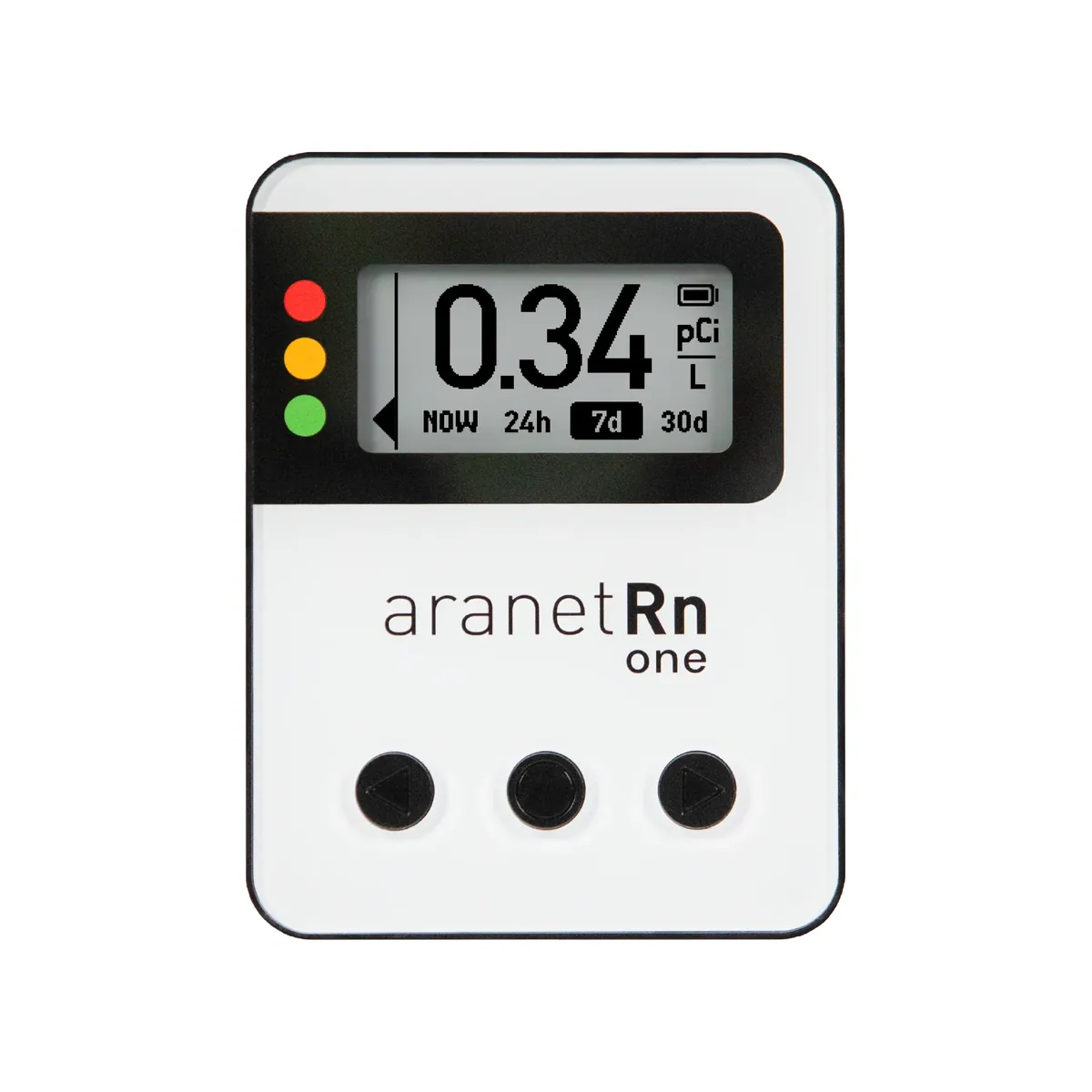
Each has its own page with every specification and its evidence box: Aranet Radon Plus and Airthings Corentium Home. Aranet's other radon model is on the Aranet Radon One page, the Corentium Home is set beside its successor on Corentium Home vs Corentium Home 2, and every monitor we cover is on best radon monitors.
Monitor
Method: Alpha spectrometry
MonitorAranet
Method: Ion chamber
First reading: Within 10 minutes
MonitorAranet
Method: Ion chamber
First reading: Within 10 minutes
The monitors in this section: 1 of 3
As an Amazon Associate, Radon411 earns from qualifying purchases.
Step 1 of 5:
Pick the floor
The lowest lived-in level of the home, such as a basement or ground floor, in a room used regularly, not a kitchen, bathroom or laundry room.
Step 2 of 5:
Pick a room people use
A room occupied for at least 4 hours each day.
Step 3 of 5:
Set the height
At least 20 inches above the floor, away from drafts, high heat, high humidity and exterior walls.
Step 4 of 5:
Keep the Aranet out of the sun and the damp
Aranet asks for a spot away from direct sunlight and humid areas, and warns that rubbing the sensor can briefly push the reading up.
Step 5 of 5:
Give it time
At least 3 months, preferably in the heating season, and decide on the long-term average. With less than 91 days of data, follow up with a long-term test. The Aranet's screen stops at 30 days, so its app's history carries the longer picture.
More on placement is at where to place a radon test, and on reading the result at continuous radon monitors.
Neither is shown to be more accurate. C-NRPP's 2024/25 evaluation approved both with an A in all four rounds. Aranet states ±8% for its averages and Airthings about 10% after 7 days at 5.4 pCi/L; each is the maker's own figure, on a different basis.
The names line up: C-NRPP lists the Aranet RN+, and Aranet's quick start guide shows the Radon Plus appearing in its app as AranetRn+ followed by its device number.
The Aranet: a first number after about 10 minutes, with full accuracy after 1 hour. C-NRPP's list gives the Corentium Home's first reading as taking 24 hours.
On paper, the Aranet. Aranet gives 5.1 years on alkaline batteries with Bluetooth off and 3.3 years with it on, figures it calls extrapolations. Airthings rates the Corentium Home's three AAA batteries for 2 years.
No. Aranet says the sensor works as a standalone device, with readings and averages on its screen. The app adds history, trends and alerts. The Corentium Home has no app at all.
Aranet says the Radon Plus needs no registration, subscriptions or recurring fees. The Corentium Home has no app or connection to subscribe to, and Airthings points out that it has no lab fees.
Both run on batteries, so either can sit on the lowest lived-in level with no outlet. Pick the Aranet if you want temperature and humidity on the screen beside radon; pick the Corentium Home if you want nothing to pair. Keep the Aranet out of direct sunlight and condensation.
By default, green is under 2.7 pCi/L, yellow is 2.7 to 8.1 pCi/L and red is above 8.1 pCi/L, thresholds Aranet bases on World Health Organization guidance; they can be changed in the app. A US household may want to move them to EPA's reference points of 2 and 4 pCi/L.
Consumer monitors cannot be professionally calibrated and are not approved by C-NRPP for use by radon measurement professionals. Check what the contract and your state accept, which may be a test by a certified professional; see radon measurement professionals.
At least 3 months, preferably in the heating season, and decide on the long-term average. With less than 91 days of data, C-NRPP recommends following up with a long-term test. The Aranet's screen shows up to a 30-day average, so its app history is where a three-month picture comes from.