Monitor
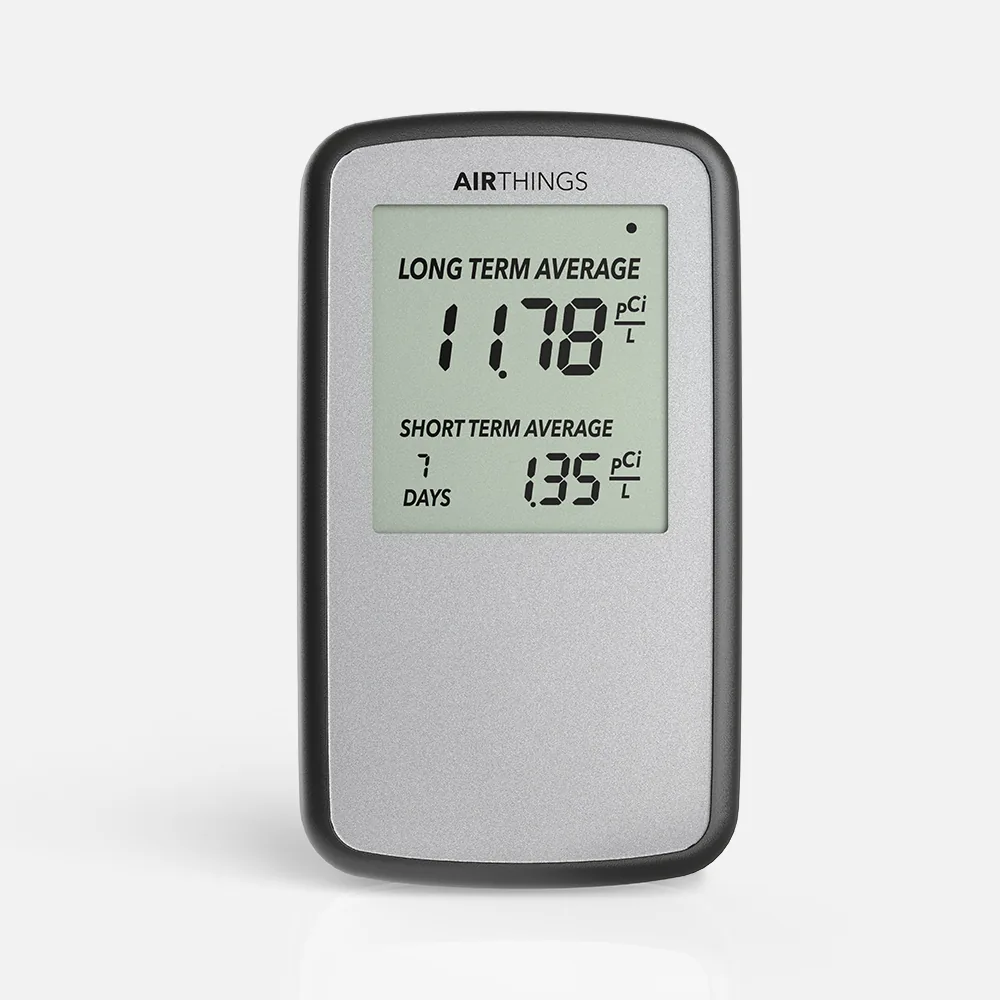
Corentium Home battery digital radon detector
- C-NRPP 2024/25: Approved
- Battery
- Screen
Method: Alpha spectrometry
ProductsCompare
Short answer
The Airthings Corentium Home and Corentium Home 2 use the same passive diffusion, alpha spectrometry radon sensor, and Airthings' US store sells both. The Corentium Home 2 adds Bluetooth, temperature and humidity and runs on two AA batteries, while only the original was graded in C-NRPP's 2024/25 evaluation.
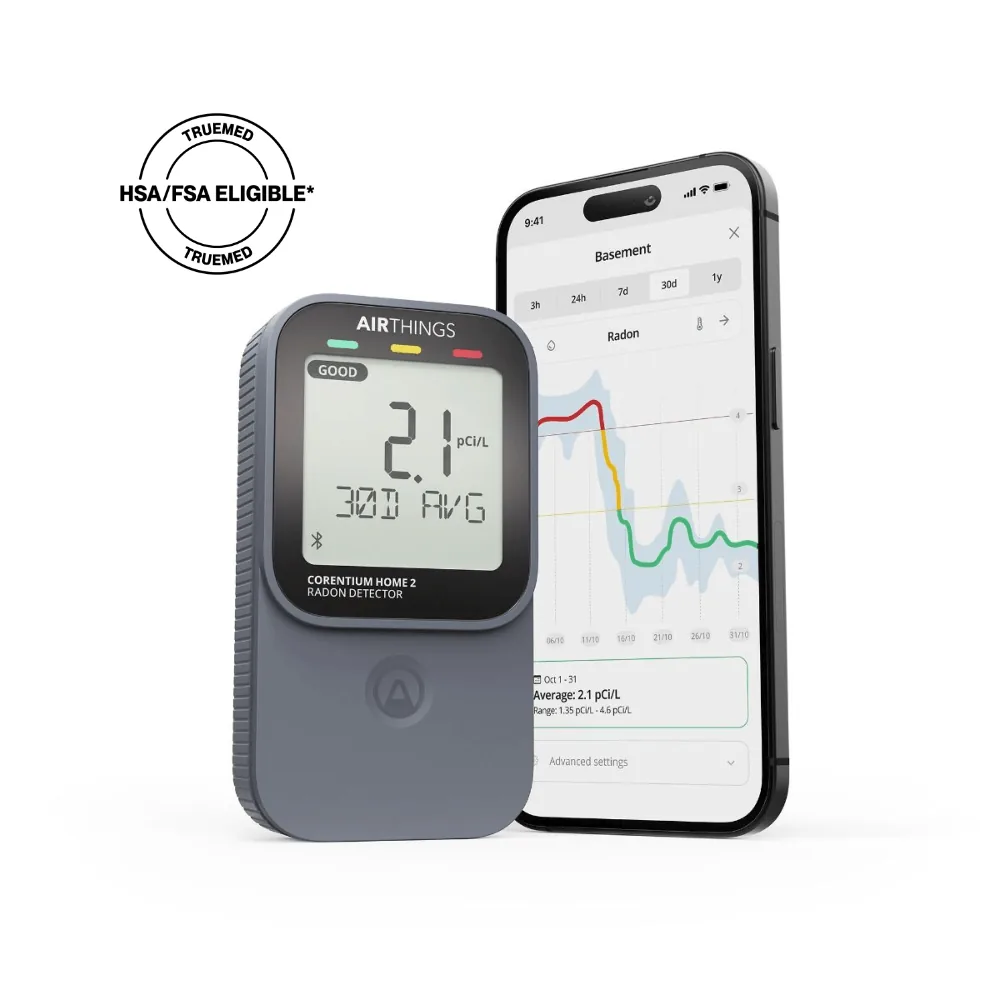
The Corentium Home is Airthings' plain digital radon detector: a small battery unit with a screen, no app and no wireless connection. The Corentium Home 2 keeps that idea and the same kind of sensor, and adds a phone connection and two extra sensors. This page sets out what stayed the same, what changed, and what independent results exist for each, in Airthings' own figures. It does not pick one. Airthings presents the Corentium Home 2 as the newer model, but its US store still sells the original.
| Compared | Corentium Home | Corentium Home 2 |
|---|---|---|
| Model number | 223 (United States), 244 (Europe) | 325 |
| Radon sensor | Passive diffusion chamber, alpha spectrometry | Passive diffusion chamber, alpha spectrometry |
| Power | 3 AAA alkaline batteries | 2 AA alkaline batteries |
| Battery life, as stated | 2 years | Up to 3 years unconnected, up to 2 years on Bluetooth |
| Phone app | None | Airthings app over Bluetooth |
| Other sensors | None | Temperature and humidity |
| Radon range | 0 to 500 pCi/L | 0 to 250 pCi/L |
| Availability from Airthings | For sale on its US store; no longer available on its Canadian page | Listed on its US store |
| C-NRPP 2024/25 | Approved, A in all four rounds | Not included |
Inside, the two detectors work the same way. Airthings describes the radon sampling in both as a passive diffusion chamber: air drifts in on its own, with no fan or pump, and the sensor counts the alpha particles that radon and its decay products give off, which is what alpha spectrometry means. Neither needs a laboratory, and Airthings points out for the original that there are no lab fees and you can check the reading whenever you like.
Both run on batteries rather than a wall socket, so either can sit in any room. Both show averages on a built-in screen rather than one live number: the Corentium Home shows rolling short-term and long-term averages, and the Corentium Home 2 adds views up to a 30-day average and a long-term average covering up to a year. Airthings gives the same recommended operating range for both, 39 to 104°F with relative humidity below 85%, and describes the Corentium Home 2 as keeping the original's accuracy while adding smart connectivity.
| Specification | Both models |
|---|---|
| Radon sampling | Passive diffusion chamber |
| Detection method | Alpha spectrometry |
| Power | Batteries, no cable needed |
| Reading on the device | A screen showing radon averages |
| Lab fees | None |
| Operating range | 39 to 104°F, relative humidity below 85% |
Airthings sums up the changes as Bluetooth connectivity, the Airthings app, two bonus sensors and better battery life. In practice that means four things. First, power: the Corentium Home runs on three AAA alkaline batteries that Airthings rates for 2 years, while the Corentium Home 2 takes two AA batteries and is rated for up to 3 years when it is not connected, or up to 2 years with Bluetooth in use.
Second, the phone. The original has no app; everything is on its screen. The Corentium Home 2 connects over Bluetooth to the free Airthings app for graphs, and it can connect through Airthings SmartLink to an Airthings hub device for Wi-Fi access. Third, the extra sensors: the Corentium Home 2 also measures temperature and humidity, and Airthings markets it for basements and lower floors, where its humidity reading flags damp conditions. Fourth, the screen: after 30 days the Corentium Home 2 offers six views, the 24-hour, 7-day, 30-day and long-term radon averages plus temperature and humidity, and it returns to the long-term average after 5 minutes.
| Compared | Corentium Home | Corentium Home 2 |
|---|---|---|
| Batteries | 3 AAA alkaline | 2 AA alkaline, installed |
| Battery life, as stated | 2 years | Up to 3 years unconnected; up to 2 years on Bluetooth; up to 3 years on SmartLink |
| Connection | None | Bluetooth; SmartLink to an Airthings hub for Wi-Fi access |
| Extra sensors | None | Temperature and humidity |
| Screen views | Rolling short-term and long-term averages | 24-hour, 7-day, 30-day and long-term radon averages, temperature, humidity |
| Radon range | 0 to 500 pCi/L (0 to 9,999 Bq/m³) | 0 to 250 pCi/L (0 to 9,999 Bq/m³) |
| Size and weight | 4.7 x 2.7 x 1.0 in, 5.2 oz with batteries | 2.40 x 1.14 x 4.45 in, 5.08 oz with batteries |
Airthings states its accuracy figures at 5.4
The independent picture differs. C-NRPP's 2024/25 consumer monitor evaluation, which put each device through four rounds of testing in four different sets of conditions, approved the Corentium Home and graded it A in all four rounds; Airthings' Canadian page also says the model is C-NRPP approved. The Corentium Home 2 was not included in that evaluation, so there is no C-NRPP result for it either way. Not being included is a fact about which devices took part, not a failed test. C-NRPP tested the Canadian version of the original, and we have not confirmed that the US model 223 is identical.
| Evidence | Corentium Home | Corentium Home 2 |
|---|---|---|
| Maker's figure at 5.4 pCi/L | About 10% after 7 days; about 5% after 2 months | Within 10% after 7 days |
| Maker's figure at 10 pCi/L | Not stated | Within 10% after 4 days |
| C-NRPP 2024/25 evaluation | Approved; A, A, A, A | Not included |
Nothing about the newer model changes how the original measures. Its screen still shows a short-term and a long-term average, and the long-term figure is the one to act on. C-NRPP's advice for any consumer monitor applies to both: run it for at least 3 months, ideally in the heating season, in a room people use for at least 4 hours a day, and base a decision on the long-term average rather than a day's reading.
Airthings also notes a reporting feature on the original: you can generate a radon self-inspection report to document or share your readings. If what you miss is a phone history or a humidity reading, those are what the Corentium Home 2 adds. Either way, a consumer monitor cannot be professionally calibrated and is not approved by C-NRPP for use by radon measurement professionals, so a home sale may need a different test; check what your state accepts.
Neither comes out ahead. Each column below has four points drawn from what Airthings and C-NRPP state, so the choice rests on what you need.
| Compared | The Corentium Home fits if | The Corentium Home 2 fits if |
|---|---|---|
| Evidence | You want the model that was itself graded in C-NRPP's 2024/25 evaluation | You are content with the maker's figures and C-NRPP's general advice for consumer monitors |
| Buying | You already own one, or want the simpler model Airthings' US store still sells | You want the model Airthings presents as the newer of the two |
| Phone | You want no app and no wireless connection at all | You want graphs in a phone app over Bluetooth |
| Extras | You want a radon range listed up to 500 pCi/L | You want temperature and humidity in the same device |
Each has its own page with every specification and its evidence box: Airthings Corentium Home and Airthings Corentium Home 2. Every monitor we cover is on radon detectors and monitors, and the other Airthings pair is compared on View Plus vs Wave Plus.
Monitor
Method: Alpha spectrometry
Monitor
Method: Alpha spectrometry
Readings: Every 60 minutes
As an Amazon Associate, Radon411 earns from qualifying purchases.
Step 1 of 5:
Pick the floor
The lowest lived-in level of the home, in a room used regularly, such as a living room, playroom, den or bedroom, not a kitchen or bathroom.
Step 2 of 5:
Pick a room people use
A room occupied for at least 4 hours each day.
Step 3 of 5:
Set the height
At least 20 inches above the floor, away from drafts, high heat, high humidity and exterior walls.
Step 4 of 5:
Keep clear of openings (Corentium Home 2)
Airthings asks for at least 3 feet from the nearest door, window or air vent, out of direct sunlight and moisture, and not to move it during a measurement.
Step 5 of 5:
Give it time
At least 3 months, preferably in the heating season, and decide on the long-term average.
More on placement is at where to place a radon test, and on reading the result at continuous radon monitors.
Not in the United States as of October 2026: Airthings' US store lists it for sale. Its Canadian page lists it as no longer available, and the Corentium Home 2's page calls the original its previous model.
Model 223 is Airthings' number for the United States version of the original Corentium Home; the European version is model 244. The Corentium Home 2 is model 325.
Airthings describes both as a passive diffusion chamber read by alpha spectrometry, and says the Corentium Home 2 keeps the original's accuracy while adding smart connectivity.
It was not included in C-NRPP's 2024/25 evaluation, so there is no result for it either way. The original Corentium Home was approved in that evaluation, with an A in all four rounds.
No. It shows its readings on its own screen and has no wireless connection. The Corentium Home 2 adds Bluetooth and the Airthings app.
The original takes three AAA alkaline batteries, which Airthings rates for 2 years. The Corentium Home 2 takes two AA batteries, rated for up to 3 years unconnected and up to 2 years with Bluetooth.
Airthings states about 10% after 7 days and about 5% after 2 months at 5.4 pCi/L for the original, and within 10% after 7 days at the same level for the Corentium Home 2. Those are the maker's figures; the independent results are in the table above.
Consumer monitors cannot be professionally calibrated and are not approved by C-NRPP for use by radon measurement professionals. Check what the contract and your state accept, which is often a test by a certified professional.
Yes: temperature and humidity. Airthings markets it for basements and lower floors, where the humidity reading flags damp conditions.
At least 3 months, preferably in the heating season, and decide on the long-term average rather than a short-term figure.