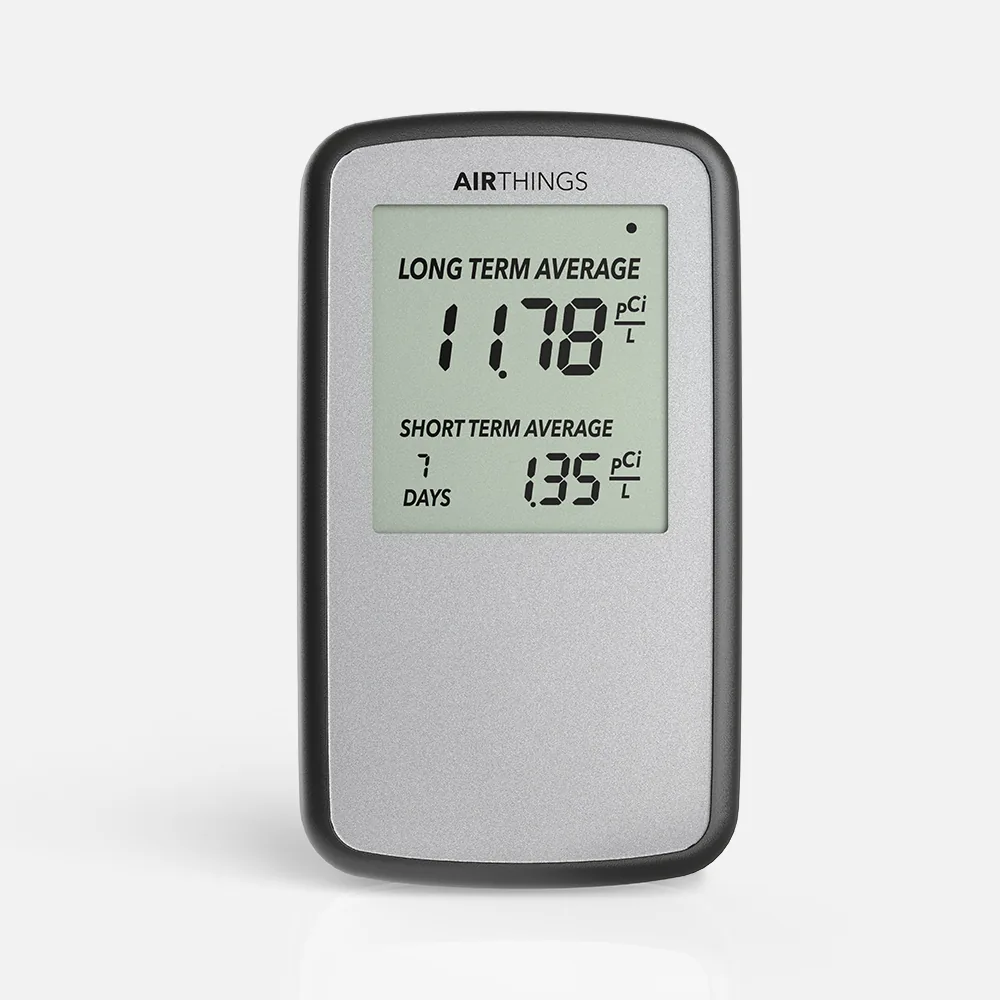
Monitor
Corentium Home battery digital radon detector
- C-NRPP 2024/25: Approved
- Battery
- Screen
Method: Alpha spectrometry
ProductsCompare
Short answer
The Airthings Corentium Home and the Ecosense RadonEye RD200 were both approved in C-NRPP's 2024/25 evaluation with an A in all four rounds, so the choice comes down to how you will use one. The Corentium Home runs on batteries with no app and takes 24 hours for a first reading, while the RadonEye plugs in, shows a first reading after 10 minutes and keeps its history in a Bluetooth app.
The Corentium Home and the RadonEye RD200 are two consumer radon monitors that C-NRPP's 2024/25 evaluation approved with an A in every round. They are built for different habits. One runs on batteries and keeps everything on its own screen; the other plugs into the wall, counts radon every 10 minutes and sends its history to your phone. This page sets those differences side by side in each maker's own figures, with the independent results for each, and ends with the one we would pick for each kind of use. Nothing here comes from a test of our own.
| Compared | Corentium Home | RadonEye RD200 |
|---|---|---|
| How it measures | Passive diffusion chamber, alpha spectrometry | Pulsed ionization chamber |
| Power | 3 AAA alkaline batteries, rated for 2 years | Plug-in adapter, 12 V |
| On the device | LCD screen: rolling short-term and long-term averages | OLED screen: the last measurement, scrolling through averages |
| Phone app | None | Ecosense app over Bluetooth |
| First reading | After 24 hours, as C-NRPP lists it | After 10 minutes |
| Alarm | Not stated | Built-in audio alarm |
| C-NRPP 2024/25 | Approved, A in all four rounds | Approved, A in all four rounds |
Airthings describes the Corentium Home's radon sampling as a passive diffusion chamber and its detection method as alpha spectrometry. Air drifts into the chamber on its own, with no fan or pump, and the sensor counts the alpha particles that radon and its decay products give off. Nothing goes to a laboratory: Airthings points out that there are no lab fees and that you can check your readings whenever you need to.
Ecosense names a pulsed ionization chamber as the RadonEye RD200's sensor and rates its sensitivity at 30 counts per hour for each
| Compared | Corentium Home | RadonEye RD200 |
|---|---|---|
| Range | 0 to 500 pCi/L (0 to 9,999 Bq/m³) | 0.2 to 99.9 pCi/L (7 to 3,700 Bq/m³) |
| Maker's accuracy claim | About 10% after 7 days and about 5% after 2 months, at 5.4 pCi/L | Under ±10% at 10 pCi/L after 10 hours |
| Stated accuracy on C-NRPP's list | ±10% after 7 days at 200 Bq/m³, ±5% after 2 months | ±10% at 370 Bq/m³ after 10 hours |
| How often it reports | 12-hour, 24-hour and 7-day reading periods, as C-NRPP lists them | Every 10 minutes, as a 60-minute moving average |
| Operating range | 39 to 104°F, relative humidity below 85% | 32 to 104°F, relative humidity under 80% |
The Corentium Home's screen is the whole interface. Airthings describes it as a simple, always-on radon detector with short-term and long-term radon levels on an integrated LCD display, and it has no Bluetooth, Wi-Fi or app. C-NRPP's list gives its reading periods as 12 hours, 24 hours and 7 days, with the first reading taking 24 hours. Airthings adds that you can generate a radon self-inspection report to document or share your readings.
The RadonEye RD200 answers sooner. Ecosense says the first reading arrives in 10 minutes, with no 24-hour wait, and that results update every 10 minutes on the OLED display, which shows the last measurement taken and scrolls through averages. Its app connects over Bluetooth, tracks short-term and long-term trends and keeps track of hourly levels, and the device saves data for up to a year. It has no internal clock, so anything tied to a date lives in the app rather than on the screen.
| Compared | Corentium Home | RadonEye RD200 |
|---|---|---|
| On the device | LCD: rolling short-term and long-term averages | OLED: the last measurement and scrolling averages |
| In an app | No app | Short-term and long-term trends and hourly levels, over Bluetooth |
| First number | After 24 hours | After 10 minutes |
| Stored on the device | Not stated | Up to a year of data |
| Extras | A radon self-inspection report | A built-in audio alarm |
The Corentium Home runs on three AAA alkaline batteries, which Airthings rates for 2 years, so it can sit in any room without a cable. The RadonEye RD200 runs from its 12 V adapter, which Ecosense sells separately as a replacement, so it needs an outlet in the room you want to measure. Ecosense says the RadonEye keeps its stored data through a power cut unless you reset it through the app, but the real-time data and the daily and weekly averages on its screen reset, and nothing is measured without power.
Neither needs a laboratory. Airthings describes a 5-year extended warranty on its consumer monitors, with registration required within 30 days of purchase. Ecosense gives the RadonEye RD200 a 12-month limited warranty, adds a one-year extension when you register the device within 30 days, and gives it an expected service life of 5 years.
| Compared | Corentium Home | RadonEye RD200 |
|---|---|---|
| Power | 3 AAA alkaline batteries | 12 V, 1 A adapter |
| Stated battery life | 2 years | No battery; it runs from the adapter |
| In a power cut | It runs on batteries, not the mains | Stored data kept; screen averages reset; no measuring without power |
| Warranty | 5-year extended warranty with registration within 30 days | 12 months, plus one year when registered within 30 days |
| Expected service life | Not stated | 5 years |
Both models were approved in C-NRPP's 2024/25 consumer monitor evaluation, which put each device through four rounds of testing in four different sets of conditions, and both graded A in all four rounds. C-NRPP's list describes the RadonEye RD200 as taking measurements every 10 minutes and displaying an hourly rolling average, and the Corentium Home as showing a short-term and a long-term average on its display. C-NRPP tested Canadian-market units; we have not confirmed that the US versions are identical.
Only the RadonEye took part in a 2024 field study that ran consumer monitors beside a calibrated reference instrument at a natural radiation laboratory in Salamanca, Spain, between 1 July and 23 August 2023. Over those 54 days its average differed from the reference by -15.8%, and 2.2% of its records were lost. The Corentium Home was not among the monitors in that study, so there is no field result for it either way.
| Evidence | Corentium Home | RadonEye RD200 |
|---|---|---|
| C-NRPP 2024/25 evaluation | Approved; A, A, A, A | Approved; A, A, A, A |
| 2024 field study: difference from the reference over 54 days | Not in the study | -15.8% |
| 2024 field study: records lost | Not in the study | 2.2% |
On the independent evidence the two are level: C-NRPP approved both with an A in every round. So the pick turns on how you will use it. Each row below follows from what Airthings, Ecosense and C-NRPP state, and each monitor gets three.
| If you want | Our pick | Why |
|---|---|---|
| A monitor for a room with no outlet | Corentium Home | It runs on three AAA batteries rated for 2 years; the RadonEye runs from its adapter |
| Nothing to pair: no app and no wireless connection | Corentium Home | Everything is on its own screen |
| Readings that carry on through a power cut | Corentium Home | It runs on batteries; Ecosense says the RadonEye measures nothing without power |
| A first number within minutes | RadonEye RD200 | Ecosense states a first reading after 10 minutes; C-NRPP lists 24 hours for the Corentium Home |
| An hour-by-hour record on your phone, for example after sealing a crack or changing a fan | RadonEye RD200 | It measures every 10 minutes and keeps hourly levels in its Bluetooth app |
| A built-in alarm | RadonEye RD200 | Ecosense lists an integrated audio alarm; no alarm is stated for the Corentium Home |
Each has its own page with every specification and its evidence box: Airthings Corentium Home and Ecosense RadonEye RD200. Each is also set beside its own sibling, on Corentium Home vs Corentium Home 2 and RadonEye RD200 vs EcoQube, and every monitor we cover is on best radon monitors.
Monitor
Method: Alpha spectrometry
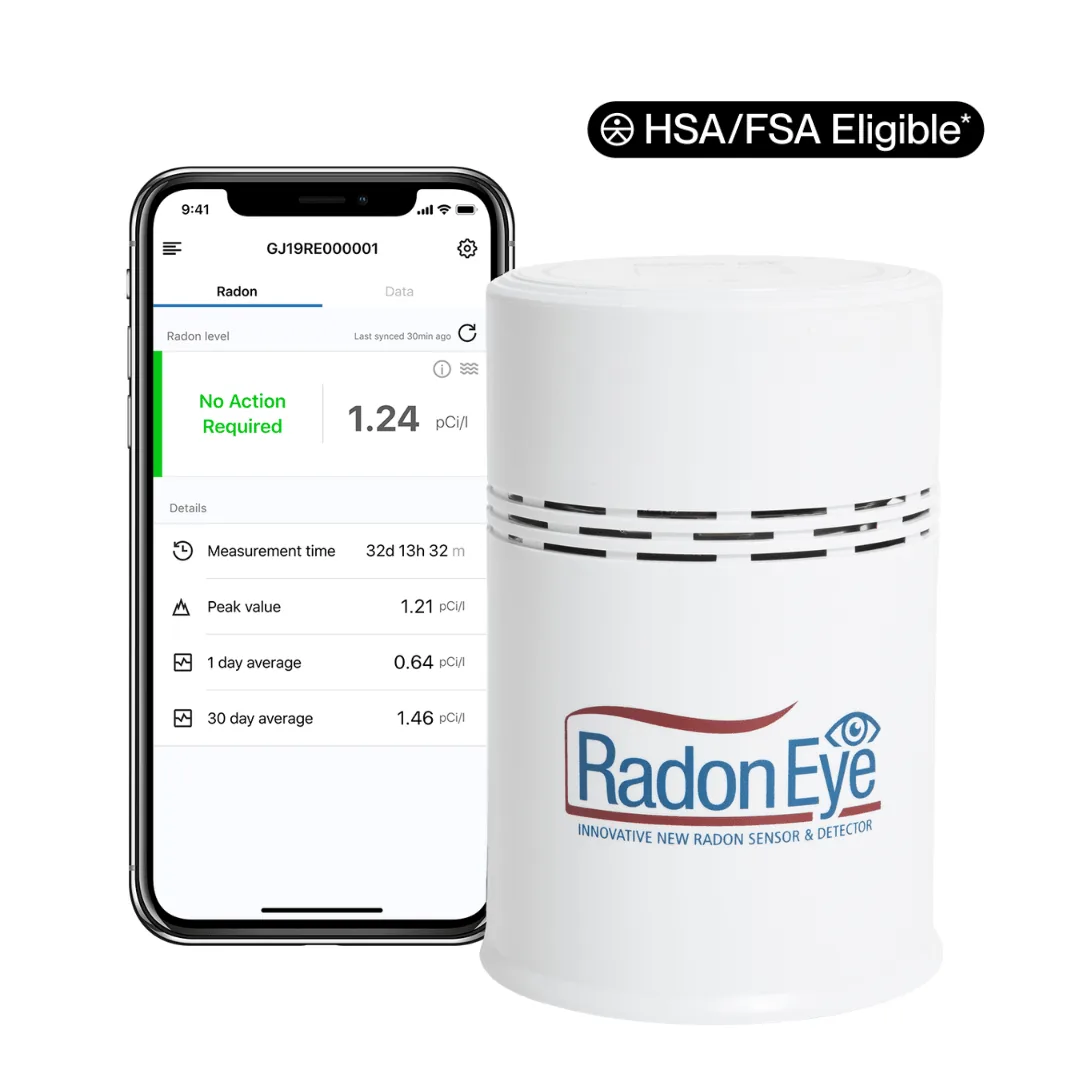
Monitor
Method: Ion chamber
First reading: Within 10 minutes
As an Amazon Associate, Radon411 earns from qualifying purchases.
Step 1 of 6:
Pick the floor
The lowest lived-in level of the home, in a room used regularly, such as a living room, playroom, den or bedroom, not a kitchen or bathroom.
Step 2 of 6:
Pick a room people use
A room occupied for at least 4 hours each day.
Step 3 of 6:
Set the height
At least 20 inches above the floor, away from drafts, high heat, high humidity and exterior walls.
Step 4 of 6:
Mind the router and the wall (RadonEye)
Ecosense asks for at least 20 inches above the floor and from the wall, at least 24 inches from any Wi-Fi router or hotspot, and no spot close to open windows or vents.
Step 5 of 6:
Mind the damp (Corentium Home)
Airthings gives an operating range of 39 to 104°F with relative humidity below 85%, so a very damp corner is not the place for it.
Step 6 of 6:
Give it time
At least 3 months, preferably in the heating season, and decide on the long-term average. With less than 91 days of data, follow up with a long-term test.
More on placement is at where to place a radon test, and on reading the result at continuous radon monitors.
Neither is shown to be more accurate. C-NRPP's 2024/25 evaluation approved both with an A in all four rounds. Each maker states its accuracy at a different level and after a different time, so those figures do not compare, and only the RadonEye took part in the 2024 field study.
No. It has no app and no Bluetooth or Wi-Fi: its LCD screen shows rolling short-term and long-term averages.
Ecosense states a first reading after 10 minutes, with no 24-hour wait, and a reliable average within an hour. It then updates every 10 minutes, showing a 60-minute moving average.
C-NRPP's list gives its first reading as taking 24 hours, with reading periods of 12 hours, 24 hours and 7 days.
Either can go on the lowest lived-in level. Pick the Corentium Home if there is no outlet where it should sit, since it runs on batteries; pick the RadonEye if there is one and you want an hour-by-hour record. Keep the Corentium Home out of very damp corners: Airthings gives its operating range as relative humidity below 85%.
Only the Corentium Home runs on batteries: three AAA alkaline cells, which Airthings rates for 2 years. The RadonEye runs from its 12 V adapter and has no battery.
Yes. Both were approved in C-NRPP's 2024/25 consumer monitor evaluation, each with an A in all four rounds. C-NRPP tested Canadian-market units, and we have not confirmed that the US versions are identical.
No. It shows readings on its own screen and connects to its app over Bluetooth. Ecosense asks that it sit at least 24 inches from any Wi-Fi router or hotspot.
No. Both measure radon in the device itself, so there is nothing to post and no lab to pay; Airthings points out that the Corentium Home has no lab fees.
Consumer monitors cannot be professionally calibrated and are not approved by C-NRPP for use by radon measurement professionals. Check what the contract and your state accept, which may be a test by a certified professional; see radon measurement professionals.
At least 3 months, preferably in the heating season, and decide on the long-term average. With less than 91 days of data, C-NRPP recommends following up with a long-term test.