Monitor
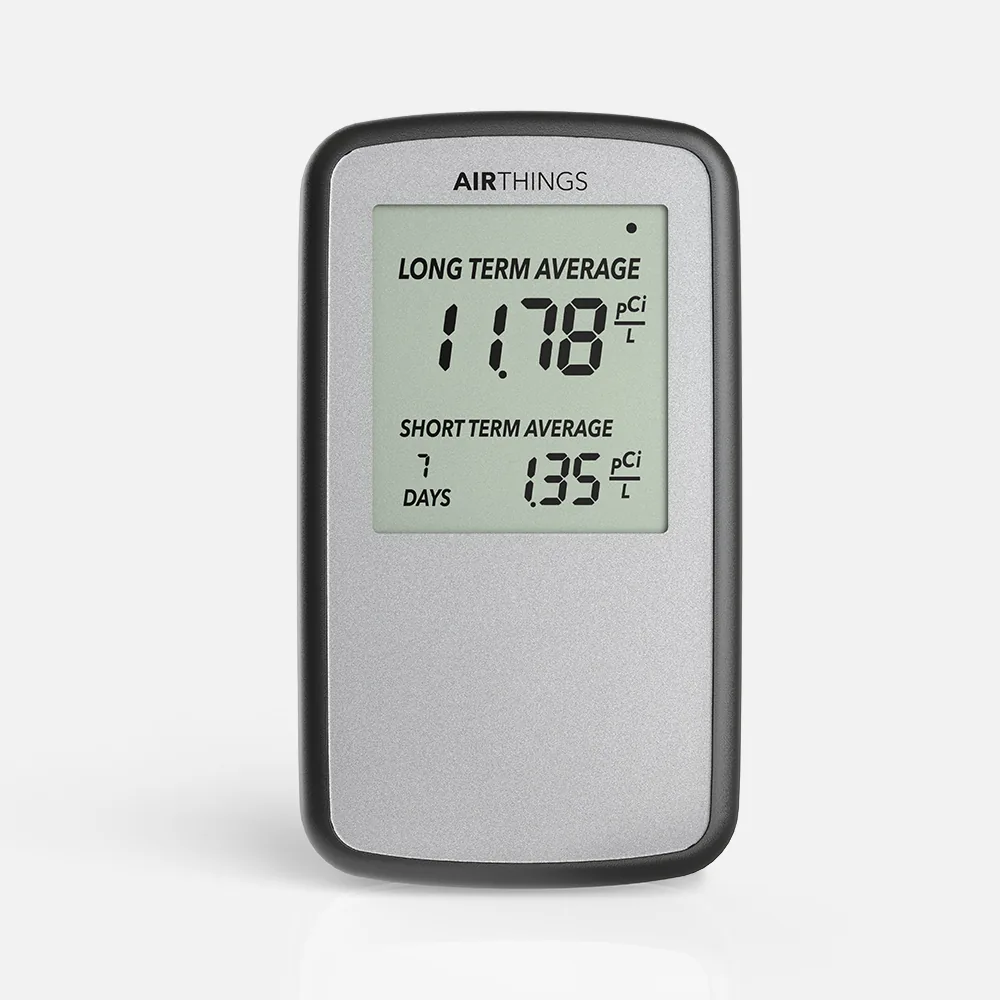
Corentium Home battery digital radon detector
- C-NRPP 2024/25: Approved
- Battery
- Screen
Method: Alpha spectrometry
ProductsCompare
Short answer
Airthings lists the same radon sensor and the same stated accuracy for the View Plus and the Corentium Home, but the View Plus adds six air quality sensors and an ePaper screen with Wi-Fi, while the Corentium Home measures radon alone with no app. C-NRPP graded the Corentium Home A in all four 2024/25 rounds, and a device it lists as the Airthings View B, C, B and B.
The Airthings View Plus and Corentium Home come from the same maker and, for radon, Airthings describes the same kind of sensor and the same accuracy for both. Everything else differs. The View Plus adds six more sensors and a large ePaper screen, connects over Wi-Fi to an app, and can run from a cable; the Corentium Home is a small radon-only detector on three AAA batteries that you read by looking at it. Their independent results differ too. This page sets it all out in Airthings' and C-NRPP's own figures and ends with the one we would pick for each use. Nothing here comes from a test of our own.
| Compared | View Plus | Corentium Home |
|---|---|---|
| Radon method | Passive diffusion chamber, alpha spectrometry | Passive diffusion chamber, alpha spectrometry |
| Other sensors | PM2.5, CO2, VOCs, temperature, humidity, air pressure | None |
| On the device | 2.9-inch ePaper screen and a glow indicator | LCD screen: rolling short-term and long-term averages |
| Connection and app | Wi-Fi (2.4 GHz), SmartLink, Bluetooth; the Airthings app | None |
| Power | 6 AA batteries or USB-C | 3 AAA alkaline batteries |
| C-NRPP 2024/25 | Approved as "Airthings View": B, C, B, B; model not stated | Approved: A, A, A, A |
For radon, Airthings lists the same design for both. Air reaches a passive diffusion chamber with no fan or pump, and the radon in it is measured by alpha spectrometry, counting the alpha particles that radon and its decay products give off. Both have a stated radon range of 0 to 500
| Specification | Both models |
|---|---|
| Radon sampling | Passive diffusion chamber |
| Detection method | Alpha spectrometry |
| Radon range | 0 to 500 pCi/L |
| Maker's accuracy claim | About 10% after 7 days, about 5% after 2 months |
| Lab fees | None |
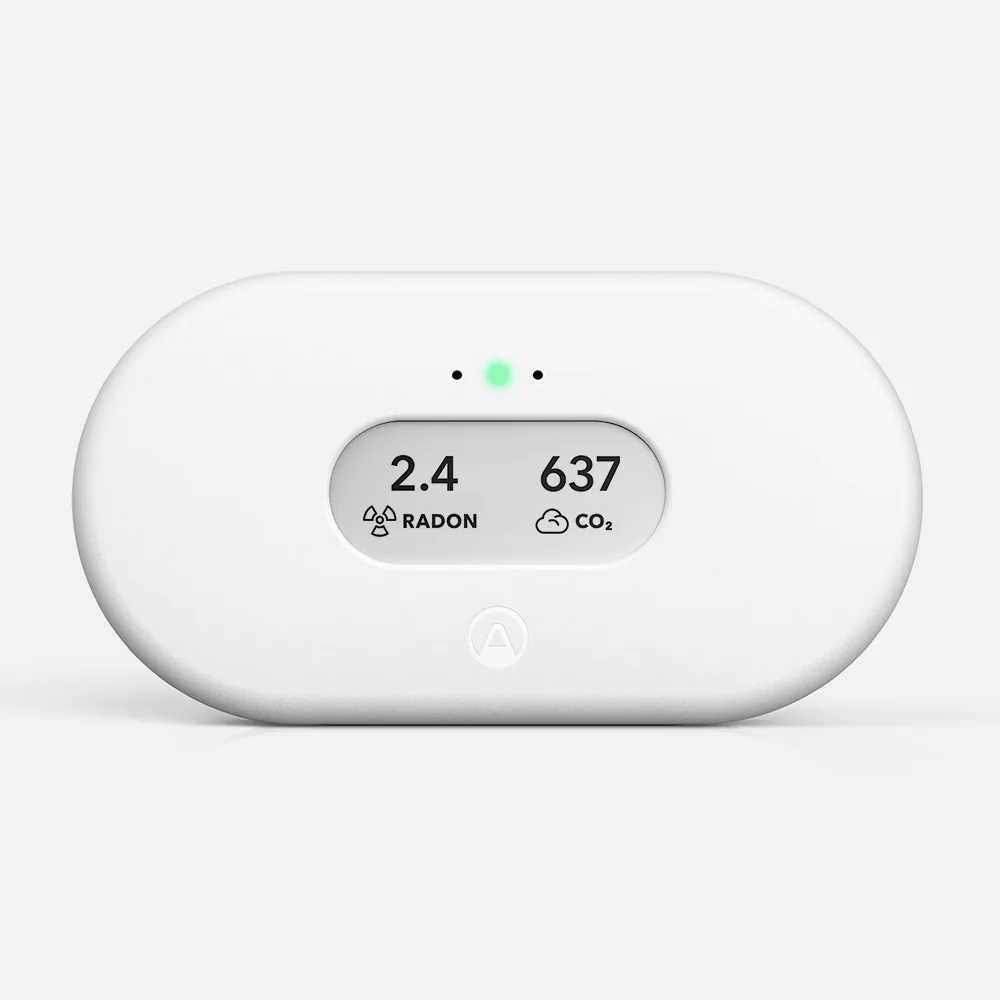
The View Plus is an air quality monitor first. Besides radon it measures particulate matter (PM2.5), carbon dioxide, airborne chemicals (VOCs), temperature, humidity and air pressure, and its other sensors sample every 5 minutes. The readings you choose show on a 2.9-inch ePaper screen, and a red, yellow and green glow gives the level at a glance; for radon, Airthings lists the glow's thresholds as 4 pCi/L and above, and from 2.7 to under 4 pCi/L. It connects over 2.4 GHz Wi-Fi, Airthings SmartLink and Bluetooth Low Energy, uses Bluetooth for onboarding and daily configuration, and lets you access your air data and history from anywhere over Wi-Fi. With Wi-Fi and its USB-C cable connected, its hub functionality is enabled.
The Corentium Home does one job. Airthings describes it as a simple, always-on radon detector with short-term and long-term radon levels on an integrated LCD display. It has no Bluetooth, Wi-Fi or app, so there is nothing to pair and no account, and you check rolling short-term and long-term averages by looking at it. Airthings adds that you can generate a radon self-inspection report to document or share your readings. C-NRPP's list gives its reading periods as 12 hours, 24 hours and 7 days, with the first reading taking 24 hours.
| Compared | View Plus | Corentium Home |
|---|---|---|
| Sensors | Radon, PM2.5, CO2, VOCs, temperature, humidity, air pressure | Radon |
| Screen | 2.9-inch ePaper, the readings you choose | LCD, rolling short-term and long-term averages |
| Glow indicator | Red, yellow and green | None stated |
| Away from home | Air data from anywhere over Wi-Fi | No connection |
| Hub for other Airthings monitors | With Wi-Fi and USB-C connected | No |
| First radon reading | Not stated | After 24 hours, as C-NRPP lists it |
The View Plus runs on 6 AA batteries or a USB-C cable, and falls back to its batteries if the cable is removed; Airthings gives a battery life of up to 2 years, depending on the sensor interval and the Wi-Fi router. The Corentium Home runs on three AAA alkaline batteries, rated for 2 years, and runs cable-free. Both can sit in a room with no outlet. Neither has a lab fee, and Airthings describes a 5-year extended warranty on its consumer air quality monitors, with registration required within 30 days of purchase.
| Compared | View Plus | Corentium Home |
|---|---|---|
| Power | 6 AA batteries, or USB-C | 3 AAA alkaline batteries |
| Stated battery life | Up to 2 years, depending on sensor interval and Wi-Fi router | 2 years |
| Weight | 12.7 oz (360 g) with batteries | 5.2 oz (130 g) with batteries |
| Size | 17 x 9 x 3.3 cm | 4.7 x 2.7 x 1.0 in |
| Model number | 2960 | 223 (United States), 244 (Europe) |
C-NRPP's 2024/25 consumer monitor evaluation put each device through four rounds of testing in four different sets of conditions. It approved the Corentium Home with an A in all four rounds. It also approved a device it lists as the Airthings View, linking Airthings' View Radon page, with grades of B, C, B and B; C-NRPP recommends devices that average B or better. The listing does not say which View model was tested, and C-NRPP's 2023 report listed the View Plus as passing. C-NRPP tested Canadian-market units; we have not confirmed that the US versions are identical.
Only the View Plus took part in a 2024 field study that ran consumer monitors beside a calibrated reference instrument at a natural radiation laboratory in Salamanca, Spain, between 1 July and 23 August 2023. Its average differed from the reference by 7.7%, and 1.6% of its records were lost. In the study's test of a sharp rise in radon, which the reference followed in about 8 hours, it reached only the 10% level of the change. The Corentium Home was not among the monitors in that study.
| Evidence | View Plus | Corentium Home |
|---|---|---|
| C-NRPP 2024/25 evaluation | "Airthings View" listing approved: B, C, B, B; model not stated | Approved: A, A, A, A |
| 2024 field study: difference from the reference over 54 days | 7.7% | Not in the study |
| 2024 field study: records lost | 1.6% | Not in the study |
| 2024 field study: a sharp rise | Reached only the 10% level | Not in the study |
For radon alone, the Corentium Home is the one with a C-NRPP grade of its own: the model itself was graded A in every round. The View Plus is the pick when radon is one question among several. Each row below follows from what Airthings and C-NRPP state, and each monitor gets three.
| If you want | Our pick | Why |
|---|---|---|
| Radon and the air in the rooms you live in: particles, carbon dioxide, VOCs | View Plus | Seven sensors on one screen |
| Readings from anywhere, over Wi-Fi | View Plus | Air data and history in the Airthings app; the Corentium Home has no connection |
| The choice of batteries or a cable | View Plus | 6 AA batteries or USB-C, falling back to the batteries |
| Radon only, on a model itself graded A in every C-NRPP round | Corentium Home | C-NRPP's 2024/25 grades: A, A, A, A |
| Nothing to pair: no app, no Wi-Fi, no account | Corentium Home | Everything is on its own LCD screen |
| A small radon detector for the lowest lived-in level | Corentium Home | 5.2 oz on three AAA batteries; radon is a test for the lowest lived-in level, while the View Plus's other readings matter most where you live |
Each has its own page with every specification and its evidence box: Airthings View Plus and Airthings Corentium Home. The View Plus is also set beside its screenless sibling on View Plus vs Wave Plus, and every current Airthings model is on Airthings radon monitors compared.
Monitor
Method: Alpha spectrometry
Monitor
Method: Alpha spectrometry
As an Amazon Associate, Radon411 earns from qualifying purchases.
Step 1 of 5:
Pick the floor for radon
The lowest lived-in level of the home, in a room used regularly, such as a living room, playroom, den or bedroom, not a kitchen or bathroom.
Step 2 of 5:
Pick a room people use
A room occupied for at least 4 hours each day.
Step 3 of 5:
Set the height
At least 20 inches above the floor, away from drafts, high heat, high humidity and exterior walls.
Step 4 of 5:
Weigh the two jobs (View Plus)
Radon is usually highest on the lowest floor, while the other readings matter most where people sleep and live. Airthings itself sells the View Plus with a View Radon as a living-room-and-basement pair.
Step 5 of 5:
Give it time
At least 3 months, preferably in the heating season, and decide on the long-term average. With less than 91 days of data, follow up with a long-term test.
More on placement is at where to place a radon test, and on reading the result at continuous radon monitors.
Airthings states the same radon accuracy for both, about 10% after 7 days and about 5% after 2 months. The independent grades differ: C-NRPP approved the Corentium Home with an A in all four 2024/25 rounds, and a device it lists as the Airthings View with B, C, B and B, without saying which View model it tested.
Airthings describes both as a passive diffusion chamber read by alpha spectrometry, with a radon range of 0 to 500 pCi/L.
No. It has no Bluetooth, Wi-Fi or app; its LCD screen shows rolling short-term and long-term averages. The View Plus connects over Wi-Fi, SmartLink and Bluetooth, with the Airthings app.
Airthings uses Bluetooth for onboarding and daily configuration. Wi-Fi is what gives access to your air data from anywhere and enables its hub functionality, with the USB-C cable connected.
Particulate matter (PM2.5), carbon dioxide, VOCs, temperature, humidity and air pressure. The Corentium Home measures radon only.
For radon alone, the Corentium Home: a small battery detector for the lowest lived-in level. The View Plus's other readings matter most in the rooms where people sleep and live, and Airthings itself pairs it with a View Radon for the basement. Keep either out of humidity over 85%.
Both are rated at about 2 years: the Corentium Home on three AAA batteries, the View Plus on six AA batteries, depending on its sensor interval and Wi-Fi router. The View Plus can also run on USB-C.
C-NRPP's 2023 report listed the View Plus as passing. Its 2024/25 evaluation approved a device it lists as the Airthings View, linking Airthings' View Radon page, with B, C, B and B, and does not say which View model it tested.
Consumer monitors cannot be professionally calibrated and are not approved by C-NRPP for use by radon measurement professionals. Check what the contract and your state accept, which may be a test by a certified professional; see radon measurement professionals.
At least 3 months, preferably in the heating season, and decide on the long-term average. With less than 91 days of data, C-NRPP recommends following up with a long-term test.