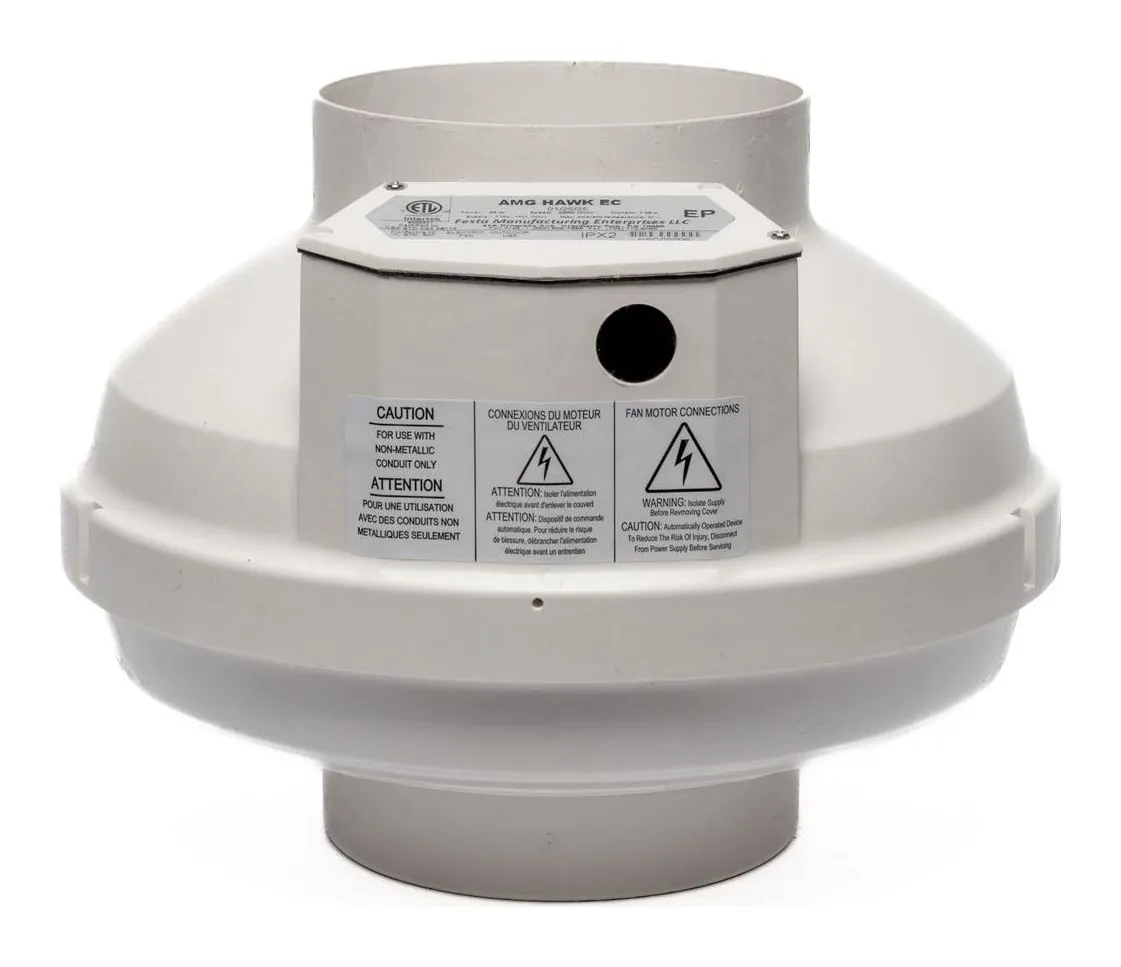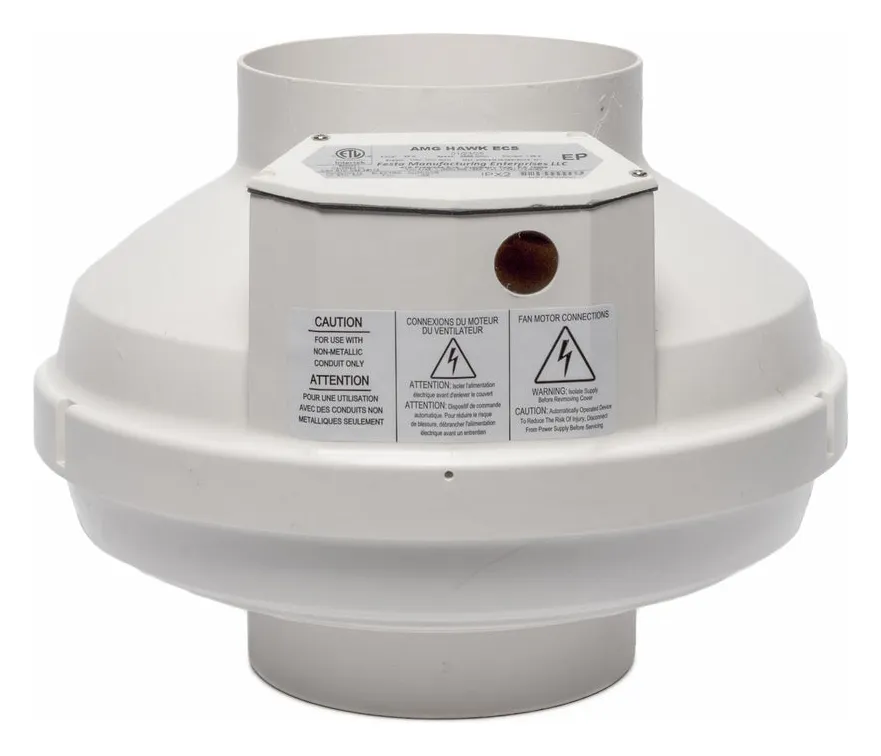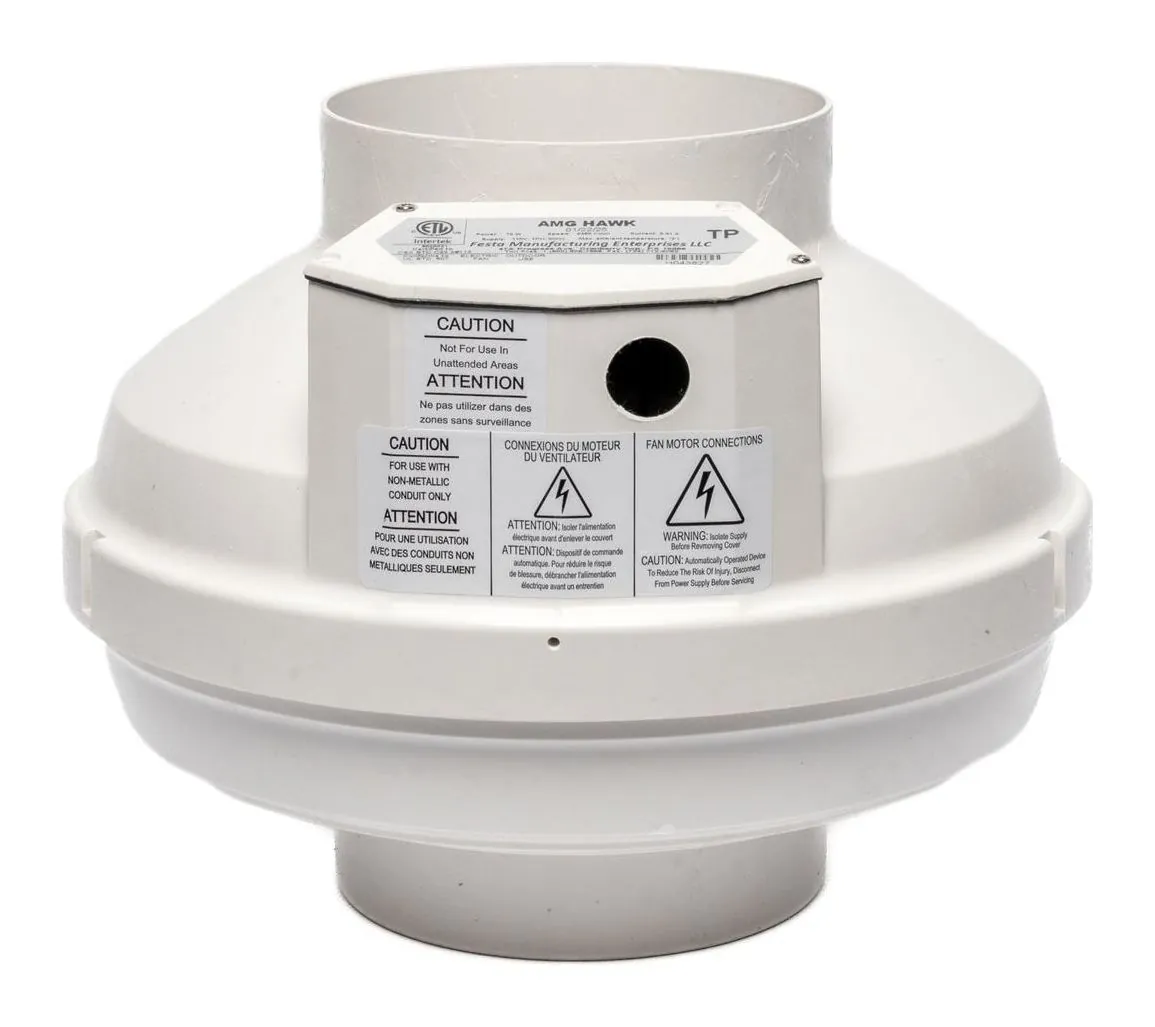
Radon fan
AMG Hawk high-flow inline radon fan
- 6 in. Fernco coupler size
- 66 W
Max airflow: 322 CFM
Max pressure: 2.1 in w.c.
Festa
8 inch inline radon fan
Best for you if
Skip it if
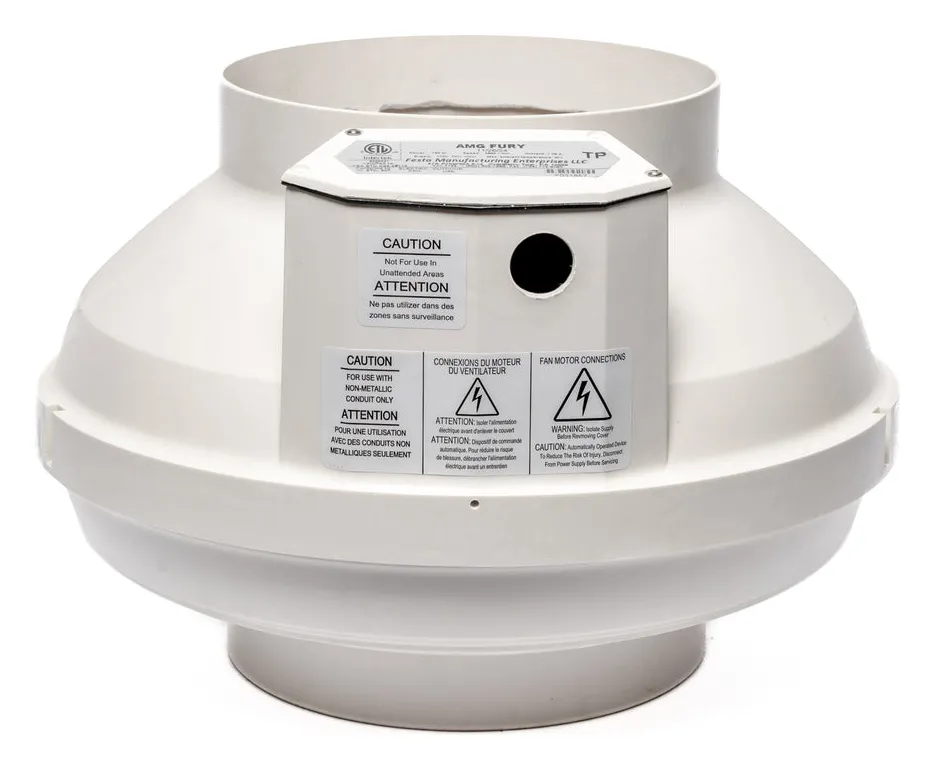
Photos: Festa
 (opens in a new tab)Check price on Amazon (opens in a new tab)
As an Amazon Associate, Radon411 earns from qualifying purchases.
Amazon and the Amazon logo are trademarks of Amazon.com, Inc. or its affiliates.
See ratings and reviews on Amazon (opens in a new tab)As Festa states it
The AMG Fury is an 8 inch AC radon fan, sold in white or grey, that Festa recommends for homes and other structures of 4,000 square feet or more built over porous fill such as gravel, and calls ideal for commercial projects. Festa's 2022 catalog rates it at 520 CFM with nothing in the way and a 2.65 inch w.g. maximum pressure on 140 W, and Festa's warranty document puts it on the five-year list for AC fans.
Festa's Fury page lists four styles: white or grey, each as fan only or with a 4 inch installation kit. The kit holds two Fernco couplers that fit the fan to 4 inch PVC pipe, white with the white fan and grey with the grey one, plus a green 5.5 inch radon system manometer, a line cord with connector and system labels. Buying the fan alone means sourcing the 8 by 4 inch Fernco separately.
In the box and running costsHow it works
The suction, the airflow and the housing, then who has checked it
In our words, from the maker's documents
Big slabs on clean gravel set a particular task. Air travels freely through the stone, so holding the whole area below room pressure takes volume more than pull. Festa's fan selection chart in its 2022 catalog sorts by footprint and fill, and for homes over 2,200 square feet on fill that is not compact it lists high flow fans: the Hawk, the Legend and the Fury, with the Legend Extreme also named.
The catalog prints the Fury's airflow in quarter-inch steps: 520 CFM at zero, 400 at 0.5 inch, 340 at 0.75, 291 at 1.0, 252 at 1.25, 221 at 1.5, 178 at 1.75, 133 at 2.0, 77 at 2.25 and 29 at 2.5, against a stated maximum pressure of 2.65 inches. Read as a curve, the fan gives up about a quarter of its free flow by the first half inch, then loses roughly 30 to 60 CFM with every further quarter inch.
For scale, the EPA's guide to radon-resistant construction says most contractors have found 90-watt in-line fans adequate for most home styles and sizes, and that a fan moving 100 cubic feet a minute at one inch of water column should be sufficient for most applications. Festa's table has the Fury moving 291 CFM at that inch, close to three times the guide's figure, which fits Festa aiming it at buildings of 4,000 square feet and up rather than at a typical house.
The catalog's specification block lists 115 V at 60 Hz, 140 W, 1.23 A at most, 2,600 RPM, an 8 inch Fernco and a weight of 11 lbs. The same page set gives the 6 inch Legend and the 3 inch Prowler those same watts, amps and speed, so on paper the Fury differs from them in its coupler size, its weight and the air it moves.
Festa Manufacturing Enterprises' installation and wiring instructions cover nine AMG in-line models and name the Fury among them. They say the units can be mounted indoors or outdoors, that the electric motor is protected by an internal overheat device, and that the fans must not be used with solid state speed controllers. Canadian users are the one exception: they may use only KB Electronics' KBMC-13BV, and not with the Extreme models.
Festa offers the Fury in white or grey and sells both colours alone or with a 4 inch installation kit. Its product page gives an estimated noise range of 70 to 75 dB that can vary with the system configuration; for the AC Hawk, a 6 inch high flow fan, Festa's estimate is 55 to 60 dB.
Festa's own statements, attributed
These are Festa's own statements, attributed to it. They are not our findings, and we have not tested this product ourselves.
Who checks a device like this
C-NRPP's consumer evaluation covers electronic radon monitors, not mitigation fans, so it has no result for Festa AMG Fury. The safety listing and performance certification the maker states are under “What the manufacturer says”, and what shows whether any fan is working in your home is a radon test after it is installed.
Festa AMG Fury
Check price on Amazon (opens in a new tab)Specifications
Every figure as the maker states it
Festa's Fury page lists four styles: white or grey, each as fan only or with a 4 inch installation kit. The kit holds two Fernco couplers that fit the fan to 4 inch PVC pipe, white with the white fan and grey with the grey one, plus a green 5.5 inch radon system manometer, a line cord with connector and system labels. Buying the fan alone means sourcing the 8 by 4 inch Fernco separately.
Festa's warranty document covers AC fans such as the Fury for five years of full replacement from the date of original purchase, for customers who bought directly from Festa. Festa says it arranges the return of a failed fan at its expense when the fan is a year old or less, and after that asks only for the terminal box lid. Buyers through an installer follow the installer's warranty, and Festa runs an evaluation program for indirect customers who ship a unit back at their own cost.
Picking the fan is the buyer's responsibility on Festa's page, and unused returns carry a 15% restocking fee; the warranty document allows them within 30 days of delivery and refuses any fan that appears to have run on an active system. Orders ship by FedEx Ground from Cranberry Township, Pennsylvania.
Power is the running cost. At the catalog's 140 W, running every hour of the year, as the EPA says a radon fan must, comes to 140 x 8,760 / 1,000, about 1,226 kWh; multiply by your utility's rate per kWh for a yearly figure. The EPA notes that fan-powered systems reduce radon more effectively but slightly increase the electric bill.
The EPA's guide says fans may last five years or more, that manufacturer warranties tend not to exceed five years, and that a failed fan may then need repair or replacement; it suggests retesting the home at least every two years. Festa's five-year term for the Fury matches that horizon.
Festa's performance table, point by point
| Static pressure | Airflow |
|---|---|
| 0.00 in w.c. | 520 CFM |
| 0.50 in w.c. | 400 CFM |
| 0.75 in w.c. | 340 CFM |
| 1.00 in w.c. | 291 CFM |
| 1.25 in w.c. | 252 CFM |
| 1.50 in w.c. | 221 CFM |
| 1.75 in w.c. | 178 CFM |
| 2.00 in w.c. | 133 CFM |
| 2.25 in w.c. | 77 CFM |
| 2.50 in w.c. | 29 CFM |
Airflow falls as the suction the system needs rises. A mitigator matches the fan to pressure measured under the slab.
Fit and setup
The fit, then how a system goes in
Good fit if, and look elsewhere if
Good fit if
Look elsewhere if
5 steps
To find someone to design and install a system, see radon mitigation professionals, and for how a fan fits into one, how a radon fan works.
Compare
The same three rows for each, and the one difference that matters
This page
Festa AMG Fury
This page: The AMG Fury is an 8 inch AC radon fan, sold in white or grey, that Festa recommends for homes and other structures of 4,000 square feet or more built over porous fill such as gravel, and calls ideal for commercial projects.
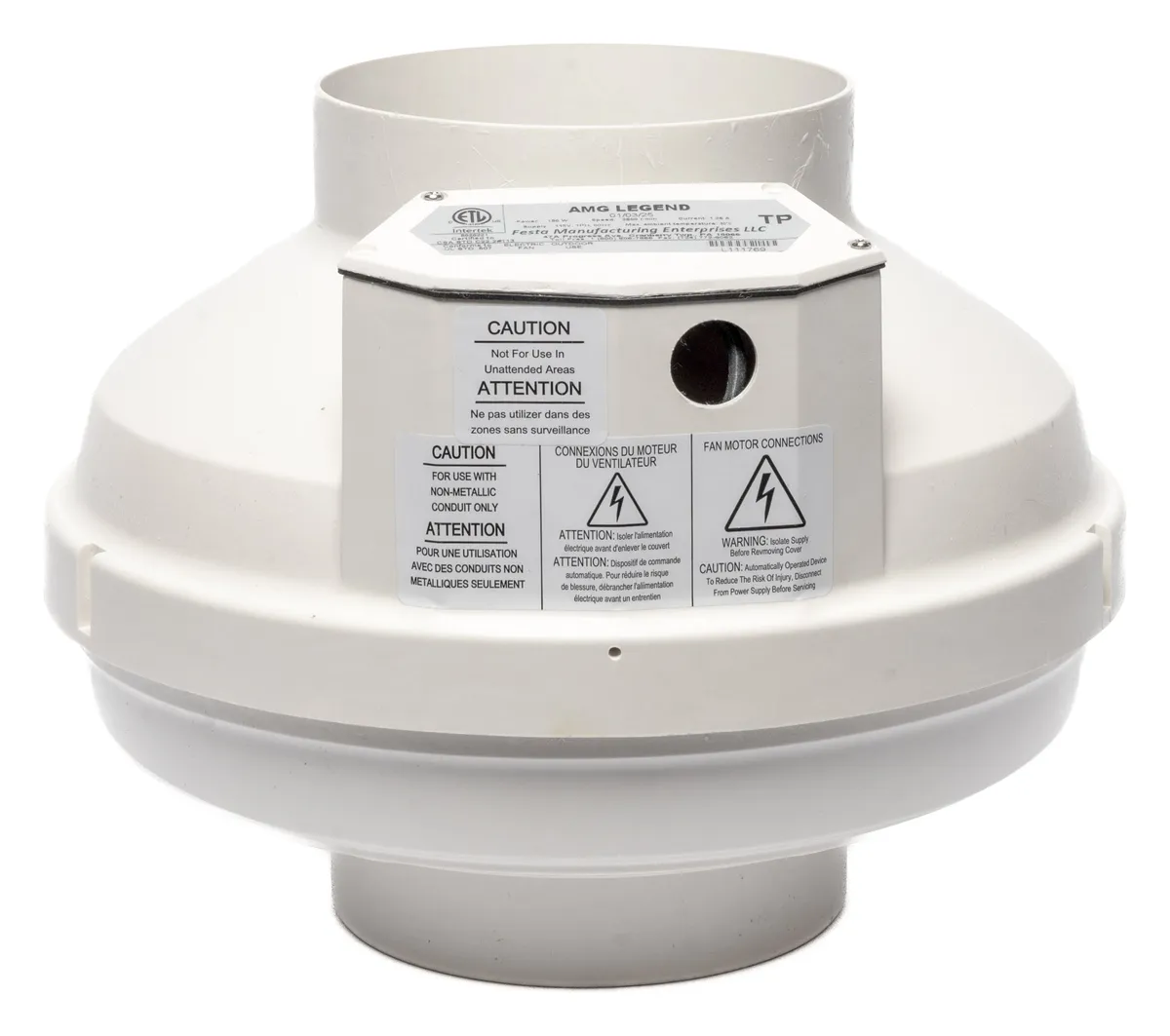
Festa
The difference: Festa's 6 inch AC fan for large porous footprints: its catalog lists the Legend at 345 CFM and a 2.6 inch maximum on the same 140 W, with 242 CFM at 1.0 inch against the Fury's 291.
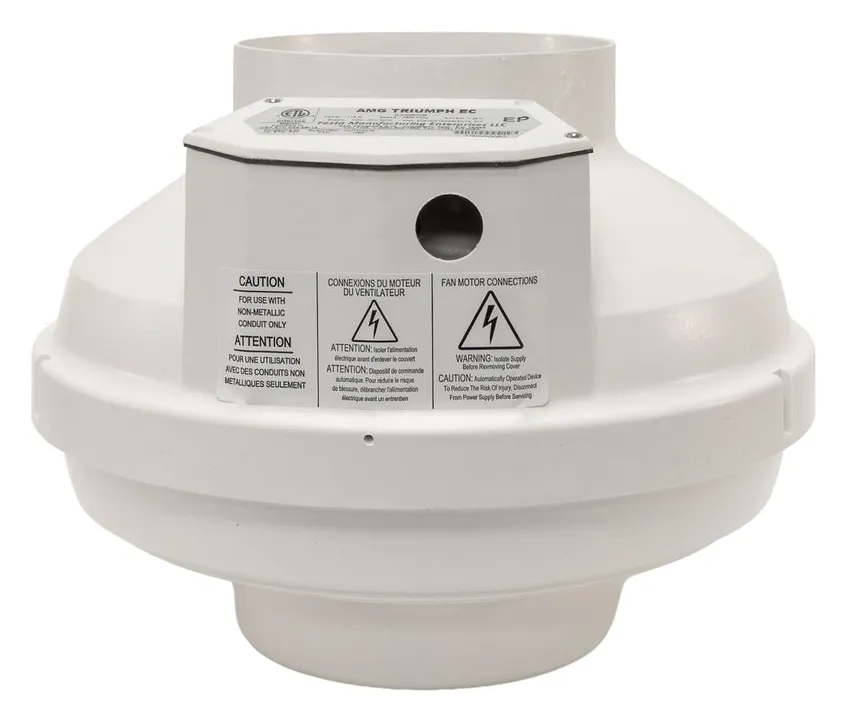
Festa
The difference: Festa's 6 inch EC fan for porous ground: its product page lists 370 CFM, a 2.9 inch maximum and 110 W, for footprints of 2,000 to 3,500 square feet.
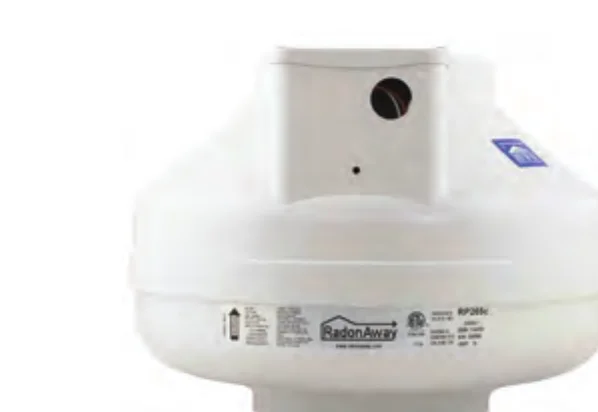
RadonAway
The difference: A 6 inch fan from another maker: RadonAway's Contractor Series table puts the RP265c at 86 to 122 W, with 326 CFM at zero pressure and a 2.2 inch recommended maximum operating pressure.
Compared with similar products: 1 of 4
Radon fan
Max airflow: 322 CFM
Max pressure: 2.1 in w.c.
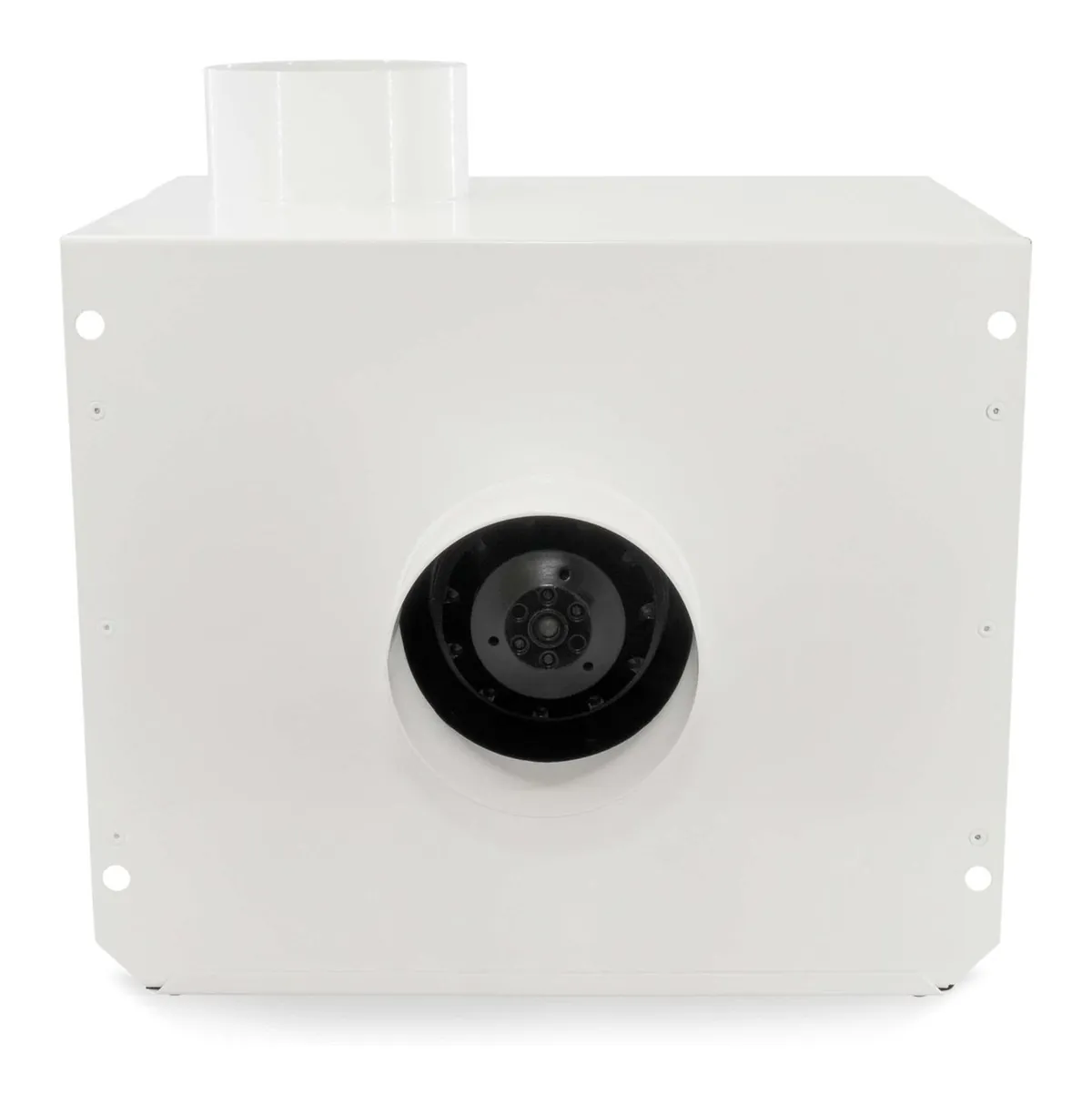
Radon fan
Max airflow: 240 CFM
Max pressure: 5.0 in w.c.
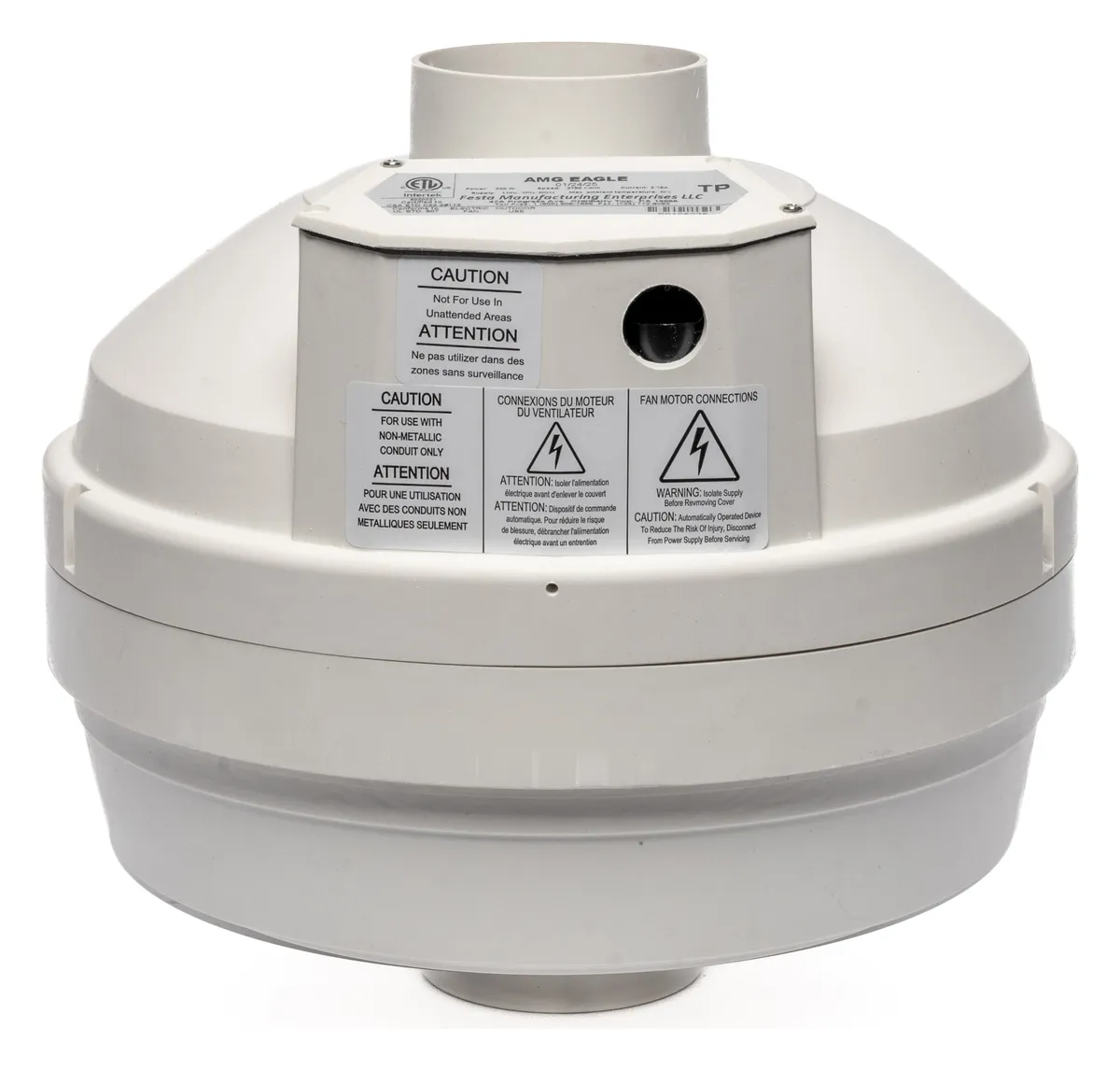
Radon fan
Max airflow: 241 CFM
Max pressure: 4.2 in w.c.
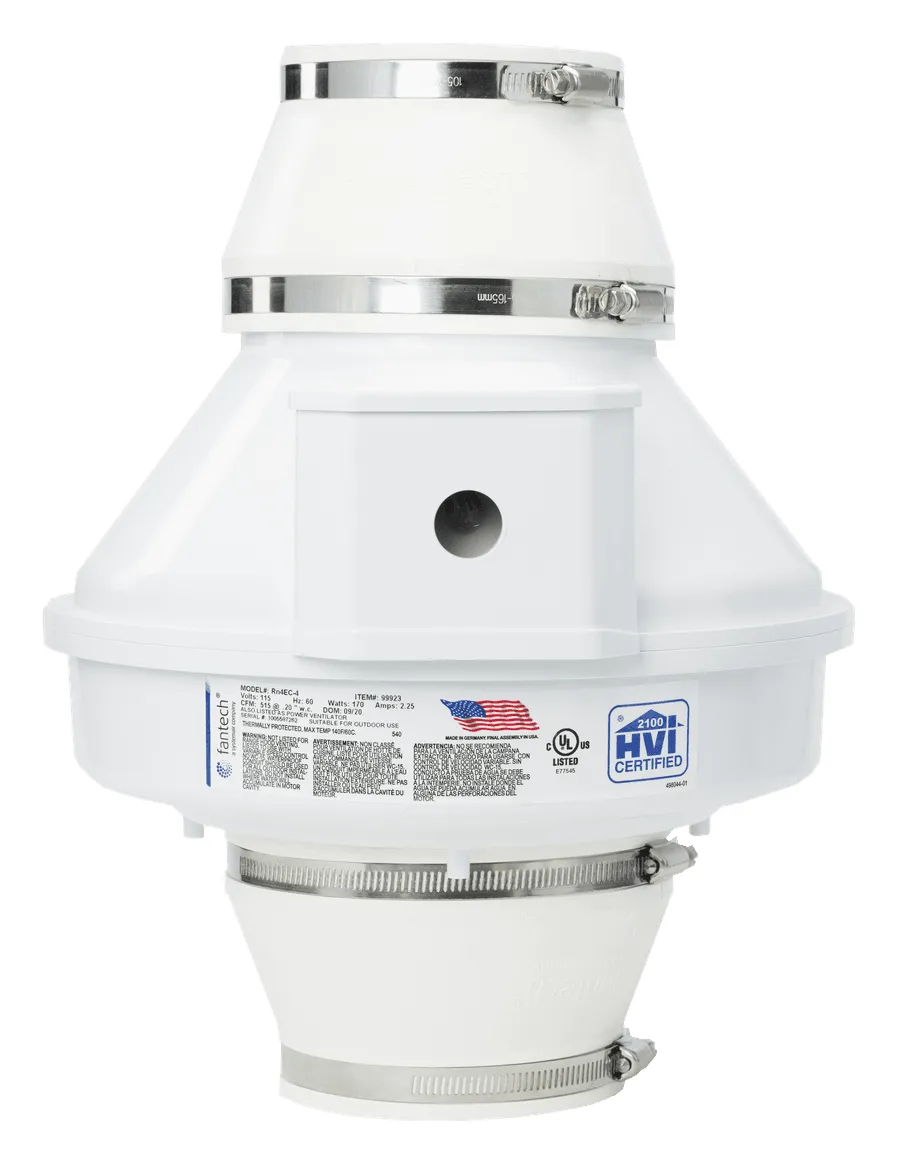
Radon fan
Max airflow: 330 CFM
Max pressure: 4.75 in w.c.
More radon fan models: 1 of 6
Questions
5 questions about the Festa AMG Fury, answered
The fan takes an 8 inch Fernco. Festa's catalog sizing guide pairs it with an 8 by 4 inch Fernco for 4 inch PVC and lists no option for 3 inch PVC, and the Fury's installation kit couplers fit the fan to 4 inch PVC pipe.
Festa's 2022 replacement guide names the AMG Fury for installed FR225 and FR250 fans. Festa's product page still leaves fan choice to the buyer and points to its phone line and replacement guide for help, so match the system's manometer reading and pipe size before ordering.
Festa's catalog lists 140 W. Running continuously, that is about 1,226 kWh a year at the rated figure; your bill is that times your rate per kWh.
Festa describes no built-in speed control for the Fury, and its AMG instructions say not to use these fans with solid state speed controllers. The single exception is for Canadian users, who may use only KB Electronics' KBMC-13BV, which the instructions rule out for the Extreme models only.
Festa estimates 70 to 75 dB and says the figure varies with the system. The EPA's construction guide puts the fan and every positively pressurized part of the vent pipe outside habitable space, ideally in an attic or attached garage, which also keeps the sound away from living areas.
Updated November 27, 2026