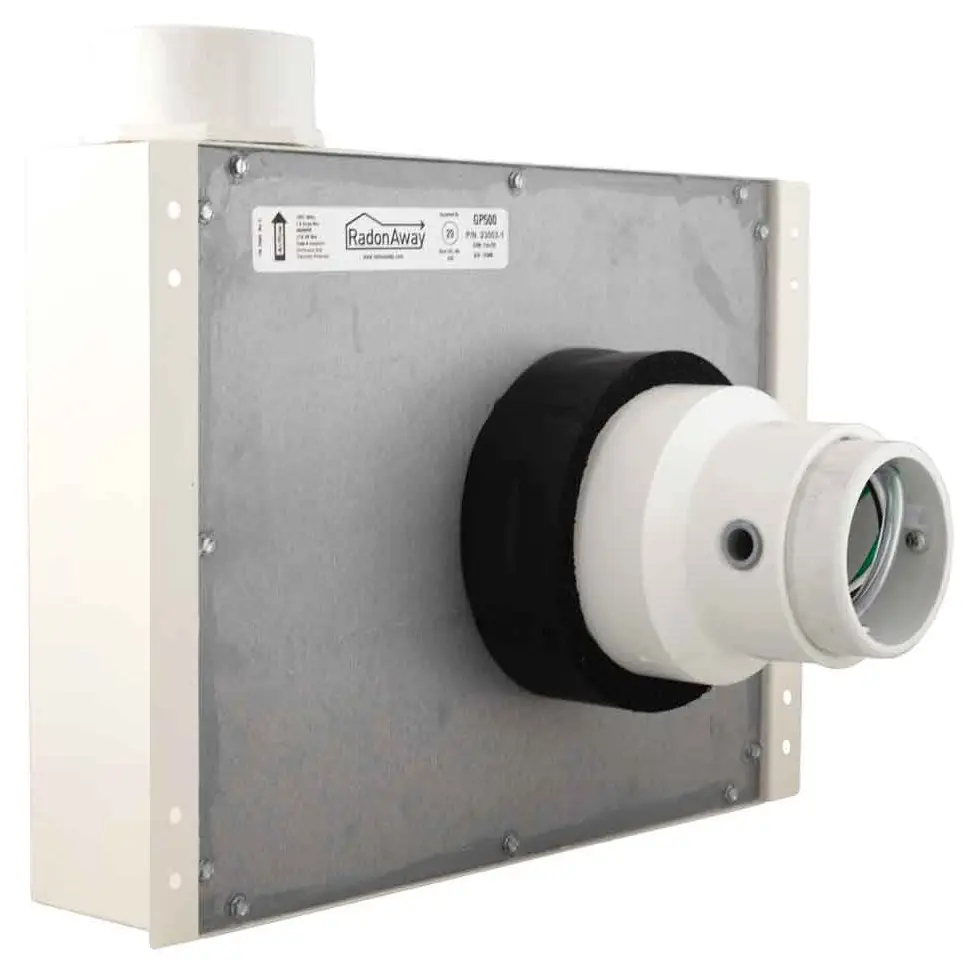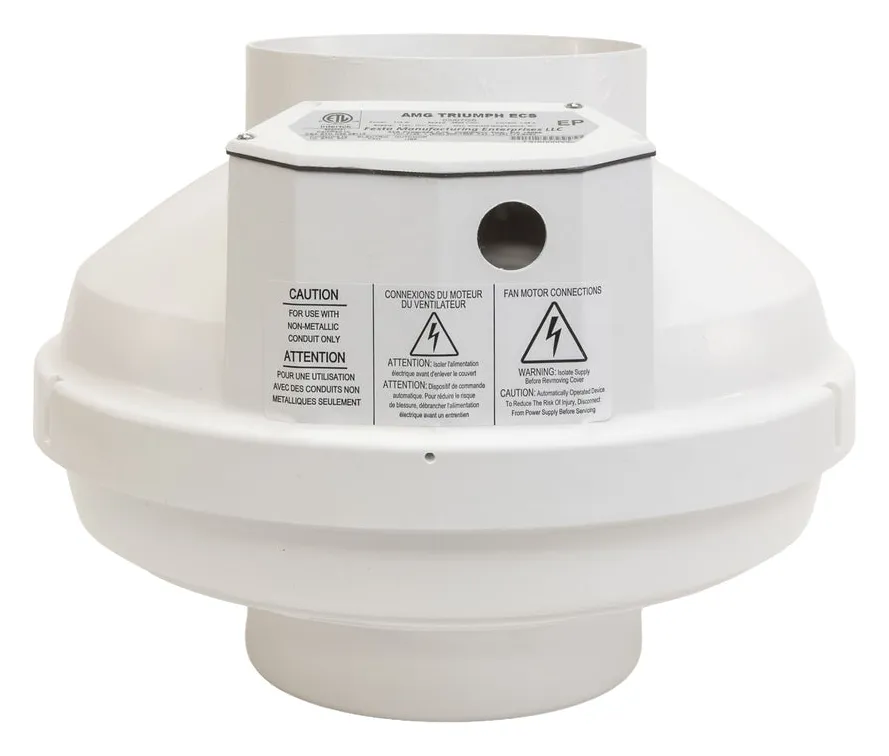
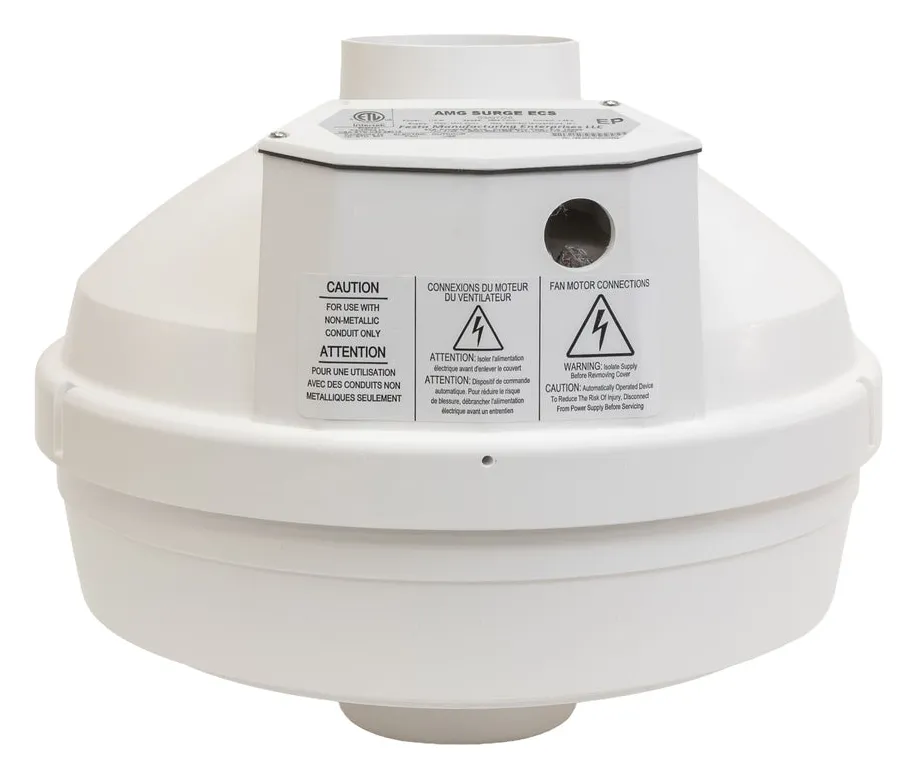
Radon fan
AMG Surge ECS speed-controlled high-suction EC radon fan
- 3 or 4 in. pipe
Max airflow: 185 CFM
Max pressure: 3.4 in w.c.
Festa
6 inch high-flow EC radon fan
Best for you if
Skip it if
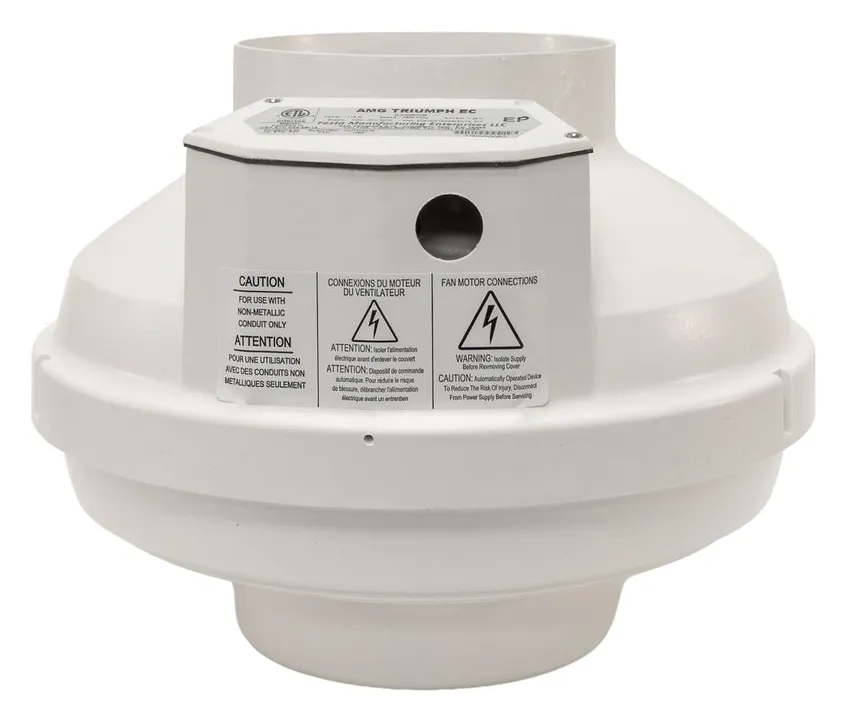
Photos: Festa
 (opens in a new tab)Check price on Amazon (opens in a new tab)
As an Amazon Associate, Radon411 earns from qualifying purchases.
Amazon and the Amazon logo are trademarks of Amazon.com, Inc. or its affiliates.
See ratings and reviews on Amazon (opens in a new tab)As Festa states it
The AMG Triumph EC is Festa's 6 inch high-flow EC radon fan, which Festa optimizes for footprints of 2,000 to 3,500 square feet on porous sub-slabs. Its product page lists 370 CFM maximum flow, a 2.9 inch w.g. maximum pressure and 110 W, with a 7 year warranty on all of Festa's AMG EC fans.
Festa's Triumph EC page lists three styles: fan only, a 3 inch installation kit and a 4 inch installation kit. Each kit holds two white flexible couplers that fit the fan to either 3 inch or 4 inch system piping, a green 5.5 inch radon system manometer, a line cord with connector and system labels.
In the box and running costsHow it works
The suction, the airflow and the housing, then who has checked it
In our words, from the maker's documents
Porous fill under a wide floor asks a fan for volume. When gravel lets soil gas move freely, the vacuum spreads easily, but the fan has to keep a large area below room pressure, so the air it can move at modest suction matters more than its ultimate pull. Festa describes the Triumph EC as an energy efficient, high flow radon fan for exactly that ground.
Festa's figures for the Triumph EC: 370 CFM maximum flow, 2.9 inches w.g. maximum pressure, 110 W, 115 V at 60 Hz, 1.45 A at most and 3,602 RPM, with a 6 inch Fernco. Those are end points only; Festa's page gives no airflow at 0.5 or 1.0 inch, the pressures its RRNC page uses for other EC models.
That gap matters more than it looks. Festa's own article on static pressure warns that a fan with an impressive maximum CFM rating may not deliver the airflow a foundation needs, because airflow falls as resistance rises, and tells readers to check performance under pressure instead of the largest advertised number. For the Triumph EC, that means asking Festa for its curve before sizing a system around 370 CFM.
Set against Festa's AC fans for large porous floors, the Triumph EC's maximums are higher on both axes: the 2022 catalog lists the AMG Hawk at 322 CFM and 2.1 inches on 66 W, and the AMG Legend at 345 CFM and 2.6 inches on 140 W. Festa's own Hawk EC, recommended for the same 2,000 to 3,500 square feet, appears on the RRNC page at 235 CFM at 0.5 inch and 175 at 1.0, with no maximum given, so the two EC fans cannot be compared point for point.
The motor is electronically commutated, which Festa's EC collection page describes as a brushless design that reduces wear, increasing longevity and minimizing maintenance needs. Festa calls the Triumph EC's motor Swiss-engineered and credits it with minimal energy consumption and quiet operation; it estimates 55 to 65 dB on the EC page, while its Triumph ECS page gives 50 to 55 dB for the speed-controlled version.
Festa's own statements, attributed
These are Festa's own statements, attributed to it. They are not our findings, and we have not tested this product ourselves.
Who checks a device like this
C-NRPP's consumer evaluation covers electronic radon monitors, not mitigation fans, so it has no result for Festa AMG Triumph EC. The safety listing and performance certification the maker states are under “What the manufacturer says”, and what shows whether any fan is working in your home is a radon test after it is installed.
Festa AMG Triumph EC
Check price on Amazon (opens in a new tab)Specifications
Every figure as the maker states it
Festa's Triumph EC page lists three styles: fan only, a 3 inch installation kit and a 4 inch installation kit. Each kit holds two white flexible couplers that fit the fan to either 3 inch or 4 inch system piping, a green 5.5 inch radon system manometer, a line cord with connector and system labels.
The product page states a 7 year warranty for all Festa AMG EC fans. Festa's warranty document defines the EC term as seven years from the date of original purchase for customers who bought directly from Festa, with a call to the office as the first step and Festa paying for the return of a fan a year old or less.
Festa leaves fan selection to the buyer, charges a 15% restocking fee on unused returns, and ships by FedEx Ground from Cranberry Township, Pennsylvania.
The fan must run continuously, so its watts set the bill. Festa's 110 W comes to about 964 kWh a year (110 x 8,760 / 1,000) at the rated figure; the AC Legend's catalog 140 W comes to about 1,226 kWh. Multiply by your rate per kWh.
The EPA's guide says fans may last five years or more and then need repair or replacement, and that manufacturer warranties tend not to exceed five years. It recommends retesting at least every two years.
Fit and setup
The fit, then how a system goes in
Good fit if, and look elsewhere if
Good fit if
Look elsewhere if
4 steps
To find someone to design and install a system, see radon mitigation professionals, and for how a fan fits into one, how a radon fan works.
Compare
The same three rows for each, and the one difference that matters
This page
Festa AMG Triumph EC
This page: The AMG Triumph EC is Festa's 6 inch high-flow EC radon fan, which Festa optimizes for footprints of 2,000 to 3,500 square feet on porous sub-slabs.
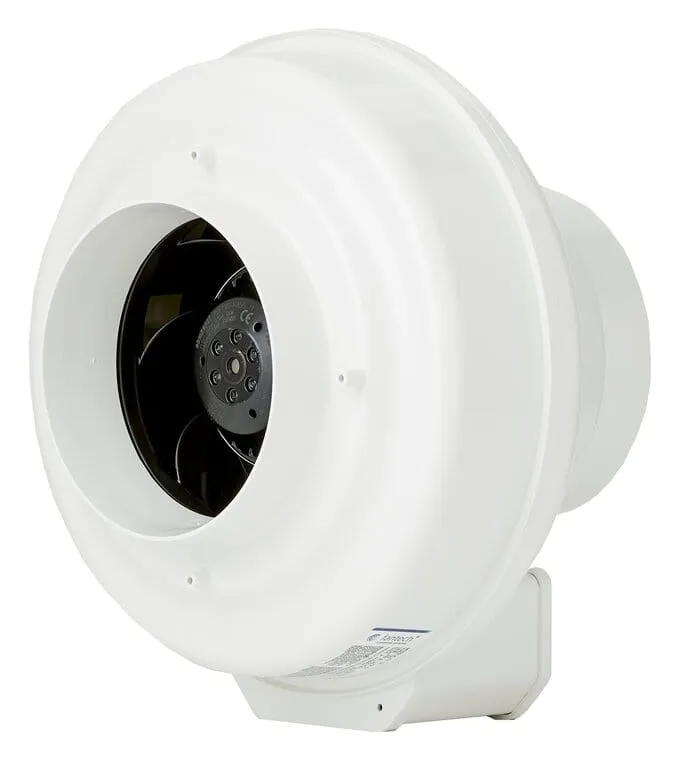
Fantech
The difference: Fantech's medium suction, medium flow fan: its 2025 brochure lists the Rn 3 at a 2.6 inch maximum static pressure, 125 W and 337 CFM.
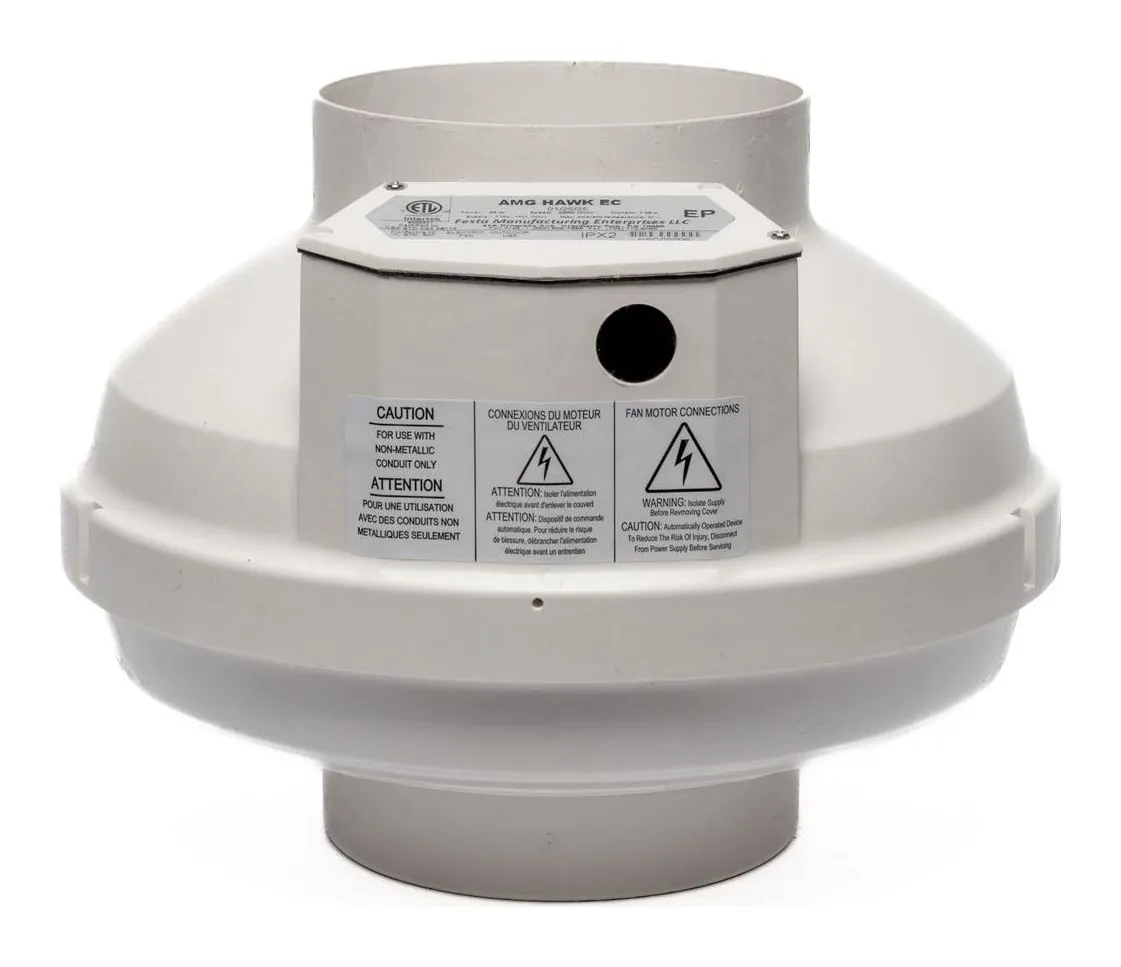
Festa
The difference: Festa's other 6 inch EC fan for the same footprint: its RRNC page lists the Hawk EC at 235 CFM at 0.5 inch and 175 CFM at 1.0 inch.
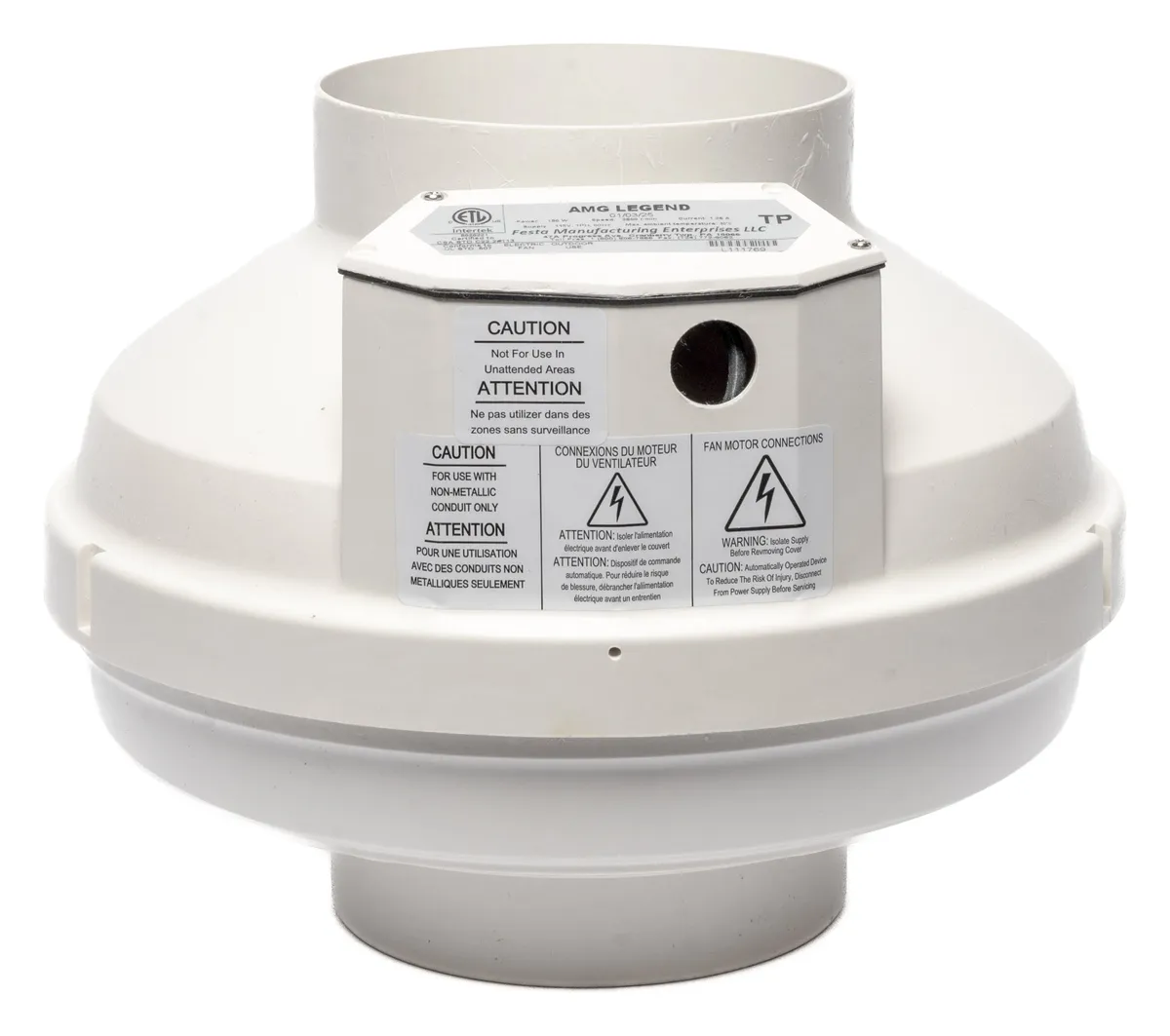
Festa
The difference: Festa's 6 inch AC fan for large porous floors: its 2022 catalog lists 345 CFM, a 2.6 inch maximum and 140 W.
The difference: The Triumph with a built-in speed potentiometer: Festa's ECS page lists the same 370 CFM and 2.9 inch maximums.
Compared with similar products: 1 of 5
Radon fan
Max airflow: 185 CFM
Max pressure: 3.4 in w.c.
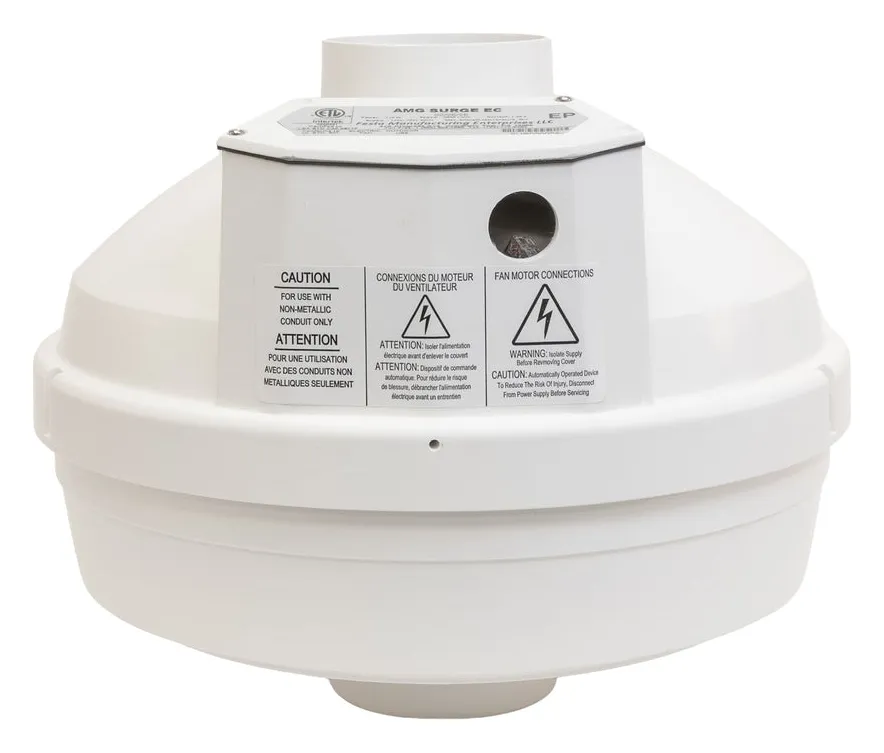
Radon fan
Max airflow: 185 CFM
Max pressure: 3.4 in w.c.
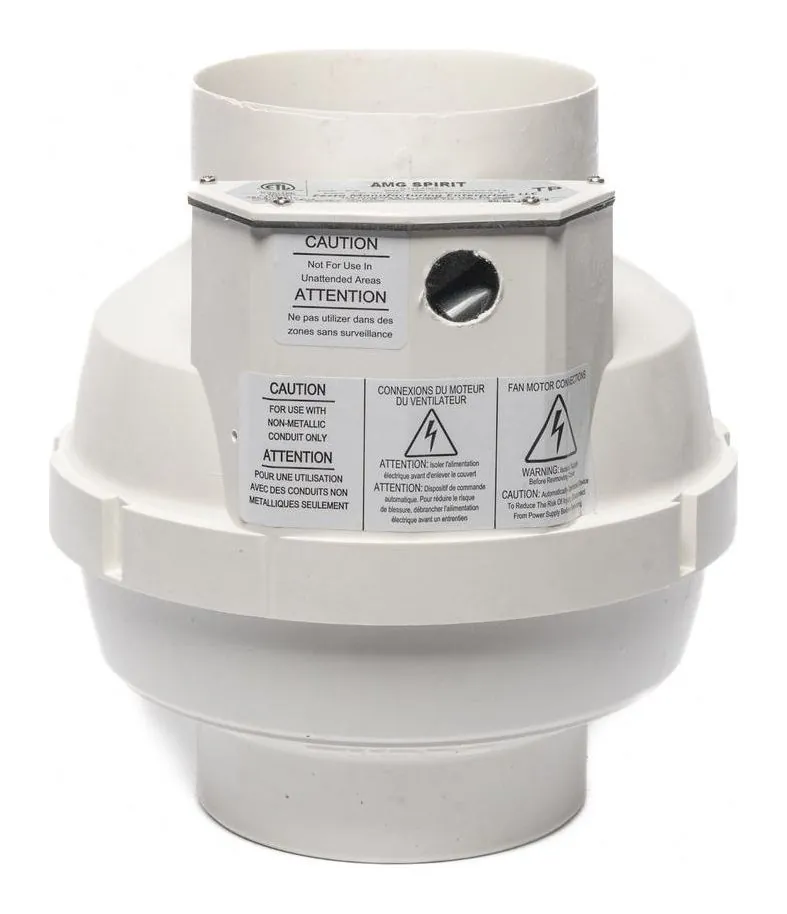
Radon fan
Max airflow: 121 CFM
Max pressure: 0.9 in w.c.
More radon fan models: 1 of 6
Questions
5 questions about the Festa AMG Triumph EC, answered
Festa optimizes it for footprints of 2,000 to 3,500 square feet on porous sub-slabs. The footprint is the floor area over the slab, not the whole house, and Festa still leaves the final choice to the buyer and its phone line.
Both are 6 inch EC fans that Festa places on porous ground of 2,000 to 3,500 square feet. Festa publishes different kinds of figures for them: maximums for the Triumph EC (370 CFM, 2.9 inches, 110 W) and two RRNC points for the Hawk EC (235 CFM at 0.5 inch, 175 at 1.0), so a direct comparison needs Festa's curves.
No. The Triumph ECS is the version with a built-in speed potentiometer, which Festa says lets the installer dial in the exact vacuum pressure a slab needs.
Festa estimates 55 to 65 dB on the Triumph EC page and says it varies with the system configuration; it gives no measuring distance. Placing the fan in an attic, garage or outdoors, as the EPA's guides describe, keeps it out of living space.
Almost certainly not. A maximum flow is measured with nothing resisting the fan; Festa's article on static pressure notes that a typical fan moves less air as resistance increases, and the soil and piping in a real system always add some.
Updated November 27, 2026