
Long-term kit
RL116 long-term radon test kit
- Lab fee extra
Method: Alpha track
In home: 90 days to 12 months
ProductsCompare
Short answer
A short-term radon test stays in your home for 2 to 90 days and gives a fast first answer, while a long-term test stays for more than 90 days and is more likely to reflect your year-round average. For most homes the order is a short-term test first, then a long-term or second short-term test to confirm a high result.
| Compared | Short-term test | Long-term test |
|---|---|---|
| How long it runs | 2 to 90 days, depending on the device; at least 48 hours | More than 90 days; usually 3 months to 1 year |
| Usual devices | Charcoal canister, charcoal liquid scintillation, electret, alpha track, continuous monitor | Alpha track, electret |
| What the result reflects | The level during those days | A result more likely to reflect your year-round average |
| Rules while it runs | Closed-house conditions; for tests under four days, from 12 hours before | Live normally |
| Main use | A first answer, a quick follow-up, a home sale | Confirming a result, deciding on a fix with time to spare |
In practice the two groups overlap less than the 90-day boundary suggests. Short-term kits typically run 2 to 7 days and long-term kits 3 months to 1 year, with 100 to 120 days a common choice for an alpha track detector. Most charcoal kits are short-term; most alpha track kits are long-term; electret devices can be either, depending on the electret.
Long-term kit
Method: Alpha track
In home: 90 days to 12 months

Long-term kit
Method: Alpha track
In home: 90 days to 12 months
Short-term kit
Method: Charcoal
In home: 48 to 96 hours
No Amazon listing on file
See details of the AccuStar PicoCan
Short-term kit
Method: Charcoal
In home: 2 to 7 days

Short-term kitempowerDX
Method: Passive sampler
In home: 48 to 96 hours
Short-term kitFirst Alert
Method: Charcoal
In home: 2 to 4 days
Short-term kitKidde
Method: Charcoal
In home: 3 days
No Amazon listing on file
See details of the Kidde 442020
Short-term kit
Method: Liquid scintillation
In home: 48 to 96 hours

Short-term kit
Method: Liquid scintillation
In home: 48 to 96 hours
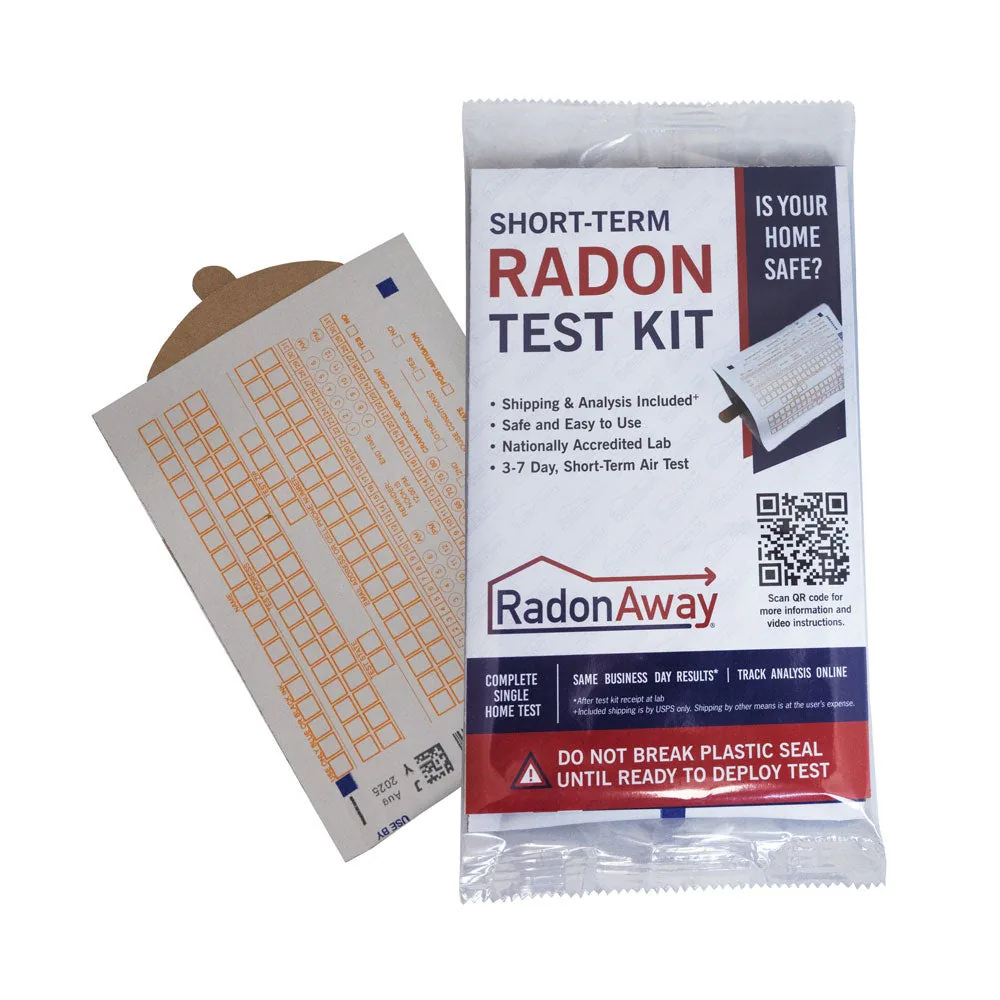
Short-term kit
In home: 72 to 168 hours
No Amazon listing on file
See details of the RadonAway Air Chek Short-TermShort-term and long-term kits we cover: 1 of 10
As an Amazon Associate, Radon411 earns from qualifying purchases.
The core difference is seasons. Radon levels tend to vary from day to day and season to season, so a
The uncertainty near the line is real: if the average of two short-term tests is 4.1
Step 1 of 4:
Take a short-term test
The first step for most homes. If the result is at or above 4 pCi/L, EPA recommends a follow-up test to be sure.
Step 2 of 4:
Follow up
Either a long-term test, for a better understanding of your year-round average, or a second short-term test if you need results quickly.
Step 3 of 4:
Choose the follow-up by how high the first result was
The higher your initial short-term result, the more certain you can be that a short-term follow-up, rather than a long-term one, is the right choice.
Step 4 of 4:
Decide on the result
EPA recommends fixing a home when the radon level is 4 pCi/L or higher. EPA recommends considering a fix when the level is between 2 and 4 pCi/L.

1Step 1: Take a short-term test.
2Step 2: Follow up with either a long-term test or a second short-term test.
3Step 3: Decide whether to fix your home.
| Compared | Short-term test | Long-term test |
|---|---|---|
| Windows and outside doors | Closed except for normal entry and exit; for tests under four days, from at least 12 hours before | Normal use |
| Fans | Recirculating heating and cooling fans may run; fans that bring in outside air should not | Normal use |
| Weather | Avoid tests under four days during severe storms or high winds | Seasons are part of the measurement; in Canada, at least 91 days in the heating season |
| Where | Lowest level that could be used regularly; at least 20 inches above the floor | A normal occupancy area of the lowest lived-in level; off the floor, away from an exterior wall |
During a long-term test you should not change how you live in the home. The point of a long-term test is to measure the home as you live in it.
A sale rarely leaves 90 days, so there are three accepted short-term options for when results are needed quickly: two short-term tests at the same time in the same place for at least 48 hours, two tests one after the other with identical devices, or a continuous monitor for at least 48 hours. Tests taken at the same time improve precision, while tests one after the other better represent the seasonal average, and that any real estate test should include steps to prevent or detect interference.

If you are testing in a real estate transaction and you need results quickly, any of the following three options for short-term tests are acceptable in determining whether the home should be fixed.
Option 1. Two tests at the same time
PassiveTake two short-term tests at the same time in the same location for at least 48 hours.
What to do nextFix the home if the average of the two tests is 4 pCi/L or more.
Two tests taken at the same time (simultaneous) would improve the precision of this radon test.
Option 2. One test, then a second
PassiveTake an initial short-term test for at least 48 hours. Immediately upon completing the first test, do a second test using an identical device in the same location as the first test.
What to do nextFix the home if the average of the two tests is 4 pCi/L or more.
One test followed by another test (sequential) would most likely give a better representation of the seasonal average.
Option 3. A continuous monitor
ActiveTest the home with a continuous monitor for at least 48 hours.
What to do nextFix the home if the average radon level is 4 pCi/L or more.
Both active and passive devices may have features which help to prevent test interference.
Any real estate test for radon should include steps to prevent or detect interference with the test device. Your state radon office can help you decide which option is best.
If time permits, a long-term test can confirm an initial short-term result. A buyer who moves in can run one through the first heating season. See buying a house with radon.
Neither test comes out ahead; each fits different situations. Each list has five points.
| Compared | A short-term test fits if | A long-term test fits if |
|---|---|---|
| Where you start | You have never tested and want a first answer | You want the closest estimate of your year-round average |
| Your timeline | You are buying or selling and the deadline is days away | A short-term result came back near or above 4 pCi/L and you have time |
| After a high result | You need a quick follow-up to a high first result | You want to decide on a fix with seasons accounted for |
| Life during the test | You can keep the house closed for a few days | You would rather live normally while you test |
| After a fix or a low result | You want to check a system soon after it is installed | You want to confirm a low result through a heating season |

| Test | How long it runs | What it is for |
|---|---|---|
| Short-term test | Stays in the home from 2 to 90 days, depending on the device, and for a minimum of 48 hours. | A faster screening result. Because radon levels vary from day to day and season to season, it is less likely than a long-term test to tell you the year-round average. |
| Long-term test | Stays in the home for more than 90 days. | It is more likely than a short-term test to tell you the home's year-round average radon level. |
| Continuous monitor | Logs readings for the whole test, run as a short-term or a long-term test under the same durations in EPA guidance. | Logs a graph over time, so you can see trends and spot anomalies rather than a single number. |
Every short-term and long-term kit we cover is on radon test kits, with more on each type at short-term kits and long-term kits. A digital monitor can serve as either, depending on how long you run it; see charcoal kit vs digital monitor.
Neither in general. A short-term test gives a fast first answer; a long-term test is more likely to reflect your year-round average. The usual order uses both: a short-term test first, then a follow-up if it is high.
Two to 90 days depending on the device, and at least 48 hours. Most charcoal kits run 2 to 7 days.
More than 90 days. Most long-term kits run 3 months to 1 year.
It can measure the level during its days accurately, but radon varies from day to day and season to season, so it is less likely to reflect your year-round average. That is why a high result calls for a follow-up.
Follow up with either a long-term test or a second short-term test. Choose the long-term test for a better picture of your year-round average, or a second short-term test if you need results quickly or the first result was very high.
No. Closed-house conditions are for short-term tests. During a long-term test, live as you normally do.
The heating season, when indoor levels are typically highest. Canada's guidance asks for at least 91 days of the test to fall in it.
Yes, if it runs for more than 90 days and you use its long-term average. Run a monitor for at least 3 months for that.
Usually a short-term option, because of the deadline: two passive tests together or one after the other, or a continuous monitor for at least 48 hours.
Because they measured different periods. Radon changes with weather and seasons, and a long-term test averages more of them.