 RadonAway
RadonAway RP140c
Inline radon mitigation fan
- Radon fan
- 4 in. fan duct
- 21 W
Photos: RadonAway
 (opens in a new tab)Check price on Amazon (opens in a new tab)
As an Amazon Associate, Radon411 earns from qualifying purchases.
Amazon and the Amazon logo are trademarks of Amazon.com, Inc. or its affiliates.
See ratings and reviews on Amazon (opens in a new tab)- Pipe size4 in. fan duct; 4.5 in. OD inlet and outlet, 4.0 in. PVC Schedule 40 size compatible; recommended duct 3 or 4 in. Schedule 20/40 PVC
- Power draw21 W
- Every figure checked against the specifications RadonAway publishes
- The maker's own performance table, point by point, unranked
About this item
As RadonAway states it
- Motor: AC
- Pipe size: 4 in. fan duct; 4.5 in. OD inlet and outlet, 4.0 in. PVC Schedule 40 size compatible; recommended duct 3 or 4 in. Schedule 20/40 PVC
- Max airflow: 138 CFM
- Max power: 21 W
- Power supply: 120 V, 60 Hz AC; 1.5 A maximum; 17 to 21 W
- Speed control: None
- Airflow at static pressure: 138 CFM at 0.00 in w.c.; 110 at 0.20; 66 at 0.50
- Outdoor use: Rated for outdoor installation
- Warranty: 12 months from purchase or 18 months from manufacture, whichever is sooner; extended to 60 months from purchase or 66 months from manufacture when installed by a professional radon mitigation contractor
The RP140c (part number 23029-1) is the lowest-power fan in RadonAway's Contractor Series, or C Series, of inline radon fans: a 4 inch fan that RadonAway lists at 17 to 21 W, with a recommended maximum operating pressure of 0.7 inches of water column. It is the one fan in that table RadonAway marks as ENERGY STAR rated, and ENERGY STAR's own dataset lists it as certified at 110 CFM and 5.9 CFM per watt.
What you get
RadonAway does not publish a package list for the RP140c; the full box contents are not stated by the maker. Its instructions refer to the wire nuts provided for the electrical connection, and treat the mounting bracket (P/N 25007) and a vent muffler as optional extras. Its mounting steps use flexible couplings on the pipe but do not say any come with the fan, so check before the install day.
In the box and running costsHow it works
What it does and how
The suction, the airflow and the housing, then who has checked it
How it works
In our words, from the maker's documents
A radon fan is the part of an active soil depressurization system that never stops. The EPA's guide describes the vent fan drawing radon gas from below the home through the suction pipes and releasing it to the outdoor air, while creating a negative pressure or vacuum under the slab. The fan has to run continuously for the system to work.
A fan is described by a curve, not one number. Static pressure, in inches of water column, is how hard it pulls against the soil and the pipe; airflow, in cubic feet per minute, is how much air it moves at that pressure. RadonAway's table gives the RP140c's typical airflow as 138 CFM at 0 inches, 110 CFM at 0.2 inches and 66 CFM at 0.5 inches, and leaves the columns from 1.0 inch up empty. It marks the 0.2 and 0.5 inch figures as HVI certified values.
RadonAway does not publish a maximum static pressure for the RP140c. What it gives instead is a recommended maximum operating pressure of 0.7 inches of water column at sea level, and its instructions say to reduce that by about 4% per 1,000 feet of altitude and by a further 10% in high temperature environments. If a system's measured vacuum is above it, RadonAway's instructions say to add suction points.
That places the RP140c at the low-suction end of the line. Its sibling the RP145c, in the same housing size, is listed at 46 to 72 W with a recommended maximum of 1.7 inches, and the RP260c and RP265c are 6 inch fans for more airflow. RadonAway's instructions name the RP140c and RP145c for general purpose use and say a slab penetration can cover up to 2000+ square feet, depending mainly on the sub-slab material: the tighter the material, the smaller the area each suction point covers.
RadonAway says the RPc fans are factory sealed, with no caulk needed to stop air leakage, and built to run year-round in all but the harshest climates. Its specifications list the RP140c as continuous duty and thermally protected, 8.5 inches high by 9.7 inches in diameter, 5.5 pounds, with a 4.5 inch outside-diameter inlet and outlet that is 4.0 inch PVC Schedule 40 size compatible. It runs on 120 V, 60 Hz AC.
The independent record is ENERGY STAR's. Its Certified Ventilating Fans dataset lists RadonAway model RP140C, with Spruce Environmental Technologies, Inc. as the partner: an in-line, single-port fan with one speed and a 4.00 inch duct, certified at 110 CFM with an efficacy of 5.9 CFM per watt, qualified on March 21, 2025, for the United States and Canada. Those are the program's results at its own test point, not a maximum, and the dataset records that the model does not meet ENERGY STAR's Most Efficient criteria.
What the manufacturer says
RadonAway's own statements, attributed
- RadonAway saysRadonAway lists the RP140c (P/N 23029-1) as a 4 inch fan drawing 17 to 21 W, with a recommended maximum operating pressure of 0.7 in. WC and typical airflow of 138, 110 and 66 CFM at 0, 0.2 and 0.5 in. WC.
- RadonAway saysRadonAway states the RP140c is ENERGY STAR rated and marks its 0.2 and 0.5 inch airflow figures as HVI certified values.
- RadonAway saysRadonAway states that its Contractor Series radon fan can be mounted indoors or outdoors and is not suitable for underground burial.
- RadonAway saysRadonAway states that its RPc, GPc, XPc and XR Series fans are factory sealed, so no additional caulk is needed to inhibit air leakage.
- RadonAway saysRadonAway states that it warrants the fan for 12 months from purchase or 18 months from manufacture, and extends that to 5 years when a professional radon mitigation contractor installs it.
These are RadonAway's own statements, attributed to it. They are not our findings, and we have not tested this product ourselves.
Independent evidence
Who checks a device like this
C-NRPP's consumer evaluation covers electronic radon monitors, not mitigation fans, so it has no result for RadonAway RP140c. The safety listing and performance certification the maker states are under “What the manufacturer says”, and what shows whether any fan is working in your home is a radon test after it is installed.
Specifications
Specifications
Every figure as the maker states it
The maker's figures
- Type
- Mitigation fan, inline
- Motor
- AC
- Pipe size
- 4 in. fan duct; 4.5 in. OD inlet and outlet, 4.0 in. PVC Schedule 40 size compatible; recommended duct 3 or 4 in. Schedule 20/40 PVC
- Max static pressure
- Not stated by the manufacturer
- Max airflow
- 138 CFM
- Max power
- 21 W
- Power supply
- 120 V, 60 Hz AC; 1.5 A maximum; 17 to 21 W
- Speed control
- None
- Airflow at static pressure
- 138 CFM at 0.00 in w.c.; 110 at 0.20; 66 at 0.50
- Outdoor use
- Rated for outdoor installation
- Warranty
- 12 months from purchase or 18 months from manufacture, whichever is sooner; extended to 60 months from purchase or 66 months from manufacture when installed by a professional radon mitigation contractor
What is in the box
RadonAway does not publish a package list for the RP140c; the full box contents are not stated by the maker. Its instructions refer to the wire nuts provided for the electrical connection, and treat the mounting bracket (P/N 25007) and a vent muffler as optional extras. Its mounting steps use flexible couplings on the pipe but do not say any come with the fan, so check before the install day.
The standard warranty covers defects for 12 months from purchase or 18 months from manufacture, whichever is sooner. RadonAway extends it to 60 months from purchase or 66 months from manufacture when a professional radon mitigation contractor installs the fan, and offers no extended warranty outside the continental United States and Canada. A return needs a Return Material Authorization number, with shipping at the owner's cost.
What it costs to run
The running cost is electricity, around the clock. RadonAway lists the RP140c at 17 to 21 W; at 21 W, a year of continuous running is about 184 kWh, and your utility rate sets what that costs. ENERGY STAR's figures, 110 CFM at 5.9 CFM per watt, work out to about 19 W at its test point. There is no filter to replace, and RadonAway says there are no user serviceable parts inside the fan.
Fans wear out. The EPA's guide says fans may last five years or more and that manufacturer warranties tend not to exceed five years, which matches RadonAway's five years with a professional install. RadonAway's annual checklist asks you to confirm the connections are tight, the fan is secure and vibration free, the manometer reads within the normal range, and radon levels are tested to EPA protocol.
Airflow at each pressure
RadonAway's performance table, point by point
| Static pressure | Airflow |
|---|---|
| 0.00 in w.c. | 138 CFM |
| 0.20 in w.c. | 110 CFM |
| 0.50 in w.c. | 66 CFM |
Airflow falls as the suction the system needs rises. A mitigator matches the fan to pressure measured under the slab.
Fit and setup
Who it fits, and installation
The fit, then how a system goes in
Who it fits
Good fit if, and look elsewhere if
Good fit if
- Your mitigator measured low suction, within the 0.7 inch recommended maximum RadonAway gives for this fan.
- You are replacing an RP140c or another low-suction 4 inch fan in an existing system.
- Electricity use matters to you, and you want a fan in ENERGY STAR's certified list.
- The fan will sit outdoors, which RadonAway's instructions allow.
Look elsewhere if
- Your system runs above 0.7 inches of vacuum; RadonAway gives its RP145c a 1.7 inch recommended maximum.
- The slab is large and needs high airflow; RadonAway names its RP265c for that job.
- You are designing a first system yourself; the EPA recommends a qualified mitigation contractor.
- You want the five-year warranty without a professional install; RadonAway gives 12 months otherwise.
Installation
5 steps
- The EPA recommends that a qualified radon mitigation contractor fix a home, and notes that many states require radon professionals to be licensed, certified or registered. RadonAway says its RPc, GPc, XPc and XR Series fans are intended for use by trained, professional, certified or licensed radon mitigators, and its retail page says non-professional installation is not intended to take the place of a qualified radon professional.
- RadonAway's instructions say to mount the fan vertically with the outlet up, plumb and level, so condensation drains through it, and never in an orientation where water can collect in the housing. When the fan hangs on the pipe, it should not touch any building surface, to avoid vibration noise; flexible couplings serve as the disconnect for service and isolate vibration. An optional RadonAway mounting bracket, P/N 25007, can hold it instead.
- Wiring is for a qualified and licensed electrician under the National Electrical Code, according to RadonAway. Outdoor installations need a UL listed watertight conduit, exterior boxes must be outdoor rated and sealed, and the fan is not meant for rigid metal conduit. RadonAway also warns not to leave the fan on the piping without power for more than 48 hours, and to check fuel-burning appliances for backdrafting after installation.
- Where the fan goes matters. The EPA's construction guide says the fan and every positively pressurized part of the vent pipe belong outside habitable space, in a vertical run of the vent pipe, so a leak at the housing or a joint cannot push radon into the home.
- A monitor is part of the system. RadonAway's instructions require a system monitor, such as its manometer (P/N 50017) or an audible alarm, plus a system label, and the EPA's guide says the warning device must be placed where it can be seen or heard easily. The EPA's guide says a post-mitigation test should be done within 30 days of installation, but no sooner than 24 hours after the system is running with the fan on, and suggests retesting at least every two years.
To find someone to design and install a system, see radon mitigation professionals, and for how a fan fits into one, how a radon fan works.
Compare
Compare with similar items
The same three rows for each, and the one difference that matters
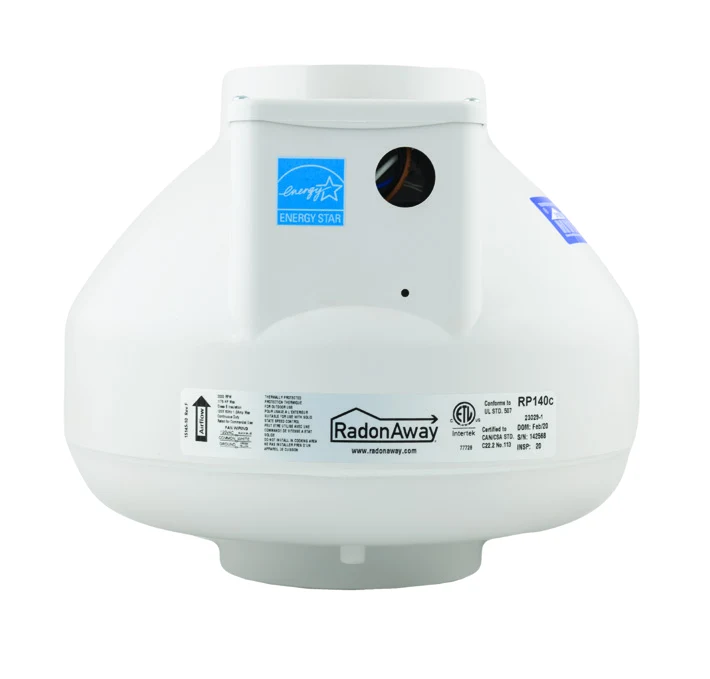
This page
RadonAway RP140c
- What it does
- Moves up to 138 CFM
- Power
- Up to 21 W
- C-NRPP 2024/25
- Not applicable (mitigation fan)
This page: The RP140c (part number 23029-1) is the lowest-power fan in RadonAway's Contractor Series, or C Series, of inline radon fans: a 4 inch fan that RadonAway lists at 17 to 21 W, with a recommended maximum operating pressure of 0.7 inches of water column.
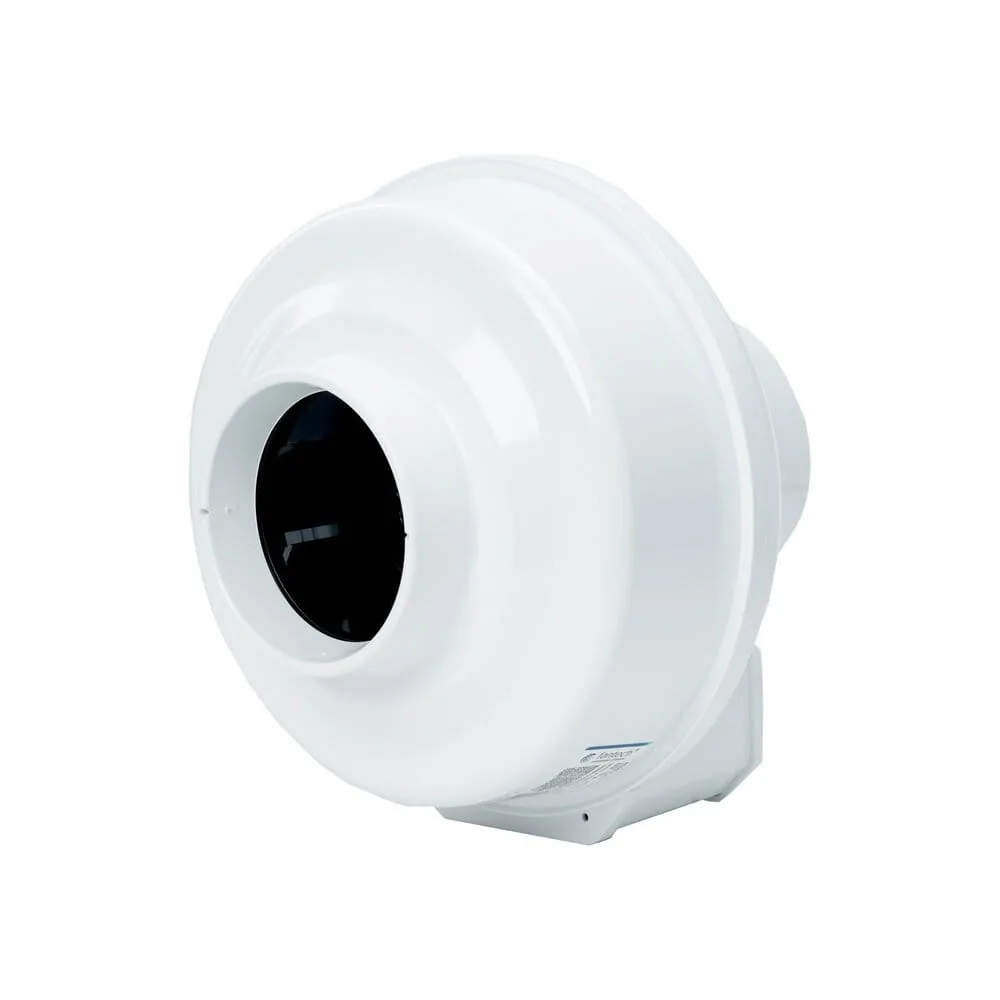
Fantech
- What it does
- Moves up to 174 CFM
- Power
- Up to 59 W
- C-NRPP 2024/25
- Not applicable (mitigation fan)
The difference: Another maker's fan, for more suction: Fantech's 2025 brochure lists an application pressure range of 0.0 to 1.8 inches for the Rn2.
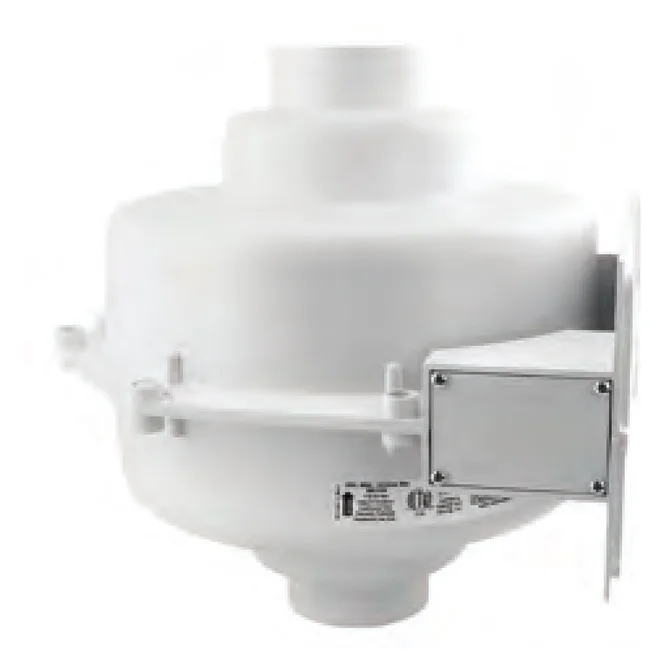
RadonAway
- What it does
- Not stated
- Power
- Up to 146 W
- C-NRPP 2024/25
- Not applicable (mitigation fan)
The difference: RadonAway's 3 inch C Series fan for high suction: RadonAway lists it at 68 to 146 W with a recommended maximum operating pressure of 3.8 inches.
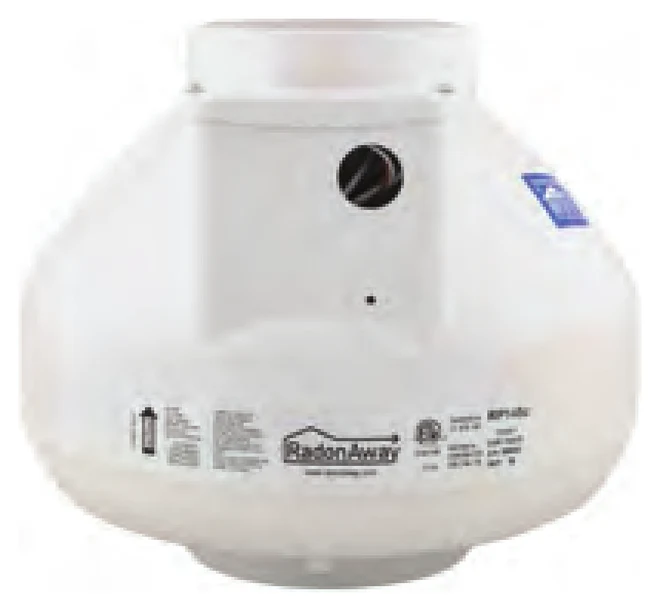
RadonAway
- What it does
- Moves up to 168 CFM
- Power
- Up to 72 W
- C-NRPP 2024/25
- Not applicable (mitigation fan)
The difference: RadonAway's other 4 inch C Series fan, for more suction: RadonAway lists it at 46 to 72 W with a recommended maximum operating pressure of 1.7 inches.
Compared with similar products: 1 of 4
More radon fan models10
All radon fan modelsRadon fan

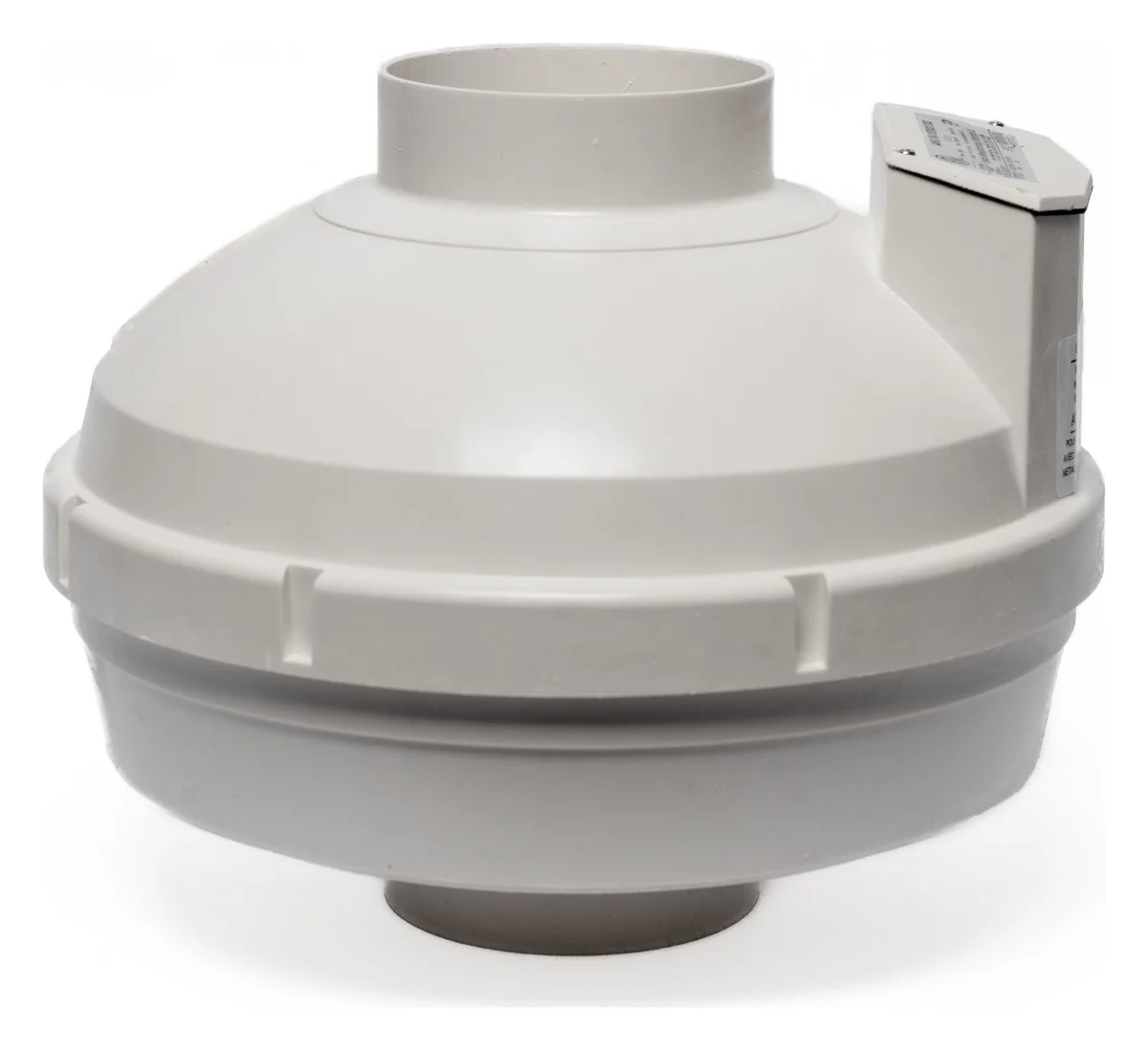
Rn2 inline radon mitigation fan
- 3 or 4 in. schedule 40 PVC
- 59 W
Max airflow: 174 CFM
Max pressure: 2.0 in w.c.
Radon fan

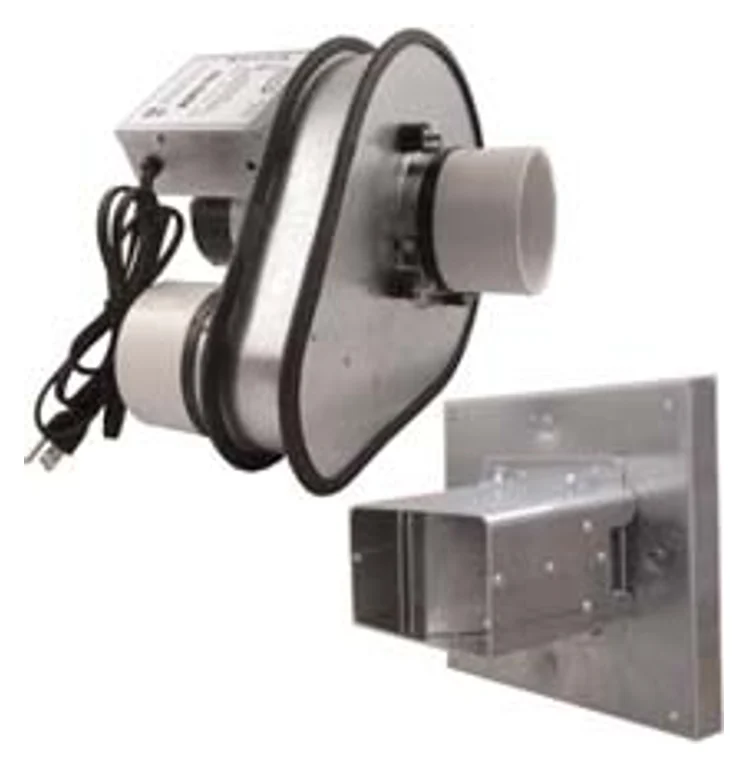
AMG Maverick inline radon mitigation fan
- 4 in. Fernco coupler size
- 66 W
Max airflow: 260 CFM
Max pressure: 2.21 in w.c.
Radon fan

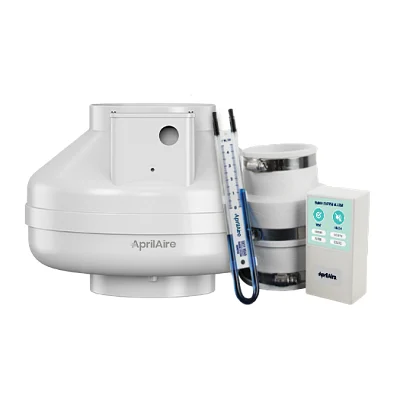
RMS160 side-wall radon mitigation system
- 3 in. schedule 40 PVC
- 50 W
Max airflow: 160 CFM
Max pressure: 2.3 in w.c.
- All radon fan modelsMore radon fan models
More radon fan models: 1 of 10
Questions
Questions people ask
6 questions about the RadonAway RP140c, answered
Asked about the RP140c
How much air does the RadonAway RP140c move?
It depends on the suction. RadonAway lists 138 CFM at 0 inches of water column, 110 CFM at 0.2 inches and 66 CFM at 0.5 inches, and gives no figures above that. ENERGY STAR certifies it at 110 CFM.
Is a fan sold as RP140 the same as the RP140c?
Go by the part number. RadonAway's Contractor Series table ties the name RP140c to part number 23029-1, and every figure on this page comes from that row. RadonAway's site also lists an RP Series and a Pro Series apart from the Contractor Series, so a fan called RP140 without the c or the part number may not be this one. The rating label on the housing shows both.
Is the RP140c ENERGY STAR certified?
Yes. ENERGY STAR's dataset shows it qualified on March 21, 2025, for sale in the United States and Canada. That listing is the program's own record; RadonAway's ENERGY STAR mark in its table is the maker's statement of the same thing.
Can the RP140c be installed outside?
RadonAway says its Contractor Series fan can be mounted indoors or outdoors, that outdoor installations need a UL listed watertight conduit, and that the fan is not suitable for underground burial. The EPA's construction guide puts the fan outside the home's living space.
Can I use a speed control with it?
RadonAway says these fans are rated for use with electronic speed controls but that speed controls are generally not recommended. If one is used, it names a Pass and Seymour solid state speed control, Cat. No. 94601-1. The fan has no control of its own: ENERGY STAR records it as a one-speed fan.
Do I need a professional to install it?
The EPA recommends a qualified radon mitigation contractor, and many states require radon professionals to be licensed, certified or registered. RadonAway says these fans are intended for trained, certified or licensed radon mitigators, and its five-year warranty applies only when a professional radon mitigation contractor installs the fan.
What to do next
- See every radon fan we coverEach maker's published pressure, airflow and power, side by side.
- Find a mitigation professionalMost systems are designed and installed by one; some states require a license.
- Understand the fanWhat the fan does in a system, and when one needs replacing.
- Test after it runsA short-term test after installation shows whether the system works.
Updated October 8, 2026